A RICH FATHER RAN HIS HOME LIKE A HOSPITAL UNTIL TWO TERRIFIED TWINS CHOSE A LAUNDRY GIRL OVER HIS PERFECT SYSTEM

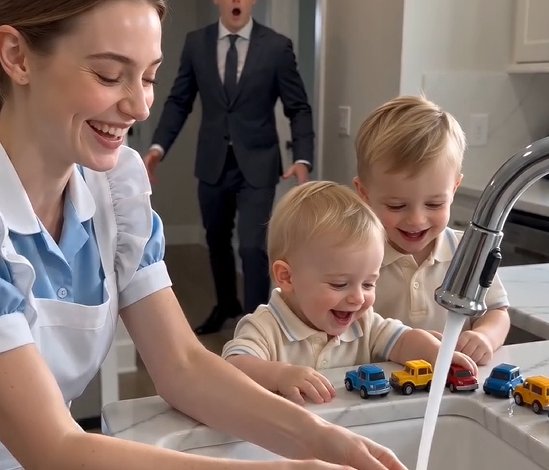
The house stayed silent for one strange second after that.
Not the polished, trained silence the Cole estate was built on. A live silence. The kind that comes when everyone in a room knows something just broke and they don’t yet know whether to stop it or protect it.Tessa kept her eyes on the cars.
That was the first thing Ethan noticed later when he replayed the scene in his mind. She was not trying to impress him. Not smiling up at him. Not delivering a method. She was watching the twins the way people watch a skittish animal at the edge of a yard, careful not to turn kindness into pressure.
The water ran in a narrow stream into the side of the deep sink. Not loud. Not splashing everywhere. Just enough to make the tiny wheels glisten.
“Ambulance is scared,” Tessa said, still in that low voice. “He can wait.”
Mason swallowed. His shoulders were high, almost touching his ears. His whole body still looked wired to flee, but he did not run. He picked up the blue car with both hands like it was something heavy and important, then stretched his arms toward the sink.
Tessa did not take it from him.
She moved the sponge under the faucet, squeezed it until it darkened, then held it out. “He can get rain first.”
Mason stared at the sponge.
For months, every adult in his life had been trying to move him toward water. Tessa moved the water toward the car.
That small difference changed the room.
Mason touched the wet sponge to the hood of the blue car. His fingers jerked, but he didn’t drop it. He pressed again. A tiny streak of soap slid over the plastic.
Miles made a sound then. Barely anything. Just a breathy little “Mine.”
Ethan heard it from across the room and felt the hair on his arms rise.
Miles had not volunteered a word during any hygiene routine since the winter. Not once.
Tessa nodded toward the yellow car without looking directly at him. “He’s behind the blue one. No cutting.”
Miles moved up beside his brother. Still tense. Still ready to lock up. But now he was close enough that Ethan could see his reflection in the steel of the sink.
Vanessa stepped forward. “This is absurd. They need their actual bath, not a game in a kitchen sink.”
Both boys flinched so hard it was like a wire had snapped through them.
Tessa set the sponge down. “Please don’t rush them.”
Vanessa turned to Ethan at once. “Did she just tell me what to do in my own home?”
Ethan did not answer her right away. He was watching Mason, who had started to back away at the sound of Vanessa’s voice. Then, to everyone’s surprise, Mason turned and grabbed the side of Tessa’s shirt.
It was not a dramatic hug. Just a fistful of cheap cotton near her hip.
But he had chosen a side.
Vanessa saw it. Her mouth tightened. “Ethan.”
Tessa stayed very still. “If they get pulled now, tomorrow will be worse.”
It was such a plain sentence. Not expert language. Not polished language. But it landed harder on Ethan than the binders of notes stacked in his study.
Because tomorrow had been worse for months.
He lifted one hand toward Vanessa without taking his eyes off the boys. “Give them a minute.”
Vanessa stared at him as if he had slapped her.
The boys finished washing four cars that afternoon. Four. Not their hands. Not their faces. Not their bodies. Four toy cars in warm water beside a prep sink.
And yet when bedtime came, they did not scream when they heard pipes in the walls.
That night Ethan pulled the full care reports for the last year and read them himself instead of skimming the summary pages his assistants prepared.
He found the same language repeated over and over.
“Initial resistance.” “Escalated intervention required.” “Physical support by two adults.” “Routine completed successfully.”
Successfully.
He read that word six times before setting the papers down.
He remembered Mason’s fingers twisted white around a towel. Miles vomiting once from panic. The way staff had spoken about “compliance” with the same clean confidence used in board meetings. He had approved all of it because every person involved sounded trained, certain, and expensive.
He had mistaken control for care.
The next afternoon, he went to the prep kitchen before anyone called him there.
Tessa was already on the floor in the service pantry area beside the sink cabinet, one knee up, sleeves rolled. She had turned a dish towel into a parking lot and arranged the toy cars in rows. The boys sat across from her, not relaxed exactly, but waiting.
Waiting was new.
“Today the car wash is open,” Tessa said. “But nobody gets shoved through. If a car says no, it stays dirty.”
Mason looked straight at the faucet. Miles looked at Mason.
Ethan stood in the doorway and said nothing.
Tessa opened the tap a thread. “Just road rain today.”
The boys watched water run over the sponge. Mason took the blue car. Miles took the yellow. Tessa washed one wheel, then another. She let them pull back every time they needed. She made absurd little mechanic sounds. She talked about mud, traffic, and impatient buses. She acted as if fear had room to sit there and still not be in charge of everything.
On the third day, Mason let Tessa wipe one wet fingertip across the back of his hand “because the driver got splashed.”
On the fourth day, Miles copied him.
That was how the twins did everything. One tested the edge of the cliff. The other trusted the first fall would be survived.
Tessa understood that quickly. She never demanded the same step from both at once. She watched who locked first, who copied, who could handle being second, who needed to pretend it was the toy making the choice.
No consultant had ever written that down, yet there it was in front of Ethan every afternoon.
Vanessa hated the entire thing.
At first she hid it behind concern. She complained to the house manager that the prep kitchen smelled like soap. She said toy bins in the pantry looked “chaotic.” She asked whether Tessa had any certifications for trauma-sensitive care. Then, when Ethan did not immediately back her, the complaint sharpened into something else.
Authority.
Vanessa had entered the house two years after the twins’ mother died in a freeway accident. She had not given birth to the boys, but she had mastered the house. She learned the schedules, the meal plans, the specialist names, the family expectations. She spoke the language Ethan respected: structure, outcomes, consistency, standards. In a home built around grief no one named, order had become her power.
Now a temporary worker in faded sneakers was undoing that power with dish towels and toy cars.
One evening, in the glass breakfast room just off the kitchen, Vanessa confronted Ethan directly while the twins sat nearby with Tessa on the floor sorting their little fleet into “clean” and “still scared.”
“I need you to answer me clearly,” Vanessa said. “Why do you trust a temp more than your family?”
Tessa’s hands stopped moving.
Ethan set down his phone. “This is not about trust. It’s about what’s working.”
“No,” Vanessa snapped. “It’s about you letting someone with no training overrule the people who have held this household together. She is turning them against routine. Against me.”
The boys had gone still again.
Tessa began very quietly rolling a small towel strip between her palms, not to interrupt, just to keep the room from hardening. Mason watched her hands.
Vanessa pointed at the sink area. “This circus is exactly why they don’t respect boundaries. You cannot build a home around whatever emotional weather a child has that day.”
That did it.
Miles slid to his feet first and moved behind Tessa’s shoulder. Mason followed half a second later and pressed against Tessa’s side so tightly he nearly climbed into her lap.
Ethan looked from his sons to Vanessa.
They had never done that before. Not with any nanny. Not with any therapist. Not with him.
Vanessa saw it happen and went pale with anger. “Unbelievable.”
Tessa spoke before Ethan could. “They’re not choosing against you. They’re choosing the place where nobody forces them.”
Vanessa laughed once, cold and short. “You don’t get to define this family.”
Mason made a choking sound and covered his ears.
Ethan stood up. “Enough.”
The word hit the room harder than shouting would have.
Vanessa turned to him. “Then say it. Say why her way matters more than ours.”
Ethan did something he almost never did in his own home.
He answered without managing the optics.
“Because our way has been hurting them.”
Vanessa looked as if she had lost balance. “Excuse me?”
“I signed off on routines I should have stopped months ago.” His voice was flat now, controlled in a different way. “I let professionals describe panic as resistance and force as success. I let this house run like treatment instead of a home.”
Nobody moved.
Then Mason reached behind him, grabbed the blue car from the towel lot, and shoved it into Tessa’s hand with a trembling urgency, as if asking her to keep the thing that made sense.
That one gesture ended the argument more completely than anything Ethan could have said.
Vanessa left the room.
She did not leave the marriage that night, and Ethan did not throw her out. Real houses did not explode that neatly. But something had shifted past repair. She could no longer claim that the old order was care, because the children themselves had rejected it in front of him.
Over the next two weeks, Ethan changed the whole rhythm of the house.
He dismissed the agency team that had insisted on restraint-based bath routines. He kept one gentle housekeeper the boys already tolerated and told the rest of the staff there would be no physical forcing for hygiene, meals, sleep, or transitions. Any report that used the word compliant without describing the child’s actual state would be returned. The house manager thought he had lost his mind.
Maybe he had. Or maybe he had finally started seeing.
Bathing did not become easy overnight. That was the part no dramatic retelling got right. Healing stayed ugly and slow.
For a while, the boys still only tolerated water in pieces. Wet sponge on a toy. A damp washcloth over Tessa’s wrist. One finger under a weak stream. A plastic cup filled and poured back out. The game moved from the prep sink to a low tub placed beside it, then to the actual bathtub upstairs with no water running at first, just the parked cars lined up on the edge like guards.
Tessa never announced progress.
She never said, “Good job, boys,” in that bright fake voice adults used when they wanted to push children past their own skin. She only named what was happening.
“The red truck is done.” “Too much today. We stop.” “Mason went first.” “Miles waited.” “The water touched and nobody got grabbed.”
That last sentence hit Ethan so hard the first time he heard it that he had to turn away.
Nobody got grabbed.
The old reports had called that support. Tessa called it what it was by refusing to repeat it.
One rainy afternoon, Ethan asked her where she had learned to do this.
They were in the back service kitchen while the boys napped for the first time after a partial rinse without panic. Tessa was folding hand towels because she could not seem to sit idle in a rich person’s home.
“My grandma,” she said.
Ethan frowned. “She worked in childcare?”
Tessa almost smiled. “No. She forgot who people were and got mad easy. Some days she thought the bathroom was a trap. If anybody pushed her, she’d fight. If somebody waited, she’d come around when the fear passed.”
Ethan leaned against the counter. “You make it sound simple.”
“It isn’t simple.” She folded another towel. “It’s just not fancy. Scared people don’t get less scared because more people explain things at them.”
That line stayed with him.
He started coming home earlier. At first to watch, then to help. Not by taking over, because the boys still stiffened when he moved too fast, but by learning the pace. Tessa had him sit on the floor in dress pants more than once. She handed him a sponge and told him to wash the toy cars in the order Mason chose, not the order that made sense.
It irritated him. Then it humbled him.
He saw how quickly his own voice turned managerial when he got anxious. How often he tried to close a scene before it had finished. How often he treated distress like inefficiency. The house had mirrored him for years.
One evening, when the bathtub upstairs held only an inch of warm water and six cars on the rim, Mason stepped in with one foot.
Nobody spoke.
Miles stood outside the tub clutching the yellow car so hard his knuckles blanched. Tessa was crouched beside the tile. Ethan was in the doorway, every muscle in his body begging him to mark the moment, praise it, secure it.
He did not.
Mason put in the second foot.
Then he looked at Miles.
That was all it took.
Miles climbed in too.
They stood there stiff and uncertain and alive, water barely covering their toes, while the toy cars floated around their ankles. Tessa smiled without showing teeth. Ethan had to press his thumb into his own palm to keep from saying the wrong thing.
When the boys stepped out thirty seconds later, it counted.
Not because they had obeyed. Because they had chosen.
Vanessa’s position in the house kept shrinking after that. She was not a monster. That would have made things easier. She had believed discipline and polish made a family safe. But she could not bear living in a system where instinct outranked authority, especially when the instinct belonged to someone younger, poorer, and temporary.
Her final break came during a dinner with Ethan’s sister, when she started describing Tessa as “the help with unusual influence.” Mason, sitting beside Ethan, put down his fork and said, very quietly but clearly, “Don’t.”
The whole table froze.
It was one word. But for a child who had spent months swallowing speech around stress, it was thunder.
Vanessa looked at Ethan for backup. He gave her none.
Within a month, she moved to the city apartment she kept “for convenience.” The marriage did not last much longer after that. There were lawyers, statements, practical arrangements, all the adult machinery wealthy people use when a life fails. But inside the house, the temperature changed. The air felt less braced.
Tessa tried to resign twice.
The first time was after the twins let warm water run over their calves in the tub while holding opposite ends of a washcloth “bridge.” She said the regular staff could take over now.
Mason cried so hard he hiccupped.
Miles dragged the yellow car into her tote bag and would not give it back.
The second time was after Ethan offered to triple her pay and formalize the role. Tessa went red in the face and said she was not trying to climb into anybody’s rich life. She still had shifts at the laundromat. Her aunt needed her. Her grandmother’s old medical debt had not vanished because some billionaire decided to become grateful.
That was when Ethan understood something else.
If he solved this by privately saving one girl, he would be repeating the same small, controlled logic in nicer clothes.
The problem had been bigger than his sons’ bath terror. He had built a world where people with lived caregiving knowledge were invisible unless a crisis forced the rich to notice them. Women who had raised siblings, parents, grandparents, neighbors, disabled cousins, terrified children. People with no polished title but real skill. His house had trusted credentials over evidence, order over response, image over truth.
So he did something that finally matched the size of what he had learned.
He launched an employee family care fund through his medical group.
Not a glossy charity project for cameras. A real internal program. Emergency grants for workers caring for parents, children, or disabled relatives. Paid flexibility for home caregiving crises. Training designed with experienced family caregivers in the room, not just executives and consultants. Listening panels. Resource stipends. The board resisted until he showed them retention numbers, leave costs, and turnover projections. He spoke their language long enough to get the vote through, then changed the language inside the program itself.
And when they asked who would help shape the practical side of it, Ethan named Tessa.
She almost refused.
“I fold sheets and get bleach on my hoodie,” she told him in the study, standing awkwardly in front of shelves that cost more than her yearly rent. “I am not some expert.”
Ethan looked past her toward the hallway where the twins were arguing in normal little-boy voices over whether a fire truck counted as a car. Water sounds drifted from a bathroom nearby, and nobody screamed.
“You are exactly the expert I missed,” he said.
She did not cry. Tessa was not built for dramatic tears. She stood there twisting the cuff of her sleeve, suspicious of generosity, suspicious of polished words, suspicious of what rich people called opportunity when they really meant ownership.
So Ethan made it concrete.
Part-time hours at first. No forced publicity. Her aunt’s laundromat schedule protected. Tuition support if she ever wanted it. A title simple enough not to lie: lived-experience care adviser.
She accepted only after he agreed the fund would include parents, grandparents, siblings, foster kin, and any worker doing real unpaid care at home, not just the neat little family shapes companies liked to market.
That was how the laundry girl ended up in conference rooms a few mornings a week, telling senior administrators that frightened people were not broken equipment and that “routine completed successfully” meant nothing if the body had been overruled.
Some executives blinked at her plain words.
Others started taking notes.
At home, the twins kept their old ritual longer than anyone expected. Even after they could bathe without freezing, they still lined up toy cars on the edge of the tub. Blue first. Yellow second. Sometimes Tessa joined. Sometimes Ethan did. Sometimes the boys did it alone, which was the whole point.
One Sunday, nearly a year after she first sat on the prep-kitchen floor, Tessa came in through the service entrance with detergent on her sleeve from an early laundromat shift and found Mason and Miles already in the big upstairs bathroom.
They had arranged the cars by themselves.
Ethan was on the tile floor in rolled-up slacks, holding the sponge wrong but trying.
Mason pointed to the line. “Dad cuts. We fix it.”
Miles added, “No grabbing.”
Tessa leaned against the doorframe and watched Ethan nod like he was receiving sacred instruction.
Maybe he was.
The house was still rich. Still enormous. Still cleaner than any normal place had a right to be. But it was no longer run like a private ward disguised as a family home. There was noise in it now. Wet footprints. Towels used for forts. Toy cars left drying near the sink in the prep kitchen where everything had changed.
The breakthrough had not come from a program, a package, or a person who knew how to sound important.
It had come from a young woman who knew how to wait next to fear without pinning it down.
And in the end, the twins did what all the adults had failed to do.
They showed a powerful father exactly who in the room understood care.