A LITTLE GIRL PUSHED AWAY EVERY BOWL IN A MANSION KITCHEN UNTIL THE LAUNDRY GIRL LET HER TEDDY BE FED FIRST

Daniel stood in the kitchen doorway with his bag still in his hand and his phone gone dark against his palm.
No one spoke for a second.Emma had said one word. It should not have felt like an earthquake. But in that house, it did.
Lily did not look proud. She did not look shocked either. She just kept her body loose, shoulders low, voice easy.
“Bear’s still hungry,” she told Emma.
Emma nodded once.
That alone made Daniel step closer.
For three months, mealtimes had been a dead zone. Emma never cried, never argued, never negotiated. She just sealed herself off. Her old nanny had documented “meal refusal with withdrawal response.” A pediatric feeding consultant had suggested stronger consistency. Another specialist had suggested removing comfort objects from the table to “reduce dependency cues.” Vanessa loved that phrase. She had repeated it twice.
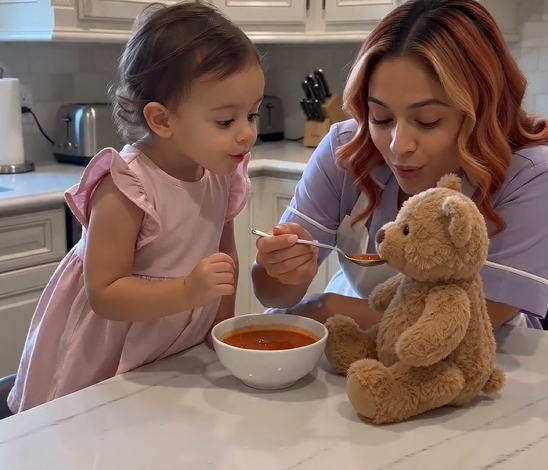
Now Daniel watched his daughter take the spoon from Lily’s hand and tilt it toward the teddy bear’s mouth. A little soup dripped onto the marble.
Vanessa inhaled sharply. “Emma, no mess. Lily, stop this right now.”
Emma flinched.
Daniel saw it. Not the old vague reports. Not the summaries in email. An actual flinch. Fast, trained, automatic.
Lily saw it too. She reached for a paper towel and wiped the spill without making it important.
Then she said to the bear, “He got too excited. Happens to everybody.”
Emma’s mouth twitched.
It was not a full smile. It was more devastating than a smile.
Daniel set his bag down.
“What is happening?” he asked.
Vanessa moved first, as if she had been waiting to narrate the scene before it got away from her. “Lily ignored the protocol. She removed the timer, put the toy on the counter, and turned lunch into a game. This is exactly how progress gets sabotaged.”
Lily did not defend herself. She only looked at Emma, not wanting the grownups to take over the air.
Daniel asked, quieter, “Emma.”
His daughter did not look at him. She was looking at the spoon.
Lily spoke like she was answering for the room, not for herself. “She doesn’t hate the soup.”
Vanessa let out a short laugh. “That is obvious. The issue is refusal.”
Lily shook her head. “No. The issue is this table.”
That made Daniel look at her fully for the first time.
She was standing in his enormous white kitchen with a loose ponytail, rolled sleeves, and a soup stain on her wrist, talking to him like she had forgotten he owned half the city.
Lily nodded toward the facedown timer. “Every time she sits here, everybody watches. Everybody waits. Everybody counts. She isn’t eating lunch. She’s surviving lunch.”
Vanessa said, “That is an absurd oversimplification.”
But Daniel’s eyes had gone back to Emma.
She was holding the spoon in a fist too tight for comfort, not lifting it to her own mouth, only to the teddy’s. Feed the bear, not herself. Safe, sideways, unwatched.
Lily lifted the second spoon. “Should Bear have another?”
Emma whispered, “And then me.”
Vanessa turned. “What did she say?”
No one needed clarification.
Lily didn’t react too big. “Okay,” she said simply, and offered Emma the spoon as if this happened every day.
Emma fed the teddy bear one more pretend bite.
Then Lily dipped the other spoon, held it halfway, and waited.
No coaxing. No countdown. No praise.
Emma took a tiny sip.
Daniel felt something cold move through his chest, because he suddenly understood that all the expensive adults in the room had been making the food the enemy and the child the problem, when really the ritual itself had become the threat.
Vanessa recovered first. “This proves nothing. She took half a spoon. If you let meals become play, she’ll manipulate it every day.”
Daniel looked at her. “She ate.”
“She performed,” Vanessa corrected.
Lily finally looked up. “Children don’t perform when they’re terrified. They bargain for a way through.”
The room went still again.
Daniel should have shut that down. People did not speak to him that way in his own house. But he had spent months hearing polished language that changed nothing. This blunt little sentence landed harder than all of it.
That lunch ended without triumph. Emma ate four small spoonfuls in total. Twice she fed the bear first. Once she set the spoon down and put both hands under her thighs like she expected someone to pressure her. Lily only talked to the bear and once to the soup itself, accusing it of being too hotheaded. Emma almost smiled again.
For the first time in months, Daniel stayed in the kitchen for the entire meal.
That afternoon he asked for all of Emma’s feeding notes.
By evening he realized the disaster had not started with appetite. It had started with control.
Every chart tracked volume, duration, resistance, compliance, mood. None tracked who touched her, who corrected her, whether the object in her lap had been removed, whether she had been allowed to stop being watched.
He also noticed the records became stricter around the same time Vanessa started “helping” with household order.
Vanessa met him in his study after Emma went down.
“I know what you’re thinking,” she said. “You saw a lucky moment and now you’re romanticizing this girl.”
Daniel looked up from the binder. “This girl got Emma to speak during lunch.”
Vanessa folded her arms. “Because she’s blurring boundaries. Today’s spoon-toy nonsense becomes tomorrow’s dependence. Emma already has attachment issues. You can’t build the household around a six-year-old’s compulsions.”
Daniel closed the binder. “She’s six.”
“Exactly.”
Her voice was polished, but the crack beneath it was new. She had been useful in a house where usefulness meant firmness. Lily had just exposed another standard: actual response.
Daniel asked, “Who decided to remove comfort objects from the table?”
“The consultant supported it.”
“Who enforced it?”
Vanessa held his stare. “I did. Because somebody had to.”
The next morning Daniel stayed home.
It changed the temperature in the kitchen immediately. Staff moved carefully. Vanessa dressed earlier than usual and acted as if this was all routine. Emma came in with her bear tucked under one arm and froze when she saw Daniel already seated in the breakfast area.
Lily noticed and said, “Maybe Dad can sit over there today.”
Not at the island. Not watching from the front.
Daniel, who gave instructions for a living, was being told where to put his body in his own kitchen by the laundry girl.
He moved without argument.
Emma watched that.
Lily put the bowl down. No timer. Bear on the counter. Spoon in Emma’s hand. Another in Lily’s.
“Bear first?” Lily asked.
Emma nodded.
Then Emma glanced toward her father, not panicked exactly, but checking if the old machinery would start again.
Daniel kept his hands flat in his lap and said nothing.
Emma fed the bear. Then herself.
Two spoonfuls. Then three.
On the fourth, Vanessa broke.
“This is ridiculous,” she snapped. “We are reorganizing the entire household around a stuffed animal and a girl who used to sort towels.”
Emma’s hand jerked. The spoon clinked.
Lily did not look at Vanessa. “It’s not the bear,” she said. “It’s that Emma gets to start somewhere safe.”
Vanessa stepped closer to the island. “Do not instruct me on what this child needs.”
Emma grabbed the teddy to her chest and slid off the stool.
That was the thing. Daniel saw it all at once. Every adult voice that rose became danger. Every correction ended the meal. Every bid for order pushed his daughter farther away.
He stood. “Enough.”
Vanessa stared at him. “I am trying to help.”
“No,” he said. “You’re trying to control the conditions under which help is allowed to count.”
She looked slapped.
Lily gathered Emma without touching her, just lowering herself near enough that Emma could come if she wanted. After a few seconds, Emma tucked herself against Lily’s side and held the bear between them like a shield.
Daniel had not seen his daughter choose a person in months.
Vanessa saw it too.
That should have been the point she stepped back. Instead it became the point she hardened.
Daniel had to leave two days later for a one-night trip to Chicago he could not cancel. Before he left, he gave one direct instruction to the household staff: no timers, no forced seating, no removal of Emma’s bear, and Lily was to handle meals.
Vanessa kissed him goodbye at the front door and said all the right things.
By noon the next day, she had changed the gate code.
By one, Lily’s key card no longer opened the side entrance.
By one-thirty, Emma’s bear had been removed from the breakfast room and locked in the upstairs linen closet.
Vanessa called it a reset.
When Lily finally got in through the service entrance because the older housekeeper took pity on her, she found Emma at the kitchen island with a clean bowl in front of her, mouth shut, hands flat against her knees, eyes gone blank again.
The old position.
Vanessa was standing nearby with false calm. “We are returning to consistency.”
Lily looked around once. “Where’s Bear?”
Vanessa smiled without warmth. “We are no longer using props.”
Emma’s breathing changed instantly, quick and shallow.
Lily moved toward her. Vanessa stepped in front.
“You were told to follow standards.”
Lily’s face went pale with anger, but her voice stayed low. “You took her bear.”
“It was making the behavior worse.”
Emma made a sound then. Not a word. A raw, small noise, like something tearing.
Lily went around Vanessa and crouched beside the stool. “Emma.”
Emma slid off the chair and clung to Lily so hard the stool nearly tipped.
At that exact moment Daniel walked in through the rear hall.
He had cut the Chicago trip short after a meeting collapsed and had not told anyone he was coming back early. He entered to find the breakfast room wrecked without a single visible mess: untouched food, a child shaking, Lily on her knees holding the line with just her body, Vanessa stiff with outrage.
Daniel looked from Emma’s clenched hands to the missing bear.
“What happened?”
Vanessa answered too quickly. “She regressed the second boundaries were reintroduced. This is what I warned you about.”
Emma buried her face in Lily’s shoulder.
Daniel asked Lily, “Where is the bear?”
Vanessa said, “Daniel, this is not about a toy.”
But Emma’s fingers dug deeper into Lily’s shirt at that sentence, like even hearing it made the room less safe.
Lily said, very carefully, “She was eating when she got to start by feeding him first. She wasn’t being defiant. She was making sure nothing bad happened when the spoon came near her. Today he was gone before lunch. She came in scared before the bowl even touched the table.”
Daniel’s voice changed. “Where is the bear?”
Vanessa’s silence answered first.
The older housekeeper, who had been pretending not to hear from the pantry door, finally said, “Linen closet, sir.”
Daniel turned to Vanessa with a look that stripped all polish off the room. “You changed the gate code?”
Vanessa tried one last time. “Because this house was slipping into chaos. You don’t see how easily staff confuse affection with authority.”
Daniel said, “And you confused order with care.”
He went upstairs himself.
When he came back down with the flattened brown teddy in his hand, Emma actually reached for him first out of pure reflex for the bear. It lasted only a second, but it was enough to stop him cold. He handed it to her. She clutched it, then immediately pressed it back between herself and Lily, like the safety still lived there.
Daniel looked at his daughter, at the woman she was hiding in, at the table where everyone had treated refusal as disobedience instead of memory.
He said to Vanessa, “You need to leave for a while.”
Vanessa stared at him as if she could not believe she had lost ground to a laundromat girl and a child with a toy. “You’re choosing this over us?”
Daniel answered with brutal clarity. “There is no us worth having if my daughter has to shut down to keep it running.”
Vanessa left that evening.
No dramatic screaming. Just tight-lipped humiliation, two phone calls, and heels crossing expensive floors that suddenly sounded empty.
After that, things did not become magical. Emma did not wake up healed. She still froze some mornings. She still needed the bear at the island. Some meals were two spoonfuls. Some were none. But the war stopped being dressed up as discipline.
Lily kept doing what had worked, not as a trick, but as a language.
Bear got fed first. Sometimes the spoon fed the bowl. Sometimes Lily fed herself first and made a ridiculous face at the soup. Sometimes Emma only stirred and listened. Sometimes they moved from the breakfast table to the kitchen island and back again, because one seat felt too much like an exam and the other felt like life.
Daniel started being there.
At first he sat far away. Then closer. Then on the stool Lily had been using when she needed both hands free. He learned to stop filling silence. He learned that Emma ate more when nobody praised each bite like a public performance. He learned that if she pushed the bowl away, the meal could end without becoming a trial.
One night, after Emma had fallen asleep on the window bench with the bear under her chin, Daniel found Lily rinsing soup spoons in the sink.
The kitchen lights were low. For once the room looked lived in instead of displayed.
He asked, “How did you know?”
Lily kept rinsing. “About the bear?”
“About any of it.”
She shrugged lightly. “My grandma had bad spells after her second stroke. Some days if people crowded her, she’d lock up. If they kept pushing, she’d clamp down harder. So sometimes I’d hand the spoon to her doll first. Or talk to the tea kettle. Or wait. People think waiting means doing nothing.”
Daniel leaned against the counter.
Lily dried her hands. “Emma doesn’t hate food. She hates being cornered.”
He let that sit.
Then he said, “I was reading reports while my daughter was learning to be afraid of lunch.”
Lily did not soften it for him. “You thought if enough smart people watched closely enough, they’d solve it.”
He gave one short nod. It was true.
She added, “Kids know when every room is asking them to prove something.”
That stayed with him more than any specialist memo ever had.
Over the next weeks, Daniel changed the whole structure of the house in ways that felt small to outsiders and enormous inside it. Meal logging stopped. Consultants were cut back. Staff were told that no one was to remove Emma’s comfort objects, narrate her intake, or discuss her “progress” in front of her. The breakfast room door was left open. Sometimes they ate at the island. Sometimes in the corner banquette. Sometimes on a blanket in the family lounge when Emma looked too tight in the shoulders to sit upright.
And Lily remained exactly what she had been at the beginning: not polished, not strategic, not trying to rise above her place with speeches or fake elegance. She folded dish towels while soup cooled. She tucked her hair back with damp hands. She let Emma feed the bear first even on good days, because rituals did not become foolish just because a child had gotten stronger.
One afternoon, Daniel came home early again and heard voices from the kitchen.
Emma’s small one. Lily’s low one. And then, unmistakably, a tiny stern voice saying, “Bear waits his turn. Dad first.”
Daniel stopped in the doorway.
Emma was sitting on her stool with a grilled cheese triangle in one hand and the teddy propped beside her bowl. Lily was laughing quietly. There was no timer on the counter. No chart. No one standing over the child. Just a meal.
Daniel took the seat Emma pointed to.
She tore off the smallest corner of sandwich and held it out. Not to the bear.
To him.
It was such a simple thing that another family might not have noticed. In that kitchen, it was a ceremony.
He took the bite. “Thank you.”
Emma nodded as if he had finally gotten with the program.
Lily looked down to hide her smile, but Daniel saw it.
That was when the line between gratitude and something more first opened, quietly and without demand. Not because he had rescued her, and not because she had saved him in some dramatic movie way. It was because she had stood inside the ugliest failure of his house and answered his daughter like a human being. Because he had finally learned to see that. Because they were both now tied to the same work, and neither was pretending otherwise.
He did not rush it. Neither did she.
The ending wasn’t a proposal. It wasn’t a sudden declaration over candlelight in a perfect dining room.
It was slower and truer.
Lily stayed on, not as a miracle worker, not as a servant everyone could overlook, but as the center of Emma’s daily trust. Daniel stopped traveling unless he had to and started arranging his life around breakfasts, school pickup, and dinner at home. Some evenings the three of them stood at the kitchen island while soup simmered, Emma bossing Bear around like a tiny foreman, Lily hiding laughter, Daniel cutting bread badly on purpose so Emma could correct him.
The house was still expensive. Still polished. Still too large in places.
But it was no longer run like a treatment plan.
And on the nights Emma fed the bear first, nobody called it regression again.