THE MILLIONAIRE FATHER CAME HOME EARLY AND FOUND HIS TWINS EATING UNDER THE TABLE WITH THE TEMP NANNY HIS MOTHER CALLED “TRASH”

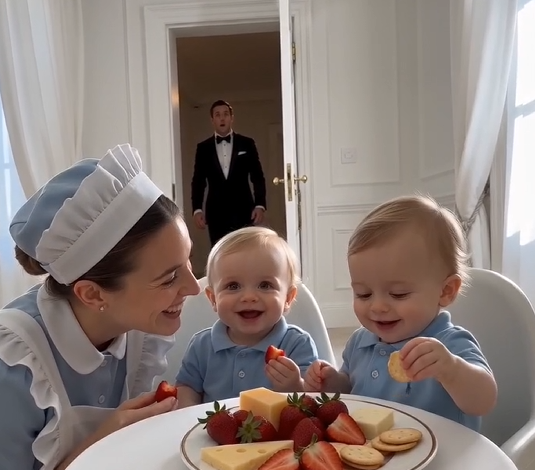
Caleb did not move at first.
He had stood in boardrooms and shut down million-dollar arguments without blinking, but now he was frozen in the doorway of his children’s dressing room, staring at two small bodies under a tablecloth like it was the first real thing he had seen in his own house in years.
Emma looked up and clearly realized how wrong it must have seemed.
The twins’ lunch tray was on the rug. Crumbs were already on the polished wood floor. The tablecloth was dragging crooked. Mason was close enough to her knee that his shoulder brushed it every time he reached for another cracker. Mia had just crawled under and was folding herself beside her brother, one fist still tight in the hem of her sweater.
In that house, the scene looked almost indecent.
Too messy. Too close. Too ordinary.
But Mason was eating.
That mattered more than anything else.
Emma held very still and let the children set the pace. “There were only three cave seats,” she said softly, not to Caleb, but to the twins. “So I guess Dad has to wait for the next picnic.”
Mia looked at Caleb, then back at Emma. Usually that glance would have been enough to send her retreating into the closet. Instead, she pointed to the extra cracker on the plate.
Emma picked it up and handed it to her.
Mia took it.
Evelyn recovered first. “This is exactly the problem,” she said sharply. “No boundaries. No standards. They’re under a table on the floor like this is some public daycare.”
Mason flinched so hard the plate rattled.
Emma immediately lowered her own voice even further. “No loud voices in the cave.”
It was such a simple sentence, almost ridiculous in any other setting, but Mason’s shoulders loosened.
Caleb saw it. He saw his mother speaking in the controlled, crisp tone that had ruled the house for years, and he saw his son shrink from it on instinct. Then he saw the young woman under the table answer not with correction, but with shelter.
For the first time, the pattern was visible.
Evelyn stepped forward. “Children, come out now. Lunch is at the table. Properly.”
Mia grabbed Emma’s sleeve.
It was a small hand. A tiny movement. But in that room it landed like a slammed door.
Caleb had spent months listening to specialists explain triggers, transitions, regulation, desensitization. Nobody had said the obvious truth plain enough for him to feel ashamed of it:
his children were not soothed by distance.
They had been trained into fear by it.
Whenever they got overwhelmed, adults disappeared behind systems. A door. A script. A soft-closed room. Silence mistaken for peace. Their corners had become the only places nobody asked anything from them.
Emma had not tried to drag them out of hiding.
She had gone inside it with them.
Evelyn looked at Caleb. “Say something.”
He finally did. “Mother, not now.”
That stunned her almost as much as the children under the table.
For years Evelyn had organized the emotional temperature of the house. After Caleb’s wife died in a car accident three years earlier, she had moved in “to keep things stable.” Stable turned into permanent authority. Staff answered to her first. Schedules were approved by her. Even the children’s clothes were laid out according to what she called structure. Caleb had let it happen because grief had hollowed him out and work gave him a cleaner language than home ever did.
He had told himself he was providing.
In truth, he had outsourced.
Emma stayed until the twins finished eating every last cracker and half the strawberries. She never once tried to pull them out. When Mason leaned against the table leg and looked sleepy from the effort of being brave, she started naming desserts in a whisper like they were secret cave treasures.
“Lemon bars.” Mia’s eyes lifted.
“Brownies.” Mason tapped the plate.
“Cherry pie.” Mia moved closer.
“Vanilla pudding with the skin on top if you leave it too long.”
That got them both looking at her.
It turned out Emma knew exactly how to hold a child’s attention because she had spent years doing double shifts around birthday cakes, sugar cookies, and impatient families. She knew how to make food feel friendly. She knew how to make waiting feel like part of the game. She did not talk at children like they were broken devices. She read the room and moved her body to meet it.
When she finally crawled out, she did it backward so the twins could watch her leave without feeling trapped. Mason followed first. Mia copied him two seconds later.
One child tried. The other trusted the try.
That was the rhythm of the twins. Everyone had missed it because they kept treating them as one problem instead of two children passing courage back and forth.
That evening, Caleb canceled the behavior consultant scheduled for the next day and asked Emma to stay through the week.
Evelyn confronted him in his office before dinner.
The room was all dark wood and city views, the kind of office that made men feel competent. She stood in the doorway with her chin high and said, “You are really going to trust a temporary hire over your own family?”
Caleb did not answer immediately.
Evelyn pushed harder. “Do you know what staff will think? What message this sends? She has no proper training. She breaks routine on the first day. She sits on the floor. She feeds them under furniture. This is exactly how chaos enters a house.”
Caleb looked at the security tablet on his desk. The still frame from the children’s suite had frozen earlier by accident: two little heads under a white tablecloth, both visible, both eating.
“Chaos?” he said. “They’re scared of people, Mother.”
“They are sensitive.”
“They hide from everyone.”
“They need discipline and predictability.”
“They need to stop living like they’re in quarantine.”
The word landed. Evelyn’s eyes hardened.
That was the truth she did not want named.
After Caleb’s wife died, the twins had cried constantly around unfamiliar adults. Evelyn’s answer had been reduction. Fewer visitors. Fewer disruptions. Fewer transitions. More control. More quiet. At first it looked like improvement because the children made less noise. Then the quiet became a cage. Anyone new felt like a threat because new had been treated like danger for too long.
Evelyn’s system had not healed them. It had simply made their fear tidier.
She said, “I kept this family functioning while you buried yourself in flights and deals.”
Caleb let that accusation stand because it was true.
Then he said, “Functioning isn’t the same as living.”
Over the next few days, Emma changed almost nothing grand and everything that mattered.
She did not arrive with a program. She arrived with snacks, dish towels, paper napkins, and an instinct for making small spaces feel safe.
If the twins hid in the walk-in closet, she sat just outside and held a “shoe store picnic” beside the built-in shelves. If they slipped under the table, lunch happened under the table. She folded blankets over two chairs to make a low tent and called it a bakery booth. She let them hand grapes to stuffed animals first. She tapped spoon rhythms on plastic bowls until Mason copied the beat with his knuckles. Once, when Mia froze at bath time, Emma washed a baby doll’s feet in a mixing bowl first and made the towel into a tiny robe. Mia watched, then let Emma wash one of her own feet.
The breakthroughs were never fancy.
They were physical. Visible. Real.
Mason started answering with single words. Mia began shadowing him less and choosing on her own sometimes. Both children stopped panicking every time a tray appeared. They still hid, but now hiding was not the end of the scene. It was just where the scene began.
And every important shift grew out of the same logic: Emma never made connection the price of obedience.
She made connection the path to it.
That was precisely why Evelyn hated her.
A young temp from a dessert shop was exposing the house in the worst possible way. Not by insulting it. By succeeding where the official system had failed.
By the end of the week, the twins were asking for “cave lunch.”
Not every meal. Just when they were tired, or startled, or when too many adults had passed through the hall. But the phrase itself changed the air in the house. It gave their fear a shape that was not shameful. It turned retreat into a place someone could meet them.
Evelyn tried to shut it down at breakfast on Friday.
The dining table was set for six though only four ever used it. Sunlight hit the silver coffee service. Everything looked expensive and dead.
Emma had just tucked a folded cotton cloth over the end of the children’s little side table because Mason was already edging beneath it. Mia was watching him, undecided.
Evelyn said, “No. Absolutely not. We are not encouraging this.”
Emma’s hands stopped.
Caleb, who had deliberately stayed home that morning to watch, looked up.
Evelyn addressed the twins in the same clipped voice she used with staff. “Sit up. In your chairs. Enough of this game.”
Mason slid halfway under the table, then froze. Mia’s face crumpled. The old panic was about to hit.
Emma did not argue with Evelyn. She simply lowered herself to the floor and lifted the cloth edge.
“Cave’s open,” she said quietly.
Mason moved toward her.
Evelyn turned on Caleb, right there in front of everyone. “Why do you trust a temp worker over your own mother? Over the people who have held this family together? Is this what it takes now, humiliating us all so some girl can play savior on the carpet?”
That was the real wound speaking.
Not hygiene. Not standards. Power.
If Caleb backed Evelyn in that moment, the old order stayed. The children would learn again that safety could be revoked by the loudest adult in the room.
Before Caleb could answer, Mia did something nobody in that room expected.
She moved.
Not toward her grandmother.
Toward Emma.
Fast, awkward, scared, but certain.
She ducked under the cloth, pressed herself against Emma’s side, then stuck one small arm out and grabbed the hem of Emma’s shirt with both hands as if anchoring her there.
When Evelyn reached down instinctively, Mia cried out, “No!”
It was not a loud word. It was worse.
It was clear.
The whole room went silent.
Mason, seeing his sister do it, crawled fully under too and shoved the little plate closer to Emma as if offering proof that this was theirs.
One child tried. The other followed. Again.
Caleb stood up so suddenly his chair scraped hard against the floor. This time he did not soften anything.
“No more,” he said.
Evelyn looked stunned. “Caleb.”
“No more forced seating. No more isolating them because adults prefer quiet. No more calling fear good behavior.”
Emma did not look triumphant. She looked worried for the twins, which only made Caleb trust her more.
Evelyn’s voice shook with anger. “You would choose a temporary employee over your own family.”
Caleb answered the right question at last. “I’m choosing what my children are showing me.”
Evelyn left the breakfast room without another word, but the power she had held there cracked for good.
The change after that was not magical. It was harder than magic because it had to become ordinary.
Caleb rearranged his life in practical ways, which was the only kind of love he knew how to offer at first. He moved meetings off evenings. He stopped taking red-eyes that left him absent for breakfast and brittle by dinner. He told staff there would be no more “calm rooms” with shut doors for the twins. If the children hid, one familiar person stayed near. Meals could happen in smaller spaces. Noise would be managed without making the children feel erased.
He also did something harder than writing checks.
He learned to get on the floor.
The first time he tried to join a cave lunch, Mason stared at him like he was an alien in a suit, which, honestly, he was. Caleb folded himself badly under the table, hit his shoulder on the wood edge, and almost tipped over a juice cup. Mia watched him with grave suspicion.
Emma, hiding a smile, passed him two apple slices. “No speeches,” she murmured. “Just eat what they eat.”
So he did.
He sat in his expensive trousers on the rug under a tablecloth and bit into an apple while his children watched him decide not to act embarrassed.
A minute later Mason pushed a cracker into his hand.
Mia leaned her head against his arm for three whole seconds before changing her mind.
For Caleb, it felt larger than any deal he had ever closed.
Weeks passed. Emma kept the job through the end of the season, but she never let the house pretend she belonged to it. She still left at odd hours for the dessert shop. She still counted her bus times. She still sent money home for her brother’s welding program and studied scholarship forms during breaks. She was not waiting to be rescued by wealth. She had a life, and it had its own direction.
That mattered to Caleb more than he expected.
He offered her a full-time contract with a number big enough to make most people dizzy.
Emma thanked him and said no.
Not cruelly. Just clearly.
She told him she had taken temporary work for a reason. Her brother’s tuition gap was nearly covered. The bakery manager had offered her steadier hours. She wanted to start a pastry certification course at the community college in the fall. She cared about the twins, but she did not want to become another permanent structure the family leaned on instead of changing itself.
Caleb did not argue, because by then he understood what she was protecting.
The last week she worked, the house was quieter in the right way. Not silent. Lived in.
There were blanket forts folded over chairs in the family lounge. Small washable mats appeared under side tables because cave lunches had become a tool instead of a secret. The children’s suite no longer felt like a private museum. There were crayons in a ceramic bowl. Tiny socks under a bench. A tray with half-cut strawberries in the kitchen instead of plated perfection waiting upstairs.
Most of all, the twins no longer vanished the second someone unfamiliar passed the threshold.
They still hesitated. They still looked to each other. Mason still usually tested first. Mia still measured his courage and borrowed it when needed. But now there was another pattern too: if they got scared, they looked for a place where someone would come close, not send them away.
On Emma’s final day, she packed her tote bag in the mudroom while the late afternoon sun hit the stone floor. No dramatic music. No big announcement. Just the plain sadness of someone good leaving at the right time.
Mason stood a few feet away, holding a paper napkin folded around two animal crackers. Mia clutched the corner of Emma’s sweatshirt one last time.
Emma crouched down. “Bakery delivery?” she asked.
Mason nodded and held out the crackers.
She took one and gave the other back. “You keep one. That’s how partners do it.”
Mia surprised everyone by speaking first. “Cave lunch tomorrow?”
Caleb was standing behind them. He answered before Emma could.
“Yes,” he said. “Tomorrow too.”
Mia looked at him carefully, making sure he understood the assignment.
Then she let go of Emma’s shirt.
Emma stood. Caleb handed her an envelope, not as a tip, not as pity, but with the dignity of one adult respecting another. Inside was enough to finish her brother’s tuition balance and cover her first semester of pastry certification, along with contact information for a local program director whose fundraising board Caleb happened to support.
No strings.
Emma looked at him, then back at the twins.
“You don’t need me to hide with you anymore,” she said softly. “But you can still make the cave.”
Mason, who once could not speak to strangers at all, answered with a small, serious nod.
After she left, the house did not go back.
That was the real ending.
Caleb kept the rhythm she brought in. Not the performance of it. The actual rhythm. Floor meals when needed. Soft approach instead of distant management. Familiar voices during hard transitions. Blankets over chairs when the world felt too big. Ordinary food served warm, close, and without ceremony. Presence before correction.
Evelyn never regained control of the children’s world the way she had before. She still visited, still had opinions, still believed she had been trying to save the family. Maybe in her own way she had. But the twins no longer folded themselves automatically around her rules. Caleb no longer mistook order for care.
Months later, a staff member passing the family lounge saw a scene that would have once been impossible in that house.
An energy investor worth hundreds of millions, lying half under a dining table in shirtsleeves, eating sliced pears off a kid’s plate while his twins whispered beside him under a draped cotton cloth, all three of them hidden in plain sight.
Nothing looked polished.
Everything looked healed enough to keep going.
And in a small bakery across town, between trays of cooling hand pies and sugar glaze, Emma’s phone buzzed with a photo from Caleb.
Mason and Mia under the table. Two plates. One extra place set between them.
The message had only four words:
We kept the cave.