WHEN THE MILLIONAIRE’S SILENT SON PULLED HIS FATHER DOWN TO THE FLOOR WITH PAINT ON HIS HANDS

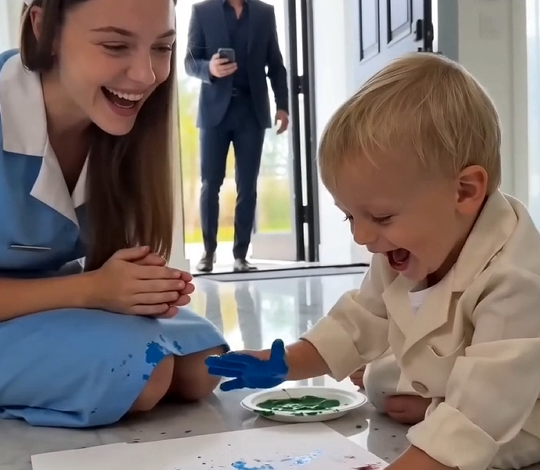
Andrew stayed on the floor long after the humming stopped.
The paint dried on his cuff. His phone buzzed six times beside him. He ignored every call.Leo didn’t speak. He didn’t suddenly become a different child. But he didn’t run either. He sat between Nora and his father, touching the wet handprints one by one, like he needed proof they were still there.
That was the first real crack in the house.
Not because Leo was healed. He wasn’t.
Because for the first time, Andrew saw that his son had not been refusing life. He had been refusing a world that kept coming at him too fast, too cold, too clean, too controlled.
Nora didn’t celebrate. She cleaned Leo’s fingers with a warm washcloth, still humming the same little pattern. Tap. Tap-tap. Pause. It was barely music. More like a breathing track with a pulse.
That night, Andrew stood outside Leo’s room and heard it again through the cracked door. Nora wasn’t reading from a therapeutic script. She wasn’t prompting language. She sat on the rug and tapped the side of the bedframe softly while Leo lay curled under his blanket, eyes open, listening.
Two hums came back from the bed.
Andrew gripped the doorframe so hard his knuckles whitened.
The next morning he canceled one meeting. Only one. For a man like him, that already felt huge. He came into the breakfast room expecting progress he could measure. A better appetite. Eye contact. Maybe another sound.
Instead, Leo sat rigid in his high chair, lips sealed, face blank, as if the day before had never happened.
The old panic rose fast in the house.
The cook whispered that children sometimes “perform” once and then stop. The house manager said the paint incident had probably overstimulated him. Andrew’s mother, calling ahead about her upcoming weekend visit, said consistency mattered and warned him not to let temporary staff improvise with a grieving child.
Andrew didn’t argue. That was the problem. His old instincts were stronger than one miracle on a floor covered in butcher paper.
By noon he had already asked Nora, too casually, whether yesterday might have been “situational.”
Nora was rinsing bowls in the kitchen sink. “Maybe,” she said.
That answer irritated him. “You don’t seem concerned.”
She dried her hands and looked at him directly. “He’s not a machine. He’s a scared little boy.”
Andrew had no answer for that.
Over the next several days, Nora did something no expensive specialist had done. She repeated the same game without forcing the same result.
Same sunroom. Same paper. Same washable bowls. Same little rhythm. Tap. Tap-tap. Pause.
Some days Leo only stood in the doorway. Some days he sat. Some days he touched one fingertip to the paint and left. Once he pushed the whole blue bowl away and trembled until Nora stopped immediately and just tapped the rhythm on her own knee from across the room.
She was building a path, not chasing a performance.
That was what Andrew slowly began to understand.
Leo did not respond to paint because paint was magical. He responded because the game had rules he could feel. The rhythm didn’t rush him. The mess didn’t demand words. Nothing disappeared when he hesitated. Nobody corrected his hands. Nobody told him to be brave. He could join and leave without being shut out.
And the final step was always the same: a second set of hands beside his, then a third.
Co-created. Predictable. Alive.
By the end of the week, Leo made that low humming sound four separate times.
The fourth time happened at bedtime.
Nora had spread fresh paper on the nursery floor after his bath because he had resisted sleep all afternoon. The lamps were low. Rain ticked softly against the windows. Leo sat in his pajamas with the blanket over one shoulder while Nora tapped the rhythm on an upside-down paint lid.
Tap. Tap-tap. Pause.
He hummed once.
Then again.
Andrew, standing in the doorway, didn’t move until Leo turned and held out a paint-smeared hand toward him.
Nora didn’t smile like she’d won anything. She only nodded.
Andrew came down to the rug in shirtsleeves this time. No phone. No shoes. Leo took his father’s fingers and pressed them onto the paper beside his own mark. Then he leaned back against Nora’s knee while humming under his breath.
That image lodged itself in Andrew’s chest harder than any boardroom crisis ever had: his son needing both steadiness and witness at once.
It should have changed everything immediately.
It didn’t.
Because old houses protect old orders.
Andrew’s parents were due to arrive that Saturday for their first visit since the funeral. The house shifted into performance mode by Friday afternoon. Silver polished. Flowers reset. Guest suite prepared. Staff sharpened. Even grief had to look presentable.
Andrew’s mother, Evelyn, had opinions before she got out of the car.
Leo needs calm. Leo needs routine. Leo must not be indulged. And under all of it, the real message: This family will not unravel publicly.
Evelyn wasn’t cruel in a dramatic way. She was elegant, disciplined, and completely convinced that emotional control was love. She had raised Andrew the same way. He recognized the tone in his own voice because it came from hers.
Nora felt the shift the second the grandparents entered the house.
Leo felt it too.
He saw strangers in his space, more perfume, more voices, more expectation. By lunch he had gone flat again. Shoulders up. Eyes down. Silent. He refused food and pressed himself into the angle between the dining room wall and a sideboard while adults pretended not to stare.
Evelyn murmured, “This is exactly why novelty must be limited.”
Andrew said nothing.
That silence hurt more than the words.
Nora did not argue at the table. She simply moved a little closer to Leo’s line of sight and tapped the rhythm once against her own wrist with her thumb. Tiny. Private.
Tap. Tap-tap. Pause.
His eyes flicked to her. Then away.
It was enough for her to know he still heard it.
The real break came an hour later in the main drawing room, where the family had gathered for coffee because that was what families in houses like this did, no matter how badly the child in the room was fraying.
Leo had been placed on a velvet settee with books he wasn’t touching. Andrew’s father tried a toy train. Evelyn tried careful sweetness. Andrew kept taking work texts and putting his phone face down, as if that counted as being present.
A server dropped a spoon on a tray in the adjoining room.
The sharp metallic crack split the air.
Leo jerked so hard he slid off the settee, hit the rug on his knees, and clapped both hands over his ears. Then came the sound the house knew too well—the trapped, breathless pre-cry that usually ended in total shutdown.
Evelyn stood at once. “No one crowd him.”
The house manager rushed to dim the lights. Andrew took one step forward, then stopped, waiting for the “right method.” Leo folded in on himself anyway.
Everything expensive in that room suddenly looked useless.
Nora was already on the floor.
Not touching him. Not speaking his name over and over. Not trying to lift him.
She reached into the canvas basket she’d started keeping near every room Leo used and pulled out three things: folded paper, a small tray of washable paint pods with lids, and a rag.
Evelyn stared. “Absolutely not. Not in here.”
Nora ignored her.
She spread the paper on the hardwood in the open space beside Leo, like making a landing strip. She opened only the blue paint. Then she tapped one finger into it and pressed the first mark.
Tap.
Then two more.
Tap-tap.
Pause.
Leo’s breathing stuttered.
Evelyn stepped forward, furious now. “This is not the time for games.”
Andrew looked from his mother to his son to the paint.
That was the moment everything balanced.
The old order said stop the mess, remove the embarrassment, regain control. The newer, shakier truth was kneeling on the floor in front of him with blue paint on one finger.
Nora made the pattern again, this time humming under it. Not louder than Leo’s panic. Just steadier.
Tap. Tap-tap. Pause.
Leo’s hands were still over his ears, but one eye opened.
Nora added a second print, then slid the paint tray into the space between them and waited.
No one in the room moved.
Andrew’s father muttered, “For God’s sake, Andrew—”
But Andrew was no longer looking at any adult.
He dropped to his knees on the hardwood.
Not elegantly. Not carefully. Just down.
He put his hand in the blue paint.
His mother actually gasped.
Andrew pressed one full handprint on the paper beside Nora’s marks and, with a voice rougher than anyone in that room had ever heard from him, tapped the pattern with his painted fingertips.
Tap. Tap-tap. Pause.
Leo froze.
His breathing hitched once. Twice.
Then his right hand slid off one ear.
Nora didn’t rush the gap. She just repeated it.
Tap. Tap-tap. Pause.
Andrew copied her exactly.
Leo crawled one step.
Then another.
The room had seen him move before, but not toward people during fear. Usually fear sent him backward, into corners, under tables, behind doors. This time he came forward on shaky knees and put one trembling hand into the blue tray.
Evelyn whispered, “Andrew, stop this.”
Andrew didn’t even turn his head.
Leo touched the paint, stared at his finger, and let out a small, ragged hum.
Nora answered with the same note.
Leo hummed again—longer this time.
Then, in front of his grandparents, the staff, and the old rules of that house, he took Andrew’s wrist and dragged his father’s hand closer to the center of the paper, exactly as he had in the sunroom days earlier.
Andrew’s face broke.
Not with tears at first. With shock. The kind that strips a person of every practiced layer.
Leo pressed his own blue hand on top of his father’s print. Then he leaned sideways against Nora’s shoulder and hummed the pattern all the way through.
Tap. Tap-tap. Pause.
Hum.
No one could call it an accident now.
No one could say the child had imagined it. No one could say Nora had gotten lucky once.
And no one in that room could ignore what failed him every time: polished distance, corrected posture, adult order before connection.
Evelyn’s mouth tightened. “He is being encouraged to regress.”
Nora finally looked up. She didn’t snap. She didn’t make a speech. She only said, “No, ma’am. He’s coming back.”
The silence after that was enormous.
Andrew stared at the paper on the floor. Three sets of marks. Nora’s small red and blue taps from habit. His own broad palm print, crooked at the edge. Leo’s little hand on top of both.
Then he stood up and did something far more radical in that house than kneeling on the floor.
He chose a side out loud.
“Mother,” he said, still breathing unevenly, “we’re done calling this nonsense.”
Evelyn went still.
Andrew turned to the house manager next. “The paper stays. The paint stays. In the sunroom and his room.”
Then to the staff who had spent months lowering their voices and tightening the schedule around a grieving child: “No one takes these away because they look messy.”
Finally he looked at Nora.
The entire room understood that her trial status had just become something else.
“You’re not finishing out the week,” he said. “If you’ll stay, I’d like a stable contract. Full authority over Leo’s daily rhythm with me included.”
Nora, still seated on the floor with Leo leaning into her side, looked less dazzled than tired.
“With you included?” she repeated.
He knew what she meant. Wealthy men outsourced all the time and called it care.
So Andrew said the harder part in front of everyone who knew how absent he’d been.
“I’ll take the third fixed block every week myself. No calls. No meetings. And we change the second house rule.”
The house manager blinked. There were dozens of rules.
Andrew said, “Leo is allowed to make mistakes. Noise, mess, unfinished things. We stop correcting every small disruption like it’s damage.”
Evelyn looked almost offended enough to leave.
His father actually laughed once under his breath, not because it was funny, but because he was witnessing a rebellion in a language this family had never used before: not shouting, not scandal, just a man refusing inherited coldness.
The rest of the visit stayed tense. Leo still withdrew at moments. He still would not speak words. He still refused dinner that night until Nora sat cross-legged near his chair and tapped the rhythm quietly against the table leg while Andrew waited without pressuring him. He ate three bites of pasta with his fingers. For that house, it might as well have been thunder.
Later, when the grandparents had gone to their suite and the downstairs lights were dimmed, Nora cleaned the brushes in the nursery sink while Andrew sat on the floor outside Leo’s bed.
The little boy was nearly asleep, one hand hanging over the mattress edge.
Andrew said, very quietly, “I kept thinking if I brought in enough help, I was doing my part.”
Nora wrung out a cloth. “You were trying.”
“That’s not the same thing.”
“No,” she said. “It isn’t.”
There was no romance in the room. Not then. Something more fragile and more necessary than that. Respect. Shame. Relief. The beginning of trust between two adults standing on opposite sides of money but now on the same side of one child.
From the bed came the smallest sound.
Hum.
Both of them turned.
Leo’s eyes were closed. His fingers flexed once over the blanket. Andrew did not rush to him. He just tapped the pattern softly on the floorboards from where he sat.
Tap. Tap-tap. Pause.
A second hum answered.
Nora smiled then, but only with her eyes.
In the weeks after the grandparents’ visit, the house changed in ways outsiders might never notice and anyone inside could feel immediately.
The doors stayed open more. The schedule loosened where it had once strangled. There was butcher paper in the sunroom basket, under the nursery console, and in a cabinet off the family lounge. One expensive side table carried a faint blue stain nobody worked very hard to remove.
Andrew kept his promise badly at first, then better.
The first parent block he missed by forty minutes. The second, he arrived on time but took one call in the hall. The third, Nora took his phone before he sat down and he let her.
By the sixth week, he was the one spreading the paper.
Leo still had setbacks. Entire afternoons of silence. Days where he couldn’t bear new people. A hard freeze whenever someone said his mother’s name too brightly, as if he should feel comfort instead of loss. But when he retreated, the house no longer treated that retreat like failure or defiance. They returned to the rhythm. The same path. The same invitation.
Tap. Tap-tap. Pause.
Sometimes Leo hummed. Sometimes he only watched. Sometimes he took Andrew’s hand and placed it where he wanted the next mark.
That became its own language.
Nora’s place in the house changed too, though not in the sentimental way people might expect. She was still an employee. She still lived in a smaller world outside those gates, still wore practical shoes, still kept her own life tightly budgeted and real. But she was no longer treated as temporary help filling a silence. She had altered the center of the family, and everyone knew it.
Andrew had the contract revised properly. Stable pay. Protected hours. Decision-making authority over Leo’s daily care. And one clause Nora requested herself: if the family ever turned Leo’s healing back into performance, she could walk.
Andrew signed it without negotiating.
On one cool evening near the start of fall, Andrew found Leo in his room before bed, sitting on the rug beside the now-permanent paint basket. The walls were still cream. The furniture was still expensive. But one corner had become unmistakably lived in—paper rolls, washable paints, old shirts for smocks, rag cloths folded in a bin.
Nora was at the doorway, not entering yet.
Leo looked from the paint to his father.
Then he patted the floor.
Andrew sat.
Leo opened the blue pod himself. Dipped one finger. Tapped the paper once.
Tap.
Then twice.
Tap-tap.
Pause.
He didn’t hum that time.
He reached back without looking, found Nora’s hand, and pulled her down beside them.
A new pattern, still unfinished, still fragile.
But no longer empty.
And in that old-money house where grief had once been shut behind doors and managed like a scheduling problem, a child who had gone silent was beginning, in his own time, to choose his people back.
That was not a perfect ending.
It was better.
It was hope.