THE LITTLE DOUGH FIREWORKS THAT MADE A SILENT GIRL LAUGH IN A MANSION FULL OF IMPORTANT PEOPLE

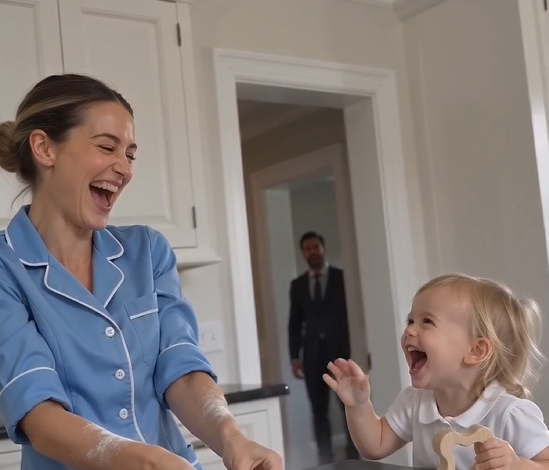
Michael told the house staff to leave the flour where it was.
Vanessa stared at him like he had just overturned the dining table himself. “You cannot be serious.”But he was still looking at Ivy.
His daughter had gone quiet again, eyes lowered, body tucked in, like the laugh had never happened. If he had not seen it with his own eyes, he might have let the moment be explained away. A fluke. A reflex. An accident.
Instead he said, “Hannah stays through the week.”
Vanessa smiled the way people smiled when they planned to win later. “Of course. For observation.”
That was how Hannah’s trial became a temporary placement.
The first day, nothing happened.
The second day, Ivy wouldn’t even enter the kitchen.
The third day, Vanessa made sure lunch happened on schedule in the breakfast room with linen napkins and a corrected little place setting. Ivy sat frozen and did not touch her food. By evening, Vanessa casually told Michael, “That dough scene was a one-time novelty. She’s already regressed.”
Michael almost accepted that. It fit the story every expert had given him. Progress would be inconsistent. Attachment responses were unclear. Continue structured intervention. Monitor.
But Hannah didn’t argue. She just kept watching.
She noticed that when doors closed too fast, Ivy’s shoulders jumped. When people gave a cheerful command voice, Ivy went blank. When something happened in a rhythm she could predict, she stayed present one second longer.
So Hannah brought the dough back, not as a performance, not as a miracle trick, but as a daily promise.
Always the same kitchen corner. Always the same wooden bowl. Always the same tap tap. Always the same soft “pop.” Always enough pause for Ivy to decide, not obey.
At first Ivy only watched from the doorway. Then she came closer. Then she touched the flour. Then she waited for Hannah to roll the next ball. On the sixth day, Ivy pushed the bowl toward her before Hannah asked. On the seventh, when Hannah deliberately sat back, Ivy slapped the dough herself and looked up first, like she wanted someone to witness it.
A smile came before the laugh.
Then the laugh came back.
That was the second real response, and this time it was bigger. Ivy hit the dough, watched it spread, and let out a bright little burst that seemed to shock her own body. She laughed again, this time looking directly at Hannah.
Michael saw that one too.
He had started coming home earlier without announcing it. He told himself he was verifying patterns, not hoping. But every evening, he ended up standing where he could see the kitchen without being seen. One night Hannah caught him there and didn’t say a word. She just kept the rhythm.
Tap tap.
Press.
“Pop.”
Ivy’s head turned toward the sound before the word was even finished.
That was when Michael finally asked Hannah, quietly, “Why this?”
She wiped flour off her hands and answered in the plainest way possible. “Because nobody in this house lets anything happen twice the same way with her. Everybody wants a result. She needs to know what comes next.”
It hit him harder than any specialist report.
After his wife died, he had filled the silence with solutions. New staff. New rooms. New consultations. New rules. New routines designed by adults. Vanessa had taken over the rest and turned grief into management. Everything in the house was smooth, corrected, impressive.
Nothing was safe.
Safe was not expensive. Safe was not beautiful. Safe was not “developmentally optimized.”
Safe was tap tap. Press. Pop.
Safe was a mess that arrived the same way every time.
So Michael began to test what Hannah had said. Not on a chart. In person.
One Saturday, he sat near the island while Hannah mixed the dough. Ivy stood close to Hannah’s leg but kept glancing at him. Michael reached too soon for a piece. Ivy stiffened. Hannah shook her head once, almost invisible.
“Wait,” she said softly.
So he waited.
Hannah rolled the dough. Tapped twice. Pressed. “Pop.”
Then she rolled another ball and set it between Michael and Ivy.
Michael copied her.
Too fast.
Ivy recoiled.
Again Hannah did not explain like a consultant. “Same speed,” she said.
He tried again.
Tap tap.
Press.
“Pop.”
Ivy watched his hand. Then, slowly, she put her small palm on top of his and pushed down with him.
It was not a big scene. No music. No speech. But Michael’s face changed. He looked at his own child like he had just been handed back a country he thought was gone.
Vanessa saw that too, and that was when Hannah became a problem.
Until then, Hannah had been a useful temporary curiosity. After that, she was a threat.
Vanessa started tightening the house.
No flour left out. No kitchen access before meals. No “unsanctioned sensory play” on event days. No rain boots in the mudroom because they “encouraged wild behavior.” And most of all, no visible disorder when the board dinner approached.
The annual reception mattered to her. It was the first one she would host as mistress of the estate with Michael’s full executive circle present: directors, spouses, investors, polished families with polished children. She wanted Ivy dressed, present, and manageable.
She did not want the child associated with a kitchen ritual that looked, to her, like peasant chaos.
Three days before the event, she took over Ivy’s prep completely.
Hair practice. Dress fittings. Timed meals. Guest rehearsal in the formal lounge.
Ivy disappeared again.
Not all at once. That was the cruel part. She simply gave less and less back. Her laughs stopped. She stopped coming to the kitchen. When neighboring children visited the garden and shrieked near the fountain, Ivy didn’t even turn her head.
Vanessa folded her arms like the evidence proved her right. “There. She’s retreating. Hannah got her overstimulated and confused.”
Staff started whispering the same thing. Michael heard it from every angle: maybe the mess play had been too much, maybe attachment to the nanny was creating instability, maybe consistency required stricter boundaries.
The old order was rebuilding itself in real time.
Michael almost let it.
But then he remembered exactly what he had seen the first day: Ivy open under one set of hands and close under another in the same minute. Not theory. Fact.
So he didn’t fire Hannah.
He asked her, “What changed?”
Hannah looked toward the staircase, where Ivy was being walked past in another pristine dress. “The ritual stopped belonging to Ivy. It became something adults were controlling.”
That answer made him sick, because he knew it was true. Even his attempts to join had come with an agenda. Get the response. Confirm the progress. Fix the problem.
Hannah wasn’t trying to produce Ivy. She was trying to meet her.
On the morning of the reception, rain started before dawn and dragged gray light across the estate. Tents went up on the back terrace. Cars lined the circular drive. Staff hurried under umbrellas carrying platters and floral boxes. Inside, the mansion glowed with polished wood, silver trays, and the cold kind of perfection people mistake for success.
Ivy was dressed in pale blue.
She looked like a portrait.
She also looked gone.
Vanessa kept smoothing the child’s sleeves and saying, “Remember, Daddy’s important guests are coming. We smile. We stand nicely. We don’t hide.”
Ivy’s breathing had already gone shallow.
Hannah stayed back because she had been told to. Employee boundaries. Event protocol. Assist only if requested.
By late afternoon, the first guests arrived. Voices filled the foyer. Expensive laughter. The clink of glasses. The high energy of adults who came to be impressed and children brought out as proof of family polish.
At first Ivy endured it. She stood beside Michael near the terrace doors, eyes fixed on nothing.
Then one of the directors’ sons, maybe four years old, darted past with a toy plane. Another child squealed. Someone dropped a serving spoon in the dining room. The sudden metal crash cut through the room.
Ivy flinched so hard her whole body jerked.
Vanessa bent down instantly, smile frozen for the guests. “Ivy, no scene. Stand up straight.”
That did it.
Ivy dropped to the floor and folded into herself, hands over ears, face white, breath broken. The nearby children stopped and stared. Adults pretended not to. The room shifted into that horrible rich-people silence where everyone is witnessing a family disaster while acting elegant.
Vanessa reached for her. “Come on. You are fine.”
Ivy recoiled from her touch and let out a raw sound, not a cry exactly, more like panic breaking through locked glass.
Michael froze for half a second.
In the old order, that half second would have turned into command. Remove her. Calm her. Apologize to the guests. Restore control.
But his eyes found Hannah at the edge of the room.
She was already kneeling.
Not in front of Ivy. Beside the low terrace step where a catering prep table had been rolled in from the garden. On it sat a covered bowl from the kitchen, because Hannah had brought one anyway. Not to defy the house. To be ready.
She didn’t ask permission.
She set the bowl down on the floor.
Tap tap.
The sound was small, almost absurd under chandeliers and executive conversation.
A few people turned.
Hannah pinched off a piece of dough.
Press.
“Pop.”
Vanessa whispered furiously, “Not here.”
Hannah didn’t look at her.
Tap tap.
Press.
“Pop.”
On the floor, Ivy’s breathing hitched.
Michael saw one tiny hand move away from her ear.
Tap tap.
Press.
“Pop.”
The room was quiet now for a different reason. Not polished silence. Human attention.
Rain started drumming harder against the terrace glass.
Ivy lifted her face.
Hannah rolled another ball and set it just within reach, not touching her, not ordering her. An invitation placed inside a pattern.
“Your turn,” Hannah said, so softly only the nearest people heard.
Vanessa stepped forward again, still trapped in the need to end the embarrassment. “This is completely inappropriate.”
The instant she moved in, Ivy shrank back.
Michael finally made his choice.
“Vanessa,” he said without raising his voice, “stop.”
She stared at him. “In front of the board?”
“In front of everyone,” he said.
Then he did something nobody in that room expected from a man like him. He lowered himself onto the polished floor in his tailored suit beside his daughter and waited.
Not demanding. Not rescuing. Waiting.
Hannah tapped twice on the bowl.
Michael copied her on the floor.
Tap tap.
Hannah pressed the dough flat.
“Pop.”
Michael took the small piece she offered and held it out in his open palm.
For one terrifying second, nothing happened.
Then Ivy crawled to him.
Not to Vanessa. Not to the nearest woman. Not even first to Hannah.
To him.
But only through the bridge Hannah had built.
Ivy put her hand on the dough. Michael did not rush. He let her set the speed. Together they pressed.
The dough burst sideways in a soft little flare.
And Ivy laughed.
Clear this time. Bright enough to cut straight through the storm, the guests, the shame, all of it.
Several people gasped. One older board member’s wife covered her mouth. A little boy nearby laughed too, not mocking, just answering her. And for the first time in longer than Michael could bear to measure, Ivy turned her head toward another child’s laughter.
Then she did the most devastating thing of all.
She grabbed her father’s hand, smacked it lightly against the dough, and pulled him to do it again.
Tap tap.
Press.
“Pop.”
She laughed harder.
Rain pounded the glass. Somewhere behind them, a server started crying quietly. Nobody cared about the schedule anymore.
Michael stayed on that floor as long as Ivy needed. Suit ruined. Guests waiting. Phone vibrating in his pocket. None of it mattered.
What had failed in public that night was not the child.
It was the adult order that had kept asking her to perform safety instead of feel it.
After that reception, the house changed in ways no consultant had managed to force.
Michael canceled two standing evening meetings every week and blocked a third recurring slot on Sunday mornings that his assistant was forbidden to touch. “Ivy time,” it said on the calendar. He learned the rhythm exactly. Same bowl. Same spoon. Same place. Same pace.
He changed one of the estate’s absurd written household rules too. Rule thirteen had been about preserving formal spaces and discouraging “uncontained child activity.” He replaced it with a sentence that made half the staff blink: Children are allowed to try, fail, spill, repeat, and learn in family areas.
Vanessa lasted less than two months after the reception.
It was not one dramatic breakup scene. It was worse for her than that. Michael began to see her clearly. Every polished correction sounded different once he understood what it cost Ivy. Every “for her own good” landed like control. Every complaint about Hannah exposed jealousy more than concern.
Vanessa accused him of letting an employee manipulate the household.
He answered, “She’s the only person who helped my daughter trust this house again.”
That was the beginning of the end.
She moved out before Christmas.
Hannah, for her part, did not try to replace anyone. That mattered. She never used Ivy’s attachment to push for status, money, or promises. She kept doing what she had always done: observing, adjusting, making ordinary life livable.
When Ivy woke from bad dreams, Hannah didn’t lecture or over-comfort. She sat on the rug and rolled little silent dough balls until Ivy’s breathing slowed enough to join in.
When rain came, and the windows made Ivy tense, Hannah started taking her to the covered garden path to watch drops hit the stone in patterns. Later, once Ivy tolerated it, they went farther. Boots on. Puddles. Wet grass. Mud.
That became another ritual.
One afternoon Michael came home early and found them outside in light rain behind the greenhouse. Hannah and Ivy were stomping shallow puddles, each splash followed by Ivy’s delighted laugh. Hannah looked up, startled, probably expecting disapproval.
Instead Michael took off his shoes, stepped into the rain, and let Ivy drag him in.
The child laughed so hard she nearly fell over.
That became the picture everyone remembered: the billionaire father in rolled-up trousers, soaked in his own garden, while his daughter held one of Hannah’s hands and one of his like she was physically connecting two halves of a broken bridge.
It did not turn into a perfect life overnight.
Ivy still had hard days. Sudden noises still shook her. Crowded rooms could still shut her down. Sometimes she retreated and would not answer for hours. But now the adults around her stopped treating retreat like defiance or failure. They met it with pattern, patience, and presence.
And because Michael finally stayed present long enough to learn, Ivy’s progress stopped depending on miracles.
Months passed.
Words came slowly, then more often. Not many at first. Small useful ones. “More.” “Again.” “Daddy.” “Pop.”
The first time she said “Hannah,” Hannah had to turn away and pretend to check the oven because her eyes filled instantly.
The relationship between Hannah and Michael changed just as slowly and carefully.
There was no sudden rich-man rescue, no dramatic confession over candlelight. In fact, for a long time, Michael was almost formal with her outside Ivy’s routines. He knew the power imbalance. He knew grief could confuse gratitude. He knew a house this wounded could attach itself to whoever brought relief.
So he waited. She did too.
But real things accumulated.
Shared coffee in the kitchen after Ivy finally slept. Quiet conversations about what his late wife had been like before the accident, not as a saint, but as a person. Admissions he had never made to anyone else—that he had mistaken provision for presence, and leadership for love. Little moments where Hannah challenged him without fear, and he listened.
He funded further training for Hannah only after asking what she wanted, not what would make her more useful to him. She chose child development courses at a local college, part-time, practical, nothing fancy. She kept working in the house because by then Ivy’s room, schedule, and sense of safety had all grown around her rhythms.
By the next year’s spring, the mansion looked different without really changing its furniture.
The kitchen was warmer. The garden was used. There were child fingerprints sometimes on lower windows. A wooden bowl lived permanently on one side of the marble island. And in Ivy’s room, on a low shelf, there was a simple tray with flour-safe tools and a little card with circles drawn on it to mark the ritual sequence.
Tap tap. Press. Pop.
Anyone could see it was not just a game. It was the shape of trust.
The new family formed so quietly that outsiders almost missed the beginning.
Ivy noticed first.
One evening after dinner, she was on the kitchen floor pressing dough while Michael cleaned up and Hannah rinsed bowls. The air smelled like butter and rain. Ivy looked from one adult to the other and said, in her still-careful little voice, “Both.”
Michael crouched down. “Both what, sweetheart?”
Ivy patted the space between them. “Both here.”
That was all.
But it told the truth.
By then Hannah was no longer a trial nanny, or just staff passing through a rich family’s crisis. She was part of the emotional architecture of the home. And Michael, for once, did not rush to define it before it had lived long enough to be real.
When he finally asked her, it was months later, not in front of Ivy, not in the shadow of panic, and not as payment for what she had done.
He asked if she could imagine building a life with them beyond the job.
Hannah did not answer quickly. She made him wait, because she understood what permanence should cost. Then she said yes only after one condition: Ivy’s safety came first, always, even before the romance adults liked to glorify.
Michael agreed before she finished the sentence.
So the estate that once felt like a museum of control became something messier and better.
A home where a child who used to ignore laughter learned to answer it. A father who used to outsource love learned to kneel on the floor and repeat a rhythm. And a young woman who arrived in flat shoes for a trial shift changed her own place in the world not by acting refined enough for wealth, but by bringing ordinary life back into a dead house.
In the end, it was never the marble, the staff, the money, or the perfect manners that saved Ivy.
It was a bowl of dough. A pattern she could trust. A father willing to learn it. And the girl who had the nerve to make a mess in the middle of a mansion full of people who called that healing unprofessional.