WHEN THE MILLIONAIRE’S SON COULDN’T FOLLOW A SINGLE CHILD, THE YOUNG NANNY PUT HIM IN A LAUNDRY BASKET AND MADE HIS FATHER SEE HIM

Sophie did not argue with Vanessa.
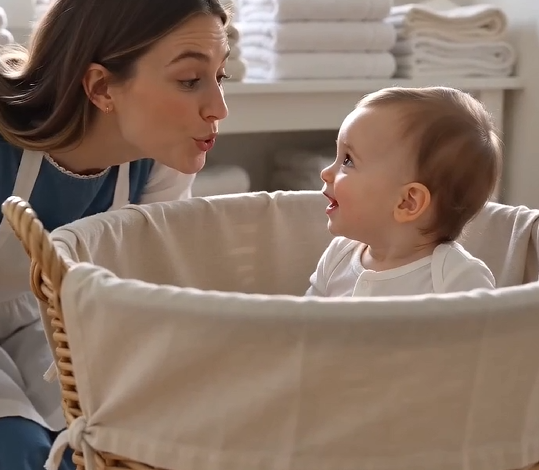
She kept her palm on the rim of the laundry basket and looked only at Miles.Two taps. A pause. One slow pull.
The tiny body that had started to collapse stiffened, then steadied. His fingers spread against the blanket. His breathing came back in rough little pulls instead of the silent panic everyone in that house had started treating like normal.
Daniel stayed in the doorway, briefcase still in his hand, watching like he had walked into a room where the laws had changed without asking him first.
“Miles,” he said again, softer this time.
Sophie didn’t tell him to say more. She didn’t tell him to stop. She just tapped the rim twice and waited.
Miles turned farther than before. His gaze landed on Daniel’s face, flickered, then dropped to Daniel’s shoes.
It was still a response.
Daniel’s eyes widened the way they did when he was absorbing data he couldn’t explain away.
Vanessa recovered first. “This is not part of the approved plan.”
Sophie finally looked up. “The approved plan isn’t reaching him.”
That should have gotten her removed on the spot. In most wealthy houses, a trial nanny did not challenge the wife in the laundry room. But Daniel was still looking at his son, not at either woman.
Miles made a small sound. Not a word. More like the beginning of one.
Sophie answered it by moving the basket one more slow foot across the floor. “Boat’s moving.”
Then she stopped again.
Wait.
That was the part everyone else kept getting wrong. They filled every silence. They corrected every delay. They rushed to prove progress before Miles had even found the edge of his own impulse. Sophie had spent three days noticing that he wasn’t absent all the time. He was bracing. The world kept coming at him too fast, with too many eyes on him, too many cheerful instructions, too much pressure to join before he felt safe enough to try.
His mother had been alive, loud, and ordinary from what the old cook quietly told Sophie. She had sung while making toast. Sat on floors in good clothes. Let Miles touch batter and spill water and drag blankets around the house. After the crash, everything became cleaner and stricter. The adults around him called it stability. To him, it felt like the world had lost its human texture.
So Sophie gave some of that texture back.
The next morning she found an email from the developmental agency Vanessa preferred. Trial care was to be paused. Standard training blocks were to resume immediately. Unstructured sensory play had been deemed “counterproductive to group adaptation.”
Vanessa printed it and left it on the breakfast table like a court order.
Daniel read it while standing. “The pediatrician referred Sophie.”
“The pediatrician doesn’t manage donor optics,” Vanessa said. “The foundation photo day is this Friday. We cannot have him regressing into floor games and household objects.”
Regressing.
Sophie hated that word by the second week. It was what polished adults said when a child refused to perform on cue.
Daniel looked at her. “What exactly are you doing with him?”
She answered plainly. “I repeat the same rhythm until he knows what comes next. Sound, movement, stop. Then I leave room for him to answer. If he answers, I answer back.”
Vanessa gave a cold little laugh. “He’s not answering. You’re projecting meaning onto random behavior.”
Sophie could have defended herself. Instead she asked, “Then why does he only turn when someone waits long enough?”
Vanessa had no answer for that. She only had standards.
Daniel did what he always did with conflict. He tried to split it into manageable pieces. “You have until Friday. No more disruptions. No chaos. I need to see if this is real.”
Vanessa stared at him. Sophie understood immediately: this was not a victory. It was a test.
So she kept to the same pattern. She did not innovate. She did not chase milestones to impress anyone. Every day she brought the same laundry basket into the same family lounge with the long windows facing the pine-covered slope. Blanket folded the same way. Two taps on the rim. One slow pull. Stop. Wait.
Sometimes Miles touched the basket. Sometimes he only watched. Twice he leaned his weight forward before she moved. On the ninth round over four days, when Daniel came in without speaking and stood against the wall, Sophie tapped the basket, pulled once, and paused.
Daniel whispered, “Miles.”
The boy’s hand came off his own shirt and landed on the basket rim.
Daniel went still.
Sophie nodded toward the basket but didn’t break the rhythm. “Again.”
Daniel swallowed and tried. “Miles.”
This time the child turned his head and looked directly at him for one full second.
It was so small that another person might have missed it.
Daniel didn’t. His face changed in a way Sophie would remember long after she left that house. It was not pride. It was not relief. It was the shock of a father realizing his son had been reachable the whole time, just not through force.
From that day on, Daniel started coming home for one short block in the late afternoon. He said almost nothing during those sessions. He watched Sophie sit on the floor in expensive rooms and make them less dead. He watched Miles begin to anticipate the pause instead of fearing it.
Sophie brought the same logic into other parts of the day.
At snack time, she didn’t put a plate in front of Miles and cheer at him. She rolled one blueberry gently toward his hand, then waited. At bath time, she let water drip over his wrist before trying to move him farther in. Outside, she sat near a muddy patch after rain and tapped the side of a plastic bucket in the same rhythm as the basket.
Heat. Sound. Touch. Pause. Answer.
That was the whole thing.
Vanessa hated every inch of it.
She hated the muddy cuffs on Miles’s pants. She hated hearing a child’s voice in rooms that had been curated into magazine silence. She hated that Daniel had begun asking what Miles liked instead of what the consultants recommended. Most of all, she hated that Sophie’s methods made her own approach look exactly like what it was: a performance of order that had mistaken stillness for healing.
By Thursday night, the foundation staff had sent over the final plan for Friday’s charity photo event at the estate. Major donors. Board members. Press images for a campaign about “resilient families.” Vanessa wanted perfect shots in the lower garden with white chairs and a mountain backdrop. Miles was to wear a tiny navy blazer and stand between Daniel and Vanessa for no more than seven minutes.
Sophie heard the plan and knew it was built for failure.
Group direction. Strange adults. camera clicks. polished clothes. no room to hide. no rhythm. no recovery.
She told Daniel in the pantry while staff loaded floral arrangements into trucks. “If he gets scared, don’t push him toward the mark.”
Daniel rubbed his forehead. “He has to get through one photo.”
“He doesn’t have to perform,” Sophie said. “He has to feel safe enough to stay in the moment.”
Vanessa entered before Daniel could answer. “This is exactly the language that keeps him behind.”
Sophie held her gaze. “No. This is the language that keeps him from disappearing.”
Friday came bright and cold. The mountain air was sharp enough to wake every nerve. Cars wound up the private road. Women stepped out in cream coats and boots too clean for the gravel. Men talked about pledges and land conservation and resilience while assistants moved chairs half an inch at a time.
Inside, Miles was already failing.
The blazer made him rigid. The unfamiliar shoes made him stop walking. The voices downstairs stacked on top of each other until he covered his ears and sat on the dressing room floor.
Vanessa crouched in front of him with a smile stretched tight across her face. “No floor. Up. Look at me. We practiced this.”
Miles didn’t look at her. He had gone flat and far away, not screaming, which everyone in that house used to mistake for calm.
Sophie knelt several feet back and said nothing.
That distance mattered. If she came too close too fast, he would lose the little control he had left.
Vanessa reached for his arm. “We don’t have time for this.”
The moment her hand closed around him, he jerked, kicked off one shoe, and made that thin terrified sound Sophie had only heard twice before.
Daniel came in from the hall at the same time.
Everything sped up. Staff outside. Cameras ready. Vanessa insisting. Miles sliding backward under a bench. Daniel looking between the schedule and his son like both were emergencies and only one could be solved cleanly.
Then somewhere in the lower garden, a cluster of balloons snapped loose from a display and slammed against the stone wall with a crack.
Miles bolted.
Not far. Just wild and blind enough to send the room into panic. He shot through the side mudroom, out the back door, and down the flagstone path toward the service lawn where the ground was still wet from overnight rain.
Vanessa shouted for security. A staff member started after him. Sophie said, “No one crowd him.”
Maybe because Daniel had seen enough by then, maybe because fear stripped him down to whatever truth he had managed to learn, he barked, “Stop. Let her go.”
Sophie ran after Miles with only one thing in her hand: the small oval laundry basket liner she had pulled out earlier that morning in case he needed the familiar texture.
She found him at the edge of a muddy drainage dip beyond the formal garden, frozen with one sock soaking through, shoulders up around his ears, unable to move forward or back. Behind them the charity guests had started to gather at a distance, pretending not to stare.
This was the public humiliation Vanessa feared. This was also the first honest thing that had happened all day.
Sophie didn’t touch Miles.
She dropped the liner into the mud, set a low plastic garden trug beside it, and tapped twice on the trug with her fingers.
The same rhythm.
Then she dragged it half an inch through the muddy water.
“Boat’s moving,” she said quietly.
Miles’s breathing hitched.
She stopped.
Wait.
The wind moved the grass. Somewhere uphill, somebody called Daniel’s name. Camera shutters clicked from too far away to matter now.
Sophie tapped twice again and dragged the trug through the shallow muddy runoff, enough to make a watery scraping sound.
Miles looked down.
She waited.
He took one step.
Mud swallowed his sock to the ankle.
Several guests gasped like they had witnessed a tragedy. Vanessa, standing back on the stone path, went white with anger.
Sophie did not look at any of them.
She tapped twice.
Miles took another step.
Then another.
He reached the trug, put both hands on the rim, and pushed. Mud rippled. Water splashed his pajamas. For one second he looked exactly like a child instead of a problem.
Daniel had come down the path by then, but he stopped when Sophie lifted one hand slightly to hold the moment open instead of crushing it.
She tapped the rim and, without turning around, said to him, “Say his name once.”
Daniel’s voice came out rough. “Miles.”
The little boy froze, hands still on the trug. Everyone in the garden went silent.
Sophie waited.
Miles turned.
Not just his head this time. His whole body.
He looked straight at his father, made a soft sound from deep in his chest, and then did the thing nobody there would ever forget.
He reached one muddy hand out toward Daniel.
Daniel did not move at first. It was too shocking. The boy who couldn’t follow a group, couldn’t handle transitions, couldn’t stay in one public moment without shutting down, was asking for him.
“Go,” Sophie said.
Daniel stepped off the stone path in six-thousand-dollar shoes and into the mud.
Vanessa said his name sharply, like she could still pull him back into the old world by force.
He ignored her.
Daniel crouched in front of Miles. He was clumsy, uncertain, expensive, and completely stripped of every useful shield he usually wore. Sophie tapped the trug twice.
Miles slapped the muddy rim, then grabbed his father’s wrist and pulled.
It was not symbolic. It was direct. Join.
Daniel put his hand on the rim. Sophie pulled the trug once through the mud. Stop. Wait.
Miles looked at Daniel.
Daniel understood.
He tapped twice on the rim himself.
The child made that same small sound again, only this time it carried something like excitement. He pushed. Daniel pushed with him. Mud splashed up both their pants. A few donors laughed in stunned disbelief. Someone near the terrace started crying. The cameras kept going because nobody could have staged a better truth if they tried.
The official family portrait never happened the way Vanessa planned it.
What went out in the foundation newsletter two weeks later was a candid image: Daniel in a white shirt streaked with mud, crouched beside his son; Miles looking awake, reaching forward; Sophie just at the edge of the frame, hand lifted from the trug after setting the rhythm and letting father and child take it.
The caption mentioned resilience. It should have mentioned surrender.
The fallout inside the house was immediate.
Vanessa called the scene degrading, irresponsible, socially disastrous. She said Sophie had manipulated a vulnerable child for attention and embarrassed the family in front of donors. She demanded the pediatric agency be informed that trial protocol had been violated.
Daniel listened all the way through.
Then he asked one question. “When she touched him, he moved toward the world. When you pushed him, he disappeared. Which part of that do you want me to defend?”
Vanessa had no answer that wasn’t about appearance.
By Monday, the agency sent another recommendation packet. Resume standard training. Limit dependency on a single caregiver. Restore formal structure.
Daniel declined.
For the first time, he did not pay for more expertise in order to avoid changing himself. He called the pediatrician directly. He asked Sophie to write down exactly what she did, in plain language. Not theories. Sequence.
She wrote it on three sheets from the family notepad.
Announce the action simply.
Repeat the same rhythm.
Stop before the child shuts down.
Wait long enough for him to choose.
Answer the choice, even if it’s small.
Never punish fear.
Keep one part of the day ordinary and alive.
Daniel took it seriously in the only way he knew how at first: rigorously. He blocked one fixed afternoon every week, no calls, no staff interruptions, no rescheduling. It became the fifth immovable slot in his calendar, after board meetings, market openings, legal review, and one standing investor call he finally moved for the first time in years.
Then something stranger happened.
He stopped treating parenting like a project with deliverables.
He started sitting on the family room floor without asking what it would produce. He let Miles take too long. He left pauses unfilled. He changed the second house rule Vanessa had insisted on since moving in: no avoidable mess. The new rule became this instead: if Miles is trying, don’t stop him just because it looks wrong.
The room Miles slept in changed too. Not dramatically. Just honestly. One laundry basket stayed in the corner with folded blankets inside. A wooden spoon and plastic bowl sat on the shelf because he liked the sound. A patchwork mat replaced the hard decorative bench where he’d used to hide underneath. The house still looked expensive. It no longer looked untouched by life.
Vanessa lasted another month in that system.
What broke her position was not a dramatic fight. It was that the house stopped agreeing with her. The chef stopped remaking snacks into perfect shapes after Sophie showed Daniel that Miles ate more when food looked like food. One of the housekeepers left an old towel by the back terrace because it was now expected that a child might come in muddy and laughing. Staff took their cues from what worked.
Vanessa eventually moved to the city apartment “for space.” Nobody said separation right away, but the mountain house grew quieter without her kind of control in it.
And Sophie?
She stayed just long enough to make herself unnecessary.
That had always been the point, though Daniel only understood it near the end. Sophie’s gift was never that Miles attached to her alone. It was that she taught the adults around him how to become answerable.
By early fall, Miles no longer shut down at every transition. He still couldn’t follow most group activities cleanly, and Sophie never pretended otherwise. Healing in children like him was not neat. Some mornings he still froze at shoes. Some afternoons he still needed the basket rhythm before he could cross a room. But now he reached. He answered. He looked for his father and found him there often enough that the world stopped feeling like a place that simply happened to him.
One evening Daniel found Sophie on the back steps after Miles had finally fallen asleep, the laundry basket upside down beside her, mountain air turning cold again.
He sat down without making it formal. “The pediatrician says he’s stabilizing.”
Sophie nodded. “He’s trusting sequence.”
Daniel let that sit. “I thought money was me doing everything possible.”
“For a while,” she said, “money let you hire people so you didn’t have to be the one he waited for.”
That landed. He did not defend himself.
After a minute he said, “Stay. Name the salary.”
Sophie looked out over the dark pines. “If I stay too long, this becomes another house where the child connects through the worker while the parent watches.”
He exhaled slowly. He knew she was right.
She told him then about the thing she had been holding quietly for years. She wanted to open a small community childcare program in town. Not polished. Not luxury. A place for kids who went quiet, kids who got labeled difficult, kids whose parents couldn’t buy six opinions and still felt lost. Floor-level care. Warm meals. Rhythm. Mess allowed.
Daniel asked what it would take.
She gave him a number so modest he almost laughed from shame.
He funded the building, but only after she made him do it properly. Her plan. Her board. Her hiring choices. No naming rights after his family. No charity portrait of him handing over a check. She refused to let his money turn her work into another vanity structure.
When Sophie left the estate, Miles did not collapse the way Vanessa predicted he would.
That was the clearest proof of all.
On her last afternoon, she brought the laundry basket to the family lounge one more time. Tap. Pull. Stop. Wait.
Miles pushed the rim, then looked up when Daniel said his name.
The boy crossed the room on his own two feet and pressed the basket handle into his father’s hand.
Daniel’s throat worked once before he managed to take it.
Sophie smiled, stood, and stepped back.
Months later, people in town knew her as the founder of a small childcare house where children built blanket dens, stirred batter, sat in kitchen light, and were not hurried past their fear. Daniel still drove down every Friday when he could, not as a donor, but as a parent volunteer who sat on floors and learned from people who had less money and more usable wisdom than he did.
At the mountain estate, one laundry basket remained part of the daily routine.
And in the only family picture Daniel kept on his desk now, his son was covered in mud, looking straight at him, hand outstretched like an invitation he had almost missed forever.