THE LITTLE GIRL WHO ONLY POINTED FINALLY SPOKE WHEN THE NANNY SMEARED JAM ON HER FATHER’S PERFECT CHRISTMAS TABLE

William did not answer right away.
He just stood there in the doorway of the formal sitting room, staring at the jam on the antique floor runner, the bread on the tray, and his daughter’s hand fisted in Emma’s sleeve.Ella was breathing fast, but she was not shutting down.
That alone was new.
For months, every adult in that house had been taught to read stillness as calm. Emma saw something else. She saw a child holding herself together so hard she had almost disappeared inside her own body.
“She said your name,” William said finally, like he didn’t trust his own ears.
Emma kept her voice even. “Yes.”
He looked at Ella. “Baby, say it again.”
That was the old mistake. Direct demand. Direct pressure. Immediate proof.
Ella’s face changed at once. Her shoulders crept up. Her fingers loosened from Emma’s sweater. Her eyes dropped to the floor.
William saw it happen in real time.
Emma reached for the bread again and, without speaking to him, dragged one slow line of jam from top to bottom. Then she tapped the edge of the tray. Tap. Smear. Tap. Smear.
Ella’s breathing slowed enough for her to stay.
William’s jaw tightened. He was a man used to systems that obeyed him. Boardrooms obeyed him. Assistants obeyed him. Schedules obeyed him. His own grief had become another machine: optimize, manage, outsource, keep moving.
His daughter was the one thing refusing to perform.
That night he ordered the formal rug sent out for cleaning and asked Emma to write down exactly what she had done.
She wrote only three lines on a notepad.
Same place. Same rhythm. No forcing.
He read it twice as if there had to be more.
“There isn’t a method?” he asked.
“There is,” Emma said. “It’s just not fancy.”
He almost smiled, but didn’t.
Over the next several days, the house bent around a ritual nobody would have approved on paper.
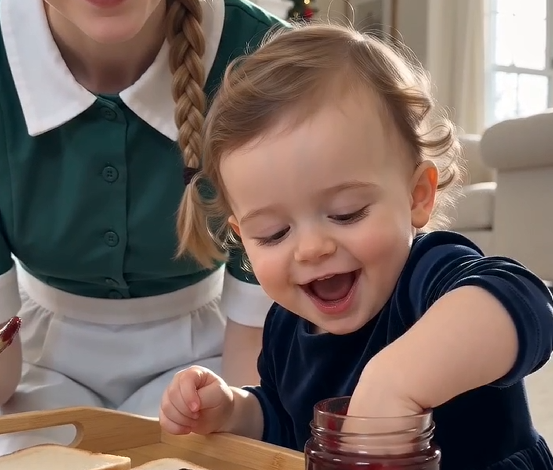
At four o’clock every afternoon, Emma spread the tea towel near the low window where winter light lasted longest. She brought bread, a tiny jar of strawberry jam, a spoon, and a damp cloth. Sometimes she added crackers. Once she used a cinnamon roll cut in half. Nothing dramatic. Nothing therapeutic-looking. Just the same small world, made predictable enough for Ella to step into.
The rule was simple. Emma started the rhythm. Ella joined when she wanted. If Ella only watched, that counted. If she touched and pulled back, that counted too.
The first day after the whisper, Ella pressed one finger into the jam and looked at Emma.
Tap. Smear.
The second day, she copied the rhythm on her own knee before touching the bread.
Tap. Smear.
The third day, she pushed the spoon toward Emma when it slipped too far away.
By the fifth day, when she wanted more bread, she did not point at the tray.
She touched Emma’s wrist.
That was how their bond formed. Not through speeches. Not through miraculous change. Through repeated safety no one tried to steal from her halfway through.
Emma also noticed something else. Ella never touched the jam randomly. She always spread from left to right, then made a little circle at the edge. Again and again. Left to right. Small circle. Left to right. Small circle.
When Emma asked the housekeeper, quietly, whether Ella’s mother used to cook with her, the older woman turned away before answering.
“Her mother used to make toast every morning,” she said. “Even after she got sick. She would spread jam and hand Ella the spoon to finish the corner.”
The small circle.
The child had not been fascinated by jam because it was messy.
She had been reaching for the last routine that still felt like her mother.
Emma did not tell Ella that. She did not try to turn memory into a lesson. She just protected the rhythm.
William began watching from the doorway more often.
At first he acted like an investor inspecting an unfamiliar asset. He checked for danger. He looked at surfaces. He asked if the spoon edges were rounded. He asked whether too much sugar would create a dependence. He asked if this kind of play encouraged regression.
Emma answered when the question mattered and ignored it when it didn’t.
Then one afternoon he arrived early from the city and saw Ella waiting by the window before four, jam jar already in her lap, feet tucked under her. Waiting.
Not for a doctor. Not for a screen. Not for a toy someone bought.
Waiting for the ritual.
He stood there longer than usual.
“You really think this is about memory?” he asked.
Emma was unscrewing the lid. “I think it’s about being able to expect something and not lose it.”
That landed harder than he let show.
Because William had loved his wife through machines, specialists, emergency calls, and calendars. After she died, he had rebuilt the house around prevention. Sharp objects removed. Doors monitored. Kitchen restricted. Garden restricted. New rules added each week. If the world could not be safe, the house would be controlled.
He never noticed that every new rule told Ella the same thing: the world is dangerous, and you cannot enter it.
By Christmas week the estate was full again. Garlands on the staircase. Silver polished for guests. Staff moving in soft shoes. A giant tree in the main dining hall waiting to be lit before dinner.
Ella should have been part of it. Instead, the old pattern returned whenever too many adults crowded near her. She went still. Then she pointed for what she needed, if she asked at all.
William was trying now, but trying in the stiff way of a man learning movement too late. Twice that week Emma had found him kneeling beside Ella with a spoon and bread, copying the rhythm with awkward concentration.
He did it too fast.
Then too carefully.
Then while looking directly at her face, waiting for reward.
Ella tolerated him but did not soften.
Emma finally said, “You’re treating the moment like a test.”
He looked offended. “I am participating.”
“You’re performing participation.”
That should have made him angry. Instead he sat back on his heels and looked, for once, embarrassed.
“What am I supposed to do, then?”
“Stay long enough to stop trying to win.”
He said nothing after that, but the next day he sat on the floor in his cashmere slacks and let Ella ignore him for fifteen full minutes.
That was the first real beginning.
Then came the Christmas tree lighting dinner.
It was the biggest social event the house had attempted since the funeral. A small one by rich people standards, maybe twelve people, but enough to turn the estate into a stage. Candlelight. Crystal. A string quartet in the next room. The giant tree at the end of the hall, dark for now, waiting for William and Ella to plug in the lights together before everyone sat down.
He wanted it to be healing. That was already dangerous.
Emma knew it the second she saw Ella in the red velvet dress with the scratchy collar, patent shoes, and a silver ribbon clipped too tightly in her hair. Too formal. Too many expectations. Too much watching.
Ella stood beside her father near the tree and stared at the crowd. Her hand was in his, but her fingers were stiff.
One guest bent down too close. “Look how beautiful you are tonight, sweetheart.”
Another said, “Maybe she’ll say Merry Christmas.”
William’s sister tried to guide Ella’s chin upward for a photo.
Emma, standing near the back wall, saw the shutdown begin before anyone else did. The eyes going flat. The chest locking. The mouth closing into that tiny hard line.
Then the housekeeper dimmed the room for the tree lighting, and a cork popped somewhere behind them in the drinks room.
The sharp sound cracked through the hall.
Ella jerked violently and yanked her hand free. She backed into the tree skirt, knocking a wrapped box sideways. Someone gasped. Another adult rushed in with soothing hands.
Wrong move.
Ella dropped to the floor and covered her ears.
The old order woke up instantly.
“Give her space.” “Turn the music off.” “Don’t let her crawl there.” “Pick her up.”
William bent down, panicked, trying to gather her. “Ella, come on, baby. Up. Up.”
She twisted away from him without sound, eyes wild, shrinking from every reaching hand.
Emma was already moving.
Not toward Ella first.
Toward the dessert sideboard.
A few people stared as she took a small dish of raspberry preserves from beside the bread basket, tore off a piece of dinner roll, and set both on the floor a few feet from the tree skirt.
In that glowing formal hall, under crystal light and in front of half the family’s holiday guests, it looked almost insane.
William snapped, “Emma, not now.”
But she had already sat down on the carpet.
She tore the roll open, dipped one finger into the preserves, and dragged a slow red line across the bread.
Tap. Smear.
No one spoke.
Ella was still curled on the floor, breathing in little trapped bursts.
Emma did it again.
Tap. Smear.
The room was so silent that the tiny sound of her fingertip against the bread carried farther than the quartet had.
William took one step toward her. “This is not the place.”
Emma looked up at him once. “Then stop making every place impossible for her.”
That shut him up.
She turned back to the bread. Another line. Another soft tap.
Tap. Smear.
From the floor, Ella moved one hand off her ear.
Then the other.
She did not stand. She did not run into anybody’s arms. She just stared at the bread like she was recognizing a path in the dark.
Emma waited.
Ella crawled the last two feet herself.
That was the first public crack in the old lie.
All those experts. All those rules. All that expensive control. And when the child was frightened in front of everyone, she did not reach for the adults who had organized her life.
She reached for the small messy ritual they had called unprofessional.
Emma slid the bread a little closer. Ella touched the jam with one finger, then froze again when somebody behind them shifted a chair.
Emma tapped the bread softly. Once. Twice.
Tap. Smear.
Ella looked up at her.
And in a whisper so thin the whole room leaned to hear it, she said, “Emma.”
The sound hit the room like a glass breaking.
William’s face changed first. Not from surprise this time. From recognition.
He had heard her say the name once before in private. Now she had said it in the middle of the house, in front of the order that had failed her.
Then came the second shock.
Ella turned, searched the room with frantic eyes, found her father, and held out her sticky hand.
Not pointing.
Reaching.
William didn’t move for half a second because he didn’t understand.
Emma did.
“Come down here,” she said quietly.
He looked at his guests, his dinner jacket, the polished carpet, the preserves on the floor.
Then he got down on his knees.
“Lower,” Emma said.
He hesitated, then sat fully on the carpet in front of his Christmas tree while twelve wealthy adults watched in stunned silence.
Ella grabbed his hand and pulled it toward the bread.
Emma dipped his finger into the jam.
“Slow,” she told him.
He copied her. A crooked line. Too shaky at first.
Tap. Smear.
Ella placed her finger beside his and made the little circle at the edge.
Left to right. Small circle.
For the first time since her mother died, she was not being managed. She was including him.
And because children are cruelly honest about where safety lives, the whole room saw it happen: William was not rescuing his daughter. He was being admitted into her world on terms another woman had taught him to understand.
No one cared about the tree lights anymore.
William looked at the small circle Ella had made and something in him gave way. He knew that shape. His wife used to do it absentmindedly on toast while talking about the weather, the mail, the impossible size of their garden in spring. He had seen it a thousand times and never thought it might one day become the last bridge back to their child.
His eyes filled before he could stop them.
He did not make a speech. He did not apologize in front of the guests. He just stayed on the floor and followed Emma’s rhythm.
Tap. Smear.
Ella leaned against his arm.
Then, while the giant tree behind them was still dark, William reached out with his free hand and plugged in the lights.
The entire hall burst warm gold around the three of them.
Ella flinched only a little.
Then she looked up at the tree, back at the bread, and gave the smallest breath of a laugh.
It was not loud. It was not movie-perfect. But it was unmistakable.
A real laugh.
The room exhaled all at once.
Later, after the guests had been quietly moved toward dinner and the house had settled, William found Emma in the kitchen. The forbidden kitchen. She was rinsing the little dish in warm water while Ella sat at the table in borrowed pajamas, drawing a red spiral in leftover jam with the end of a spoon.
No one was trying to stop her.
“I was wrong,” William said.
Emma kept rinsing. “About tonight or about everything before it?”
He accepted that. “Both.”
That was the first honest sentence he had offered her.
He looked around the kitchen as if seeing the room for the first time. Not as a service zone. As a living place. Warm lights. Bread crumbs. Steam. Human noise. A child at the table.
“This whole house has been built around what might go wrong,” he said. “I thought that was love.”
“It was fear,” Emma said. “Which makes sense. But she can feel the difference.”
He nodded slowly.
Then he asked the harder question. “Can you teach me how not to lose her every time I try?”
Emma dried her hands and finally looked at him. He did not look rich in that moment. He looked like a man who had just realized money had hidden his absence from him.
“Yes,” she said. “But you have to actually be there.”
He agreed before pride could interrupt.
The next changes were small enough to seem meaningless to outsiders, which is why they mattered.
The fourth household rule on the staff board was removed and rewritten. It had said: Ella is not permitted in kitchen or garden service areas.
Now it said: Ella may enter kitchen and garden with supervision and room to try.
Try.
That word changed the air.
William blocked two full days on his calendar each week. The first remained Emma’s structured afternoon rhythm. The second became his. No calls. No meetings. No disappearing behind office doors while staff covered the emotional cost.
At first his days with Ella were clumsy. He cut bread too thick. He forgot the damp towel. He moved too quickly when she paused. But he came back the next time, and the next.
Emma did not hover to make him look competent. She corrected him when needed.
“Wait.”
“Don’t ask twice.”
“She heard you.”
“Use less words.”
“Stay.”
He listened.
The garden opened next.
Not as a miracle scene. Just a winter coat, small boots, and a slow walk to the herb beds after rain. Ella stopped near the muddy edge and looked up for permission out of habit.
William almost said no.
Emma said nothing.
He took a breath and said, “You can try.”
Ella stepped into the mud with both feet.
It made a soft wet sound. She looked down, then up at him, waiting for the old alarm.
Instead he stepped in beside her and ruined a pair of expensive shoes.
That earned him another tiny laugh.
By late January, Ella still was not a chatty child. The story did not turn fake. She still pointed sometimes. She still shut down when too many adults crowded her. She still woke crying on certain nights and could not bear certain fabrics against her neck.
But now she had paths back.
The jam ritual stayed in her room too. A washable tray. Bread or crackers. Sometimes yogurt with food coloring instead of preserves. The point was never the ingredient. It was the rhythm, the predictability, the permission to enter the world with her hands.
And words began to return around the edges.
“More.”
“Mine.”
“Again.”
Then names.
“Emma.”
And, one afternoon by the kitchen window, while William struggled to copy the little circle properly, “Daddy.”
He put the spoon down and covered his mouth with his hand.
Emma pretended not to notice and asked Ella whether the circle needed to be bigger.
The trial week became a month. The month became a stable contract with a room over the garage suite if she wanted it and hours written around Ella’s actual needs instead of the family’s appearances. William also funded coursework Emma had put off for years, but he did it carefully, without making her into a charity project. She stayed an employee, but not a disposable one.
What changed most was less visible.
The staff no longer rushed to erase every trace of child life the second it appeared. A mixing bowl could stay on the counter. A muddy footprint could exist for ten minutes. A slice of bread with a red thumbprint on it was no longer treated like failure.
The house stopped trying so hard to look untouched.
One evening near the end of winter, Emma passed the family lounge and saw William on the floor alone with Ella beside the cold fireplace. He had a piece of toast, a little dish of jam, and the worst rhythm she had ever seen.
Tap. Too fast. Pause. Smear.
Ella frowned at him, took his hand, and slowed it down herself.
Emma kept walking.
That was enough.
No one in the estate said healing out loud. The word was too clean for what it really looked like. What they had was messier and more honest. A child not fully back, but no longer lost in the same way. A father not transformed into a perfect man, but finally willing to be an ordinary one in the right places. A nanny who entered the house as temporary staff and became part of the family’s new language without ever needing to claim more than that.
By the next Christmas, the giant tree was lit with Ella in the room, but the real change was smaller.
There was a jar of strawberry jam on the sideboard before dinner.
Not hidden. Not apologetic. Just there, like any other essential thing a family might need.