WHEN THE MILLIONAIRE FATHER SHOUTED TO STOP, HIS SILENT SON ONLY SPOKE AFTER THE YOUNG NANNY TURNED THE HOSE ON

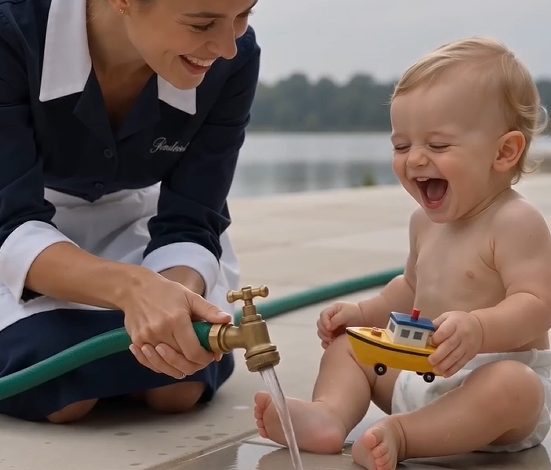
Michael spent that night replaying the same image.
Not the hose. Not the wet flagstones. Not the fact that a trial nanny had ignored the polished rhythm of his house.It was Caleb’s hand.
Small, stiff, uncertain, but choosing. Releasing that yellow boat and placing it into someone else’s palm.
No chart in the kitchen had ever gotten that from him. No timed session. No expensive specialist with a leather tote and soft, trained voice.
At 6:30 the next morning, Michael came downstairs and found Maya in the back kitchen, kneading bread dough in a ceramic bowl while Caleb stood on a chair beside her. The estate kitchen had marble counters, copper pots, and a butler’s pantry bigger than Maya’s whole apartment. Still, the scene looked almost absurdly ordinary.
Flour on the counter. A dish towel over Maya’s shoulder. Caleb pressing two fingers into the dough and pulling back to watch it rise.
She was humming under her breath. Not a song for children. Just a slow rhythm.
Push. Pause. Fold. Pause.
Caleb’s breathing had matched it.
Michael stayed at the doorway without speaking.
Maya glanced up once. “He likes the waiting part.”
Michael stepped in. “I told you not to do things like yesterday.”
“You told me to stop the hose,” Maya said. “So I stopped.”
He looked at Caleb. “And this?”
“This is bread.”
Michael almost snapped back, but Caleb touched the dough again, then looked toward the faucet. Not fully. Not directly. But enough.
Maya turned the water on to a thin stream and let it run over her fingers before she wet the dough. Same pattern. Sound. Touch. Pause.
Michael finally understood she had not been playing with water because she was careless.
She had found the one thing the whole house kept refusing to give his son: a pace he could enter on his own.
The timers had always cut in too fast. The commands came too clean. The praise came too loud. Every adult around Caleb had been asking for performance when what he needed was permission.
Still, Michael was not a man who changed in one morning.
He said, “The family is coming tomorrow for the lake weekend. I need things calm. No experiments.”
Maya wiped flour from her wrist. “It isn’t an experiment if he’s telling you yes.”
Michael looked at her as if she had crossed a line.
But he had no answer.
The lake weekend at the Ashford estate was the kind of old-money ritual no one was allowed to fail. Michael’s aunts would come in linen and pearls. His father’s old friends would stand on the lawn with drinks and discuss schools, trusts, and market corrections. Children from neighboring families would be brought in clean clothes and taught to say thank you before they could swim.
The house manager had already ordered flower arrangements. The long porch table had been set. Fresh towels had been stacked by the boathouse. And Caleb had been scheduled down to the half hour so he could be “presentable” for the family.
That word sat in the air like a threat.
By noon Saturday, the estate was full.
Voices. Laughter. Glasses clinking. Soft shoes on old wood floors. Caleb lasted eleven minutes in the family lounge before he buried his face in the curtain by the lake doors, the same way he always did when adults decided the room mattered more than he did.
One of Michael’s elderly relatives sighed, not quietly enough. “That child needs firmer handling.”
A private therapist hired for the weekend suggested a transition sequence from the printed plan.
Michael almost said yes by reflex.
Then he looked across the room and saw Maya crouching six feet away from Caleb, not touching him, not calling his name, just waiting at his level with the yellow boat in her hand.
He hesitated.
That was new for him.
Maya spoke without looking up. “Too many eyes on him.”
The therapist frowned. “Avoiding correction reinforces the retreat.”
Maya finally turned. “No. Pushing him deeper into it reinforces the retreat.”
The room went still.
Michael hated scenes. His whole life had been built around preventing scenes. But his son was trembling inside a curtain while educated adults debated him like he was a scheduling problem.
He told the therapist, “Give us the room.”
The therapist stiffened. One aunt looked offended. But Michael’s tone had closed the matter.
The family drifted toward the porch, whispering.
Caleb stayed hidden.
Maya did not rush in once the room emptied. That seemed to bother Michael most of all. Everyone else in the house always acted as if silence had to be defeated. Maya acted like silence was a door that might open if no one kicked it.
She set the yellow boat on the floor where Caleb could see it if he turned. Then she sat cross-legged and rolled a tiny piece of leftover bread dough between her palms.
Roll. Pause. Tap. Pause.
The same rhythm as the hose. The same rhythm as the kneading.
Caleb’s fingers twitched against the curtain.
Maya said quietly, “Lake wind today.”
Nothing.
She rolled the dough again.
“Boat’s waiting.”
A minute passed. Then two.
Michael checked his watch from habit, then slowly lowered his arm. Even that felt ugly now.
At last Caleb turned his face just enough to look.
Maya did not smile big. Did not praise. Did not move in.
She held up the dough ball, flattened it, and placed the little yellow boat on top like it was floating on a tiny pale lake. Then she nudged it along the floorboards with one finger and made the soft pattering sound Caleb had heard with the water.
Tap-tap. Pause. Tap-tap. Pause.
Caleb left the curtain.
Not all at once. One foot. Then the other. Shoulders still tight. Eyes flicking away every few seconds.
But he came.
Michael felt something sharp move through his chest. He had spent months trying to lure, guide, coach, and fix. Maya had done none of that. She had simply made room and held the rhythm steady until his son could bear to cross it.
Caleb crouched beside her.
Maya placed the boat in front of him and waited.
He touched it. Then he looked toward the back lawn, where the family could be heard gathering for the lakeside lunch. Wind moved the curtains. Someone laughed outside. Caleb stiffened again.
Maya spoke in the same low voice. “Too loud.”
For the first time, Caleb answered.
A rough little sound. Barely formed. But real.
“Loud.”
Michael stopped breathing.
Maya didn’t react with shock. She only nodded, as if she had been expecting him all along. “Yeah. Loud.”
Caleb pressed the boat to his chest.
That should have been enough for one day. For any sane person, it would have been a miracle and a stopping point. But old systems do not fall quietly. They fight to stay in charge.
Michael’s cousin Lauren swept in from the porch with two guests and one bright social smile that vanished the moment she saw Caleb on the floor with dough near his socks.
“What on earth is this?” she asked. “Everyone’s waiting. We finally have him calm and now he’s on the floor again?”
Maya said, “He’s not calm. He’s trying.”
Lauren looked at Michael. “He cannot go out there like this.”
Michael opened his mouth, but she was already in motion, bending toward Caleb with the clean, efficient confidence of someone used to being obeyed.
“Come on, sweetheart. Up we go.”
The moment her hand reached in too fast, Caleb recoiled so hard he nearly fell backward. His breath turned ragged. Face twisting. Boat clutched white-knuckled. The little opening in him slammed shut.
Lauren straightened in irritation. “See? This is exactly why structure matters.”
Maya was already on the floor again. “No one talk to him.”
Lauren laughed once, short and disbelieving. “You don’t tell this family what to do.”
But Michael did something no one expected.
He said, “She just did.”
Silence.
Lauren stared at him.
Michael did not look at her. He looked at his son.
Maya extended her hand toward the side door that opened to the lower lawn near the hose spigot. “We can go outside,” she said softly. “Same as before.”
Caleb’s breathing hitched.
She did not touch him. Did not repeat it. Did not bargain.
She waited.
Then Caleb moved. One tiny step, then another, clutching the boat. Heading for the side door.
Half the family on the porch turned as Michael followed them out.
The lower lawn sloped toward the lake, green and bright under the afternoon sun. Guests stood farther off near white chairs and striped umbrellas. Children’s voices carried from the dock. It was exactly the kind of public setting Michael would once have avoided at all costs. If Caleb broke down here, everyone would see.
That fear had ruled him for months.
Maya picked up the hose, tested the water on her own wrist, and lowered the pressure until it was just a soft silver arc. Not spraying Caleb. Not cornering him. Just laying sound across the grass.
Water. Pause. Water. Pause.
Caleb stood in his little canvas shoes, breathing hard.
Maya let the stream cross her own feet. Then the grass near his shoes.
“Too loud?” she asked.
Caleb swallowed. “No.”
Michael’s eyes closed for one second. Another word.
Maya tipped the water so it touched Caleb’s toes through the canvas. He flinched. Stayed.
Again. Pause.
Again. Pause.
The lawn behind them had gone quiet. Even the relatives who thought this was nonsense were watching now, because something in the scene refused to look like nonsense. The richest family on the lake stood arranged around silver drink trays and monogrammed napkins while a young nanny in wet sneakers gave their heir what none of their systems had managed to give him: a way back into his own body.
Maya held out her hand.
Not for his hand. For the boat.
Caleb looked at it. Looked at the water. Looked toward Michael.
Then he did what he had done on the patio, only this time in front of everyone.
He placed the yellow boat into Maya’s palm.
Gasps rippled behind them.
Maya crouched lower, setting the boat on the grass between herself and Michael. “Want Dad?”
Michael went still.
He had not heard anyone ask Caleb that in a way that gave him an actual choice.
Caleb stared at the boat. Then at the hose. Then at Michael’s shoes. He reached one hand out, not to Maya this time, but toward his father’s pant leg.
Michael dropped to his knees so fast the grass stained the fabric.
Caleb grabbed his finger and pulled.
Not away. In.
Maya shifted the hose into Michael’s shaking hand. “Low pressure,” she said. “Follow his pace. Don’t fill the silence.”
Michael nodded once.
He copied her exactly.
Water over his own wrist first. Pause. Water over the grass. Pause.
Caleb watched every move.
Michael had negotiated mergers, run boardrooms, buried his wife without crying in public, and reorganized his entire life into a fortress of competence. None of that helped him now. He looked terrified.
But he stayed.
Caleb stepped closer to the stream. Lifted one foot. Let the water touch it.
Then, in a voice scraped raw from disuse, he said the word that broke Michael open in front of his whole family.
“Again.”
Michael made a sound that was almost a laugh and almost a sob. He did it again.
This time Caleb smiled.
Small. Fast. But unmistakable.
Then he picked up the yellow boat and, after one long look at Maya, pressed it into Michael’s hand.
Another transfer. Another choice.
Maya’s eyes dropped for a second, as if she understood exactly what had happened and did not need anyone to say it.
The lawn stayed quiet.
Lauren turned away first.
Not because she was convinced, but because she had lost. The proof was too public now. The child the whole house had tried to manage had just shown them, in front of guests and relatives and the father who signed every check, that connection worked better than control.
That evening, after the family left and the lake went still, Michael found Maya in the mudroom hanging tiny damp clothes to dry.
He said, “I thought resources meant I was covering what he needed.”
Maya clipped a small sock to the line. “Resources covered everything except you.”
He took that without flinching.
After a long moment, he asked, “Why water?”
She leaned against the bench. “Because no one can force water to happen fast. It lands, then stops. Lands, then stops. He can feel the edge of it coming. He can decide. Same with dough. Same with waiting. His whole world changed in one violent second when his mother died. Since then, everybody’s been rushing him toward life like he’s late.”
Michael looked down.
“He isn’t late,” Maya said. “He’s scared.”
The next weeks changed the house in ways that would have seemed laughable before.
The printed schedules came down from the refrigerator. The timers disappeared from the counters. The third family rule, once phrased as “Immediate correction prevents escalation,” was replaced by a handwritten sentence Michael wrote himself and taped inside the pantry door:
Allow room for trying.
Every Tuesday morning from nine to ten, no meetings were booked. No calls were put through. Michael called it his first fixed hour, though everyone in the house knew it was really the hour he was learning how to be Caleb’s father instead of his administrator.
He started with the same rituals Maya used.
Water over his wrist. Pause. Boat on the floor. Pause. Bread dough in a bowl. Pause.
He failed often.
Sometimes he moved too quickly and Caleb retreated. Sometimes he praised too soon and Caleb covered his ears. Sometimes Michael lost patience with himself, which Caleb felt instantly.
Maya would correct him in one sentence from across the room.
“Too much voice.” “Wait longer.” “He hasn’t said yes yet.”
It irritated him at first. Then it humbled him. Then it changed him.
Caleb did not become an easy child. That was never the story. He still hid on hard days. Still went silent when rooms got crowded. Still pressed his face into curtains when he was overloaded.
But now there were returns.
He came back faster. He took the boat and handed it out. He let Michael knead dough beside him. He said “again,” then “cold,” then “Dad.”
The first time Caleb reached for Michael on his own, it was not dramatic. No audience. No lake. No crisis. Just a cloudy morning in the breakfast room, a curtain swaying near the window, and a little hand choosing his father’s sleeve instead of the fabric.
Michael sat down on the floor and cried where his son could see him.
Maya never tried to become part of the family. That was another reason Michael trusted her by the end. She did the work cleanly. She loved the child honestly. She did not attach herself to the house.
One month after the lake weekend, Michael found an envelope on his desk.
Inside was a short resignation letter.
Maya thanked the family for the position, said Caleb no longer needed her in the same way, and explained that she had been saving to open a small community childcare program for families who could not afford private support. She wanted a place where children who moved differently, spoke later, or needed rhythm more than rules would not be treated like broken furniture.
At the bottom she had written: Keep the water ritual. Keep the waiting. Do not turn it into a technique.
Michael read the note twice before going downstairs.
He found her in Caleb’s room. The yellow boat sat on the windowsill. A coiled child-safe hose attachment, now used for warm backyard water play, hung by the garden door. The room still looked expensive, but not sterile anymore. There were flour smudges on one chair leg. A towel basket by the door. Soft floor cushions near the window where Caleb used to vanish into the curtain.
Michael said, “I can fund the program.”
Maya nodded. “I know.”
He almost smiled. “You assumed I would offer?”
“I assumed you finally know what money is for.”
That landed.
He did fund it. Not as charity with his name stamped across the front. As startup money, legal help, and a quiet lease on a bright one-story building twenty minutes from downtown. Maya named it Harbor Steps.
On her last day, Caleb did not melt down the way the staff feared he would. Maya had prepared the goodbye the same way she prepared everything else.
No dramatic speech. No surprise departure. No crowd.
Just the backyard. The low hose stream on the grass. The yellow boat between them. Michael kneeling close by.
Maya let the water run over her wrist. Pause. Then she turned the hose over to Michael.
Caleb watched, breathing fast but steady.
Maya held out her hand.
For one second Michael thought Caleb would give her the boat, choose her, and break all over again when she left.
Instead, Caleb looked at her, then put the yellow boat into his father’s hand.
After that, he reached toward Maya and touched her wet sleeve with two fingers, light and deliberate.
“Bye, Maya,” he said.
Her face changed then. Not dramatically. Just enough to show that this one cost her something.
“Bye, Caleb.”
She stood, picked up her canvas bag, and walked across the back lawn without looking back until she reached the gate. When she turned, Michael was still kneeling in the grass, hose in one hand, boat in the other, his son leaning into his shoulder.
That was the point.
She had not come there to be needed forever. She had come to interrupt a dead system, return a child to connection, and leave before the house mistook dependence for healing.
Months later, family guests still talked about the strange moment at the lake house when the billionaire heir knelt on the lawn holding a garden hose like it was the most important thing he had ever been trusted with.
They told it as if it were shocking.
It was.
But not for the reason they thought.
The shocking part was not that a young nanny broke the rules. It was that the rules had been breaking the child all along.
And once Michael finally saw that, he never let the house go quiet in the old way again.