A HOUSE FULL OF PAPER PLANES BROUGHT BACK THE LITTLE BOY NO MONEY COULD REACH

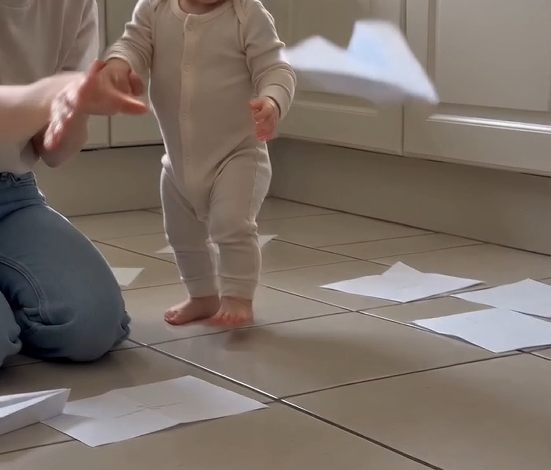
Celeste moved first because that was what she always did in that house.
She crossed the kitchen in silk heels, snatched two paper planes off the floor, and dropped them into the trash like they were contaminated. “This ends now,” she said. “Miles needs structure before tonight. Not chaos.”The word hit the room harder than her voice.
Chaos.
As if the little boy standing there with his tiny fist still twisted in Paige’s sleeve had been disturbed by the paper instead of reached by it.
Miles’s face changed at once. His shoulders went up. His mouth closed tight again. The soft opening in him vanished so quickly it was almost violent to watch.
Benjamin saw it.
That was the first thing that actually got through to him. Not the mess. Not Celeste’s anger. Not Paige kneeling in his back kitchen like she belonged in some other world. It was the speed. His son had opened for one second and then shut down again the moment the old order came back into the room.
Paige stayed very still. She did not try to touch Miles. She did not tell him to speak again. She picked up one sheet of butcher paper, folded it slowly, and set the finished plane on the floor between them.
Then she slid it an inch.
That was all.
Miles looked at the plane. Looked at Paige. Looked at the plane again.
Benjamin took one step forward, but Paige lifted her eyes to him for just a second and gave the slightest shake of her head. Not disrespectful. Just clear.
Too fast, and he would lose him.
That annoyed Celeste even more. “Benjamin, please tell me we’re not letting agency girls improvise with your son like this.”
Agency girls.
Paige’s face did not change, but Benjamin heard the class line in it. He had probably used the same kind of line himself, in cleaner language, a hundred times.
Miles crouched.
It was a tiny motion, but in that house it might as well have been an earthquake.
He picked up the plane.
Paige smiled like it was the most ordinary thing in the world. “Kitchen runway to garden gate?” she asked softly.
He didn’t answer. He just held the plane with both hands.
Paige walked backward two steps, then folded one for herself. She launched it low so it skimmed over the tile. It crossed the breakfast room and stopped by the mudroom bench. Miles followed. Not because he had been instructed to. Because the path made sense to him.
Warm kitchen. Hall corner. Mudroom. Door. Breeze.
It was a route.
A repeated route.
A child that small, after a traumatic loss, did not need another adult staring into his face asking for language on command. He needed the world to become predictable again. He needed the next moment to feel survivable before he could risk connection.
Paige had figured that out without using a single expert word.
Over the next four days, she kept the same rhythm.
She never made a grand project out of it. Every afternoon, at almost the same time, she met Miles in the back kitchen. They folded from grocery lists, shipping slips, linen order sheets, the blank backs of printed schedules. One plane for the pantry door. One for the laundry arch. One for the breakfast chair. One for the mudroom rug. One for the garden threshold.
Sometimes the last plane went outside. Sometimes it stayed at the door.
She did not force the ending.
She let him know the path would still be there tomorrow.
The house fought her quietly at first.
A maid cleared the planes too early one morning because Celeste had called them “visual clutter.” The child froze at breakfast and would not touch his toast. Paige remade the exact route from memory before lunch. He took three bites.
Celeste insisted Miles be changed out of soft play clothes and into tiny pressed outfits before guests came by. The tighter collars made him chew his lip until it reddened. Paige said nothing to Celeste. She just loosened him back into a cotton shirt the second the hallway emptied, then restarted the runway in the laundry room where no one impressive ever stood.
Benjamin began noticing patterns he had missed because he had been paying for solutions instead of watching his son live inside them.
He noticed Miles did not fear the garden itself. He feared uncertainty. Outside had become a staged place after his mother died. Beautiful, untouched, watched. It wasn’t a place to be a child anymore. It was a backdrop.
He noticed Paige never asked for eye contact. Never demanded a response in front of other adults. Never filled every silence. She gave his son sequence, sound, air, and room.
He noticed something else too: she was usually cleaning up while everybody else was explaining what was best.
On the third day, he found her in the laundry room sitting cross-legged on the floor beside Miles while the machine hummed. Paper planes were lined in a careful row on the tile like sleeping birds. Miles was pressing one wrinkled wing flat with his palm.
“Why here?” Benjamin asked quietly.
Paige looked up. “Because it sounds alive in here.”
He frowned.
She kept her voice simple. “The kitchen has heat. The laundry room hums. The mudroom smells like outside. Those are normal house sounds. He relaxes where things feel used.”
Benjamin stared at the row of planes. “We’ve given him every resource.”
Paige did not say the obvious cruel thing. She only said, “He isn’t asking for resources.”
That stayed in Benjamin’s chest all night.
By then, Celeste had stopped pretending she was merely concerned about standards.
She confronted Paige openly in the dressing room before the donation evening. Staff were steaming gowns. A makeup artist was packing brushes. Through the open door, the sea flashed silver under the late sun.
“I know exactly what you’re doing,” Celeste said. “You make yourself indispensable by encouraging dependency. It may work in ordinary homes. This family needs discipline.”
Paige was buttoning Miles’s backup cardigan. “He’s three.”
“He’s the son of a man who cannot have his child melting down in front of trustees and donors.”
Paige met her eyes then. “He’s also a child whose mother died.”
That landed badly.
Celeste stiffened. “Do not speak to me as if I am the problem.”
But in a way she was, though not because she was cruel in some dramatic storybook sense. She wanted control because control protected image, and in that house image had become more important than truth. She kept trying to introduce Miles to people before he was ready. Kept smoothing his hair when he recoiled from touch. Kept calling him shy, difficult, overtired, sensitive, everything except what he was: unsafe.
The evening of Benjamin’s alma mater donation gala finally arrived, and the house turned into a machine.
Florists came through the front hall.
Two drivers waited in the circular driveway.
A photographer was expected at the estate before the family left because the university wanted images of Benjamin and his family for a program spread. The formal garden had been lit. Every blade of ornamental grass looked expensive enough to be fake.
Miles was dressed in a miniature navy suit that made him look like a child version of the men who worked for his father. The second Paige saw him in it, she knew it was too much. His jaw was already locking.
Benjamin was in his study taking a call about pledge language when he heard raised voices downstairs.
By the time he got to the family lounge, Celeste was kneeling in front of Miles, trying to coax him toward the photographer near the terrace doors.
“Just say hello,” she was telling him in that strained sweet tone adults use when they are seconds away from losing patience. “Look up. Smile. Just once.”
Miles’s lip had disappeared between his teeth. His whole body was rigid. One more hand reaching for him and he would shut down completely.
The photographer glanced away awkwardly.
The house manager hovered.
Benjamin knew that scene. He had seen versions of it with doctors, tutors, guests, even himself. The room narrowing around the child. Adults mistaking pressure for help.
Then Paige came in carrying a stack of folded paper.
Not hidden. Not apologetic.
Celeste turned as if she had caught someone setting a fire. “Absolutely not. We are not doing that now.”
But Miles had already seen the paper.
His breathing changed.
Paige did not go to him directly. She crouched by the long console table and sent one plane gliding under it. Then another toward the piano leg. Then another through the open archway into the breakfast room.
The house manager looked horrified. The photographer actually froze with his camera half-raised.
Celeste stood up. “This is exactly what I meant by unpresentable. Benjamin, say something.”
He didn’t.
Because this was the exact scene he needed to see. Not a report. Not a theory. The thing itself.
Miles took one step.
Then another.
He followed the planes through the lounge, past the polished table no one let him touch, into the breakfast room where the late light warmed the floor. Paige launched a fourth toward the mudroom, and the child almost smiled. Almost.
Celeste moved in front of the archway. “No. He needs to stay clean.”
There it was. The real religion of the house.
Stay clean. Stay still. Stay photographable.
Miles stopped so suddenly his body swayed. His mouth sealed shut. His fingers curled.
Paige lowered herself to the floor.
Not elegant. Not strategic. Just down on the floor in the expensive house in front of all the right people.
She put a fresh sheet of paper on the rug and folded slowly, making every crease visible. Then she looked at Miles, not demanding, just waiting inside the rhythm they had built all week.
Warm room. Fold. Launch. Follow. Stop if needed. Try again.
It was the fourth time he had answered that rhythm in a real, undeniable way.
He walked around Celeste.
He went straight to Paige.
And in a voice so soft half the room missed it, he said, “Paige.”
The photographer’s hands dropped.
The house manager covered her mouth.
Benjamin felt something tear open inside him, because he had spent months trying to get his son to return to the world by asking him to perform in it. Paige had given him a smaller world first. A paper one. A route he could trust.
Then came the moment none of them expected.
Miles picked up Paige’s plane, turned, and looked at his father.
Benjamin did not move.
The child reached his free hand out and caught two fingers of Benjamin’s hand. Then he tugged once, impatiently, toward the paper.
It was an invitation.
Not just to watch. To join.
Benjamin, billionaire donor, perfectly cut tuxedo, stood in the middle of his polished lounge with a roomful of staff and a furious wife behind him, and let his three-year-old son pull him onto the rug.
Paige handed him a sheet.
“I don’t know how,” he admitted, almost absurdly.
Paige gave the tiniest shrug. “Then make a bad one.”
He did.
It was crooked and thick and flew badly, nosing into the leg of a chair. For one suspended second, Benjamin thought the room might collapse under the shame of how foolish he must look.
Instead, Miles laughed.
Not loud. Not long.
But real.
A sharp little burst of breath and sound that made everyone in the room go still.
Then the child ran after the failed plane.
That was the true break in the house. Not the first whisper. Not the first step onto the garden stone. This. The father entering the child’s rhythm instead of dragging the child into his own.
Celeste’s face hardened in a way Benjamin had never fully let himself read before. “You cannot be serious,” she said. “We are already late.”
Benjamin stood up slowly, holding a badly folded piece of paper. “We’re late because this family has been pretending presentation matters more than reality.”
The room went dead silent.
Celeste stared at him. “You’re making a scene over paper airplanes.”
“No,” he said. “We’ve been making a scene out of a grieving child.”
She looked around, aware too late that there were witnesses. “So now the staff gets to set the rules?”
Benjamin’s answer came without the usual executive smoothness. “No. My son does.”
That was not literally true, not in the spoiled way the sentence can sound. What he meant was simpler and rarer. The child’s actual condition would set the terms now. Not donor optics. Not decorative parenting. Not a house schedule designed for adults.
He told the photographer to put the camera away.
He told the drivers to wait.
He took off Miles’s stiff jacket himself.
Then he asked Paige, in front of everyone, “Show me the route.”
Celeste left the room.
Whether from humiliation or anger barely mattered. Her power had depended on the house believing neatness was care. That belief had just cracked in public.
Paige showed him.
Kitchen counter edge. Breakfast chair. Mudroom bench. Garden threshold.
By then, the formal event had become secondary, but Benjamin still had to appear. The university had built part of the evening around his pledge, and canceling would create a different kind of spectacle. So they adapted, for once around the child instead of against him.
Miles did not go to the gala ballroom.
He stayed home in soft clothes with Paige in the back wing of the estate, where they ran the paper route twice before bedtime. Benjamin attended the dinner late, made his donation, gave a shorter speech than planned, and to the shock of every trustee in the room, spoke less about buildings and legacy than about what people fail to see when they confuse provision with presence.
It was not a therapy speech. It was blunt.
He said institutions loved naming things after generous men, but the hardest thing he had done all year was sit on the floor and learn to fold paper from his son.
The clip made its way through social media before the night was over.
At home, Miles slept with one wrinkled paper plane under his hand.
After that, the changes were small enough to sound boring and big enough to save them.
The rigid child-management chart on the kitchen clipboard disappeared.
The first family rule Benjamin replaced was the dumbest one and somehow the most important: the garden was no longer only for photographs. If Miles wanted to step in dirt, he stepped in dirt. If he wanted to carry planes to the damp stone path and watch the wind wreck them, nobody rushed to stop him.
A low shelf was added in the breakfast room with paper, safe scissors, tape, crayons, and nothing precious nearby.
Paige was not sent away after the trial period. She was formally asked to stay, but not just as hired help filling a slot. Benjamin asked her to help build the week’s rhythm around what actually worked for Miles: repeated transitions, real home sounds, touch only when invited, less performance, more floor time, more ordinary life.
For the first time in years, a wealthy house stopped acting like life happened somewhere beneath it.
Benjamin also took something for himself that his staff had quietly been covering for: one fixed weekly time that nobody could schedule over. Sunday mornings. No calls. No events. No assistants at the door. The seventh standing block on the household calendar, protected like a board meeting.
He kept it.
At first he was awkward. He overfolded. Overexplained. Tried too hard. Miles would pinch his lip and drift away when Benjamin slipped back into performance mode. Paige would say one sentence from the doorway, nothing dramatic.
“Too many words.”
Or, “Same route.”
Or, “Wait.”
And Benjamin learned.
Some evenings the three of them sat in the kitchen with tomato soup cooling on the stove while planes crossed from counter to chair to mudroom. Sometimes bubbles joined the game in the garden when the weather held, little silver spheres chasing between paper glides in the sea wind. On one of those evenings, Miles ran after a stream of bubbles, then came back, seized his father’s hand, and dragged him toward Paige with a breathless urgency that looked almost like joy.
The child was still not magically healed. He still locked up around strangers sometimes. Big rooms still made him wary. Formal clothes still cost them. Grief did not vanish because a rich man finally knelt down.
But the family no longer answered his pain by tightening everything.
They answered it by making room.
Celeste lasted another two months in the house. There was no screaming final showdown. Just a steady loss of ground. The more Benjamin chose real connection over polished control, the less central she became. She had wanted to be the woman who restored order to a damaged house. Instead, she had become the symbol of everything that had kept it cold. When she left, the staff spoke about it less than expected. The home was already reorganizing around another center.
Not romance. Not scandal.
Warmth.
Paige’s position changed with it. Her pay was raised. Her authority in Miles’s daily rhythm was made formal. She was included in planning conversations instead of receiving orders after the fact. The house manager, who had once looked at the paper planes like a health violation, began leaving clean stacks of scrap paper in the back kitchen every morning without comment.
Months later, a magazine came to photograph Benjamin for a feature on philanthropy and family legacy. The stylist wanted the usual image on the terrace with the ocean behind him and the child in polished clothes.
Benjamin declined.
The published photo showed him on the breakfast room floor in a sweater, one sleeve rolled, folding paper badly while Miles watched with fierce concentration and Paige stood blurred in the background near the kitchen door. There were three planes on the rug and one dented one under the sideboard.
It was the first public image of that family that looked alive.
People online called it staged anyway. They always do.
But the staff knew better. So did the child.
Because every night before bed, Miles still chose one plane from the day’s scattered fleet and tucked it on the shelf by his room. A little record that the path remained. That tomorrow had shape. That someone would still be there at the kitchen counter, in the humming laundry room, by the mudroom bench, at the edge of the garden, waiting without forcing.
And sometimes, when Benjamin came home worn out and automatically reached for his phone before entering the house, he would stop at the back kitchen and hear the old soft sound that had changed everything.
Paper folding. A bad launch. A child’s breath catching. Then a voice, still quiet but no longer buried, saying a name out loud.
That was how the mansion changed.
Not through another expert. Not through another rule.
Through crooked paper airplanes thrown through the used-up corners of a luxury house until a broken little boy believed the world could be trusted again, and the adults finally admitted the thing that had failed him was never his silence.
It was theirs.