A LITTLE SHOE RACK CHANGED WHAT MILLIONS OF DOLLARS NEVER COULD FOR A HEARTBROKEN LITTLE BOY

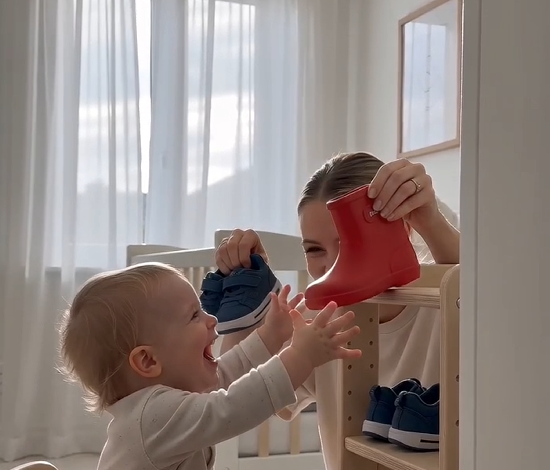
he supervisor believed she was protecting Caleb.
On paper, she had every reason.His therapy plan was organized down to fifteen-minute blocks. His posture, hand placement, and movement goals were carefully documented. Emma’s shoe game appeared nowhere in those reports.
To everyone trained to measure progress, it looked careless.
James said nothing.
He had spent nearly two years listening to confident adults promise improvement.
Yet the only thing he had seen with his own eyes was his son standing to chase a misplaced boot.
That picture refused to leave him.
He told the supervisor the trial would continue until the scheduled observation class the following week.
She reluctantly agreed.
Emma never celebrated.
The next morning, she simply rearranged the shoes again.
Sometimes one shoe hid under a bench.
Sometimes two matching shoes refused to stay together.
Sometimes James’s polished leather shoes sat beside Caleb’s tiny dinosaur sneakers.
Every arrangement became a story instead of an exercise.
Soon Caleb started waiting for mornings.
He pointed before Emma even opened the cabinet.
He smiled when he found the lonely red boot.
If Emma intentionally placed it somewhere impossible to reach, she never asked him to stand.
She only wondered out loud.
“I guess the boot is lonely today.”
Silence.
Then tiny fingers grabbed the couch.
One careful step.
Then another.
If he became frightened, Emma never corrected him.
She moved the boot closer.
The game always adjusted to Caleb.
The child never had to earn the game.
James watched from doorways almost every morning.
He noticed something every professional report had missed.
After his wife died, everyone around Caleb had become obsessed with making him perform.
Stand.
Sit.
Reach.
Grip.
Repeat.
Even kindness had become another instruction.
Emma almost never gave instructions.
She gave invitations.
The difference was so small most adults couldn’t see it.
But Caleb could.
The observation class arrived.
Families gathered inside the early learning center’s bright activity room.
There were tables covered with washable paint, puzzles, building blocks, and movement stations.
The supervisor intended to prove the standard program worked better.
Several observers watched quietly while James stood near the back wall.
Emma carried only one small cloth bag.
Inside it sat the familiar red rain boot.
The supervisor frowned immediately.
“We won’t be using personal props.”
Emma nodded and placed the bag beside the wall.
The session began according to schedule.
Children were encouraged toward different activities.
Caleb shut down almost instantly.
He gripped the wheelchair.
He stared at the floor.
The supervisor encouraged him to reach.
Nothing.
A therapist demonstrated.
Nothing.
Another adult praised him loudly.
Still nothing.
The room slowly became uncomfortable.
Someone whispered that perhaps he was simply too withdrawn.
The supervisor looked toward James as though expecting agreement.
Instead, James remained completely silent.
He remembered the promise he had made himself.
Observe first.
Judge later.
Emma asked one quiet question.
“May I have thirty seconds?”
Reluctantly, the supervisor nodded.
Emma walked to her cloth bag.
Without saying a word, she placed the red boot beneath a nearby art table.
Then she slipped one of Caleb’s little sneakers onto an empty shelf across the room.
Nothing matched.
Nothing looked correct.
Every adult appeared confused.
Emma simply sat on the floor.
She looked around dramatically.
“Oh no…”
She smiled softly.
“The shoes mixed themselves up again.”
Caleb looked up.
For the first time all morning.
She didn’t call his name again.
She crawled toward the hidden boot like it was playing hide-and-seek.
Then she stopped.
Waiting.
The room stayed completely quiet.
Paint dripped from a brush somewhere nearby.
A little girl laughed at another table.
Emma gently tapped the floor twice.
The same rhythm they had repeated every morning inside the estate.
Tap.
Tap.
Pause.
Caleb knew that rhythm.
Everyone else heard random tapping.
He heard safety.
His fingers left the wheelchair.
One hand reached the edge of a nearby shelf.
Slowly…
Carefully…
He pulled himself upright.
Gasps filled the room.
Nobody moved.
Emma stayed exactly where she was.
She refused to rush toward him.
He took one shaking step.
Then another while holding the furniture.
His eyes never left the red boot.
Paint trays sat between them.
Instead of avoiding the mess, Emma laughed.
“I think the boot likes colorful feet.”
Caleb stepped forward.
His sleeve brushed a tray.
Blue paint splashed across the floor.
Someone instinctively rushed to stop him.
James quietly lifted one hand.
“No.”
The room froze.
Caleb kept moving.
Another tiny step.
Then another.
His shoes slid through streaks of yellow and blue paint.
Emma reached the boot but didn’t hand it over.
She waited.
He stretched farther.
Finally his fingers wrapped around it.
The room erupted into applause.
Caleb startled.
His body stiffened.
Emma quickly whispered, “Too loud.”
The room fell silent again.
His breathing settled.
Then something happened no report could ever predict.
He turned away from Emma.
He looked directly at James.
Still gripping the boot with one hand and the furniture with the other, Caleb slowly reached toward his father.
James walked closer.
Not too fast.
Not too slowly.
Caleb grabbed his father’s finger.
Then tugged.
Not toward the wheelchair.
Toward Emma.
Toward the scattered paint.
Toward the silly shoe game.
James understood immediately.
His son wasn’t asking to be rescued.
He was asking his father to come inside his world.
James removed his expensive shoes.
He stepped into the wet paint wearing only socks.
The observers stared.
Emma smiled but said nothing.
James found another child’s extra rain boot lying nearby.
He placed it upside down.
“Oh no,” he said awkwardly.
“I think this one got lost too.”
Caleb laughed.
It was the first full laugh many people in that room had ever heard from him.
The sound echoed through the classroom.
Several parents quietly wiped tears away.
The supervisor looked down at her clipboard.
Every carefully designed measurement suddenly felt incomplete.
What failed that morning wasn’t Caleb.
It was the belief that healing could be scheduled into existence while connection waited outside the room.
Back at the estate, changes came slowly but permanently.
The nursery stopped looking like a clinic.
The charts disappeared from the walls.
Crayons no longer had assigned minutes.
James canceled one business meeting every week.
That became Caleb’s protected father-and-son morning.
Every Tuesday they rearranged the shoe cabinet together before breakfast.
Sometimes nothing else happened.
Sometimes Caleb walked a little farther.
Sometimes they simply laughed over shoes that clearly belonged in ridiculous places.
Mistakes stopped being corrected immediately.
They became part of the game.
James introduced a third new family rule.
Children were allowed to try, fail, and try again without adults rushing to fix everything.
The shoe cabinet stayed exactly where Emma had started the ritual.
Visitors often wondered why such an ordinary piece of furniture occupied a special place in such an extraordinary home.
James always answered the same way.
“That’s where my son decided life was worth moving toward again.”
The early learning center later revised part of its family observation program.
Playful routines created by caregivers were no longer dismissed simply because they looked unconventional.
The supervisor herself admitted that consistency built from trust could sometimes reach places formal plans could not.
Emma assumed her trial period would end.
Instead, James invited her into his study.
She expected another contract.
He handed her an envelope.
Inside was acceptance into an advanced child development program, fully funded.
Her tuition.
Her books.
Paid professional mentoring.
A salary while she