THE NANNY WHO BROKE THE RULES ON A WHITE SOFA MADE THE SILENT HEIR LAUGH—AND ON THE DAY HE WAS SUPPOSED TO FREEZE IN PUBLIC, HE CHOSE HER AND PULLED HIS FATHER BACK TO HIM

Andrew had built an empire by trusting systems.
Every division had numbers. Every risk had a protocol. Every problem had a specialist. His son had become one more impossible situation to manage that way, even if he would never have said it out loud.So when Leo looked past him and toward Maya’s little sofa rhythm, Andrew did not feel enlightened. He felt exposed.
“Not on the furniture,” he said again, quieter this time, like control could still be saved if his tone stayed even.
Maya met his eyes, but she didn’t challenge him in front of the staff. She just lowered her hand and let Leo choose.
That was the part Andrew couldn’t ignore later.
Leo didn’t choose the command. He didn’t choose the expensive sensory corner custom built in the playroom. He didn’t choose the stack of therapist notes on the side table.
He put both palms on the sofa and waited.
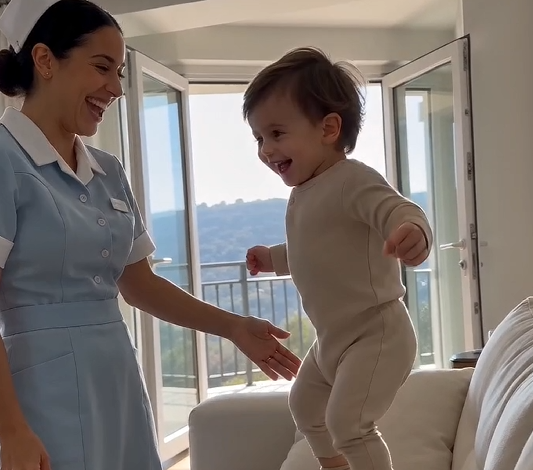
Maya tapped the cushion twice. Pause. Once.
Leo smiled again.
It wasn’t a huge movie moment. It was smaller than that, which made it harder to dismiss. His body stopped bracing. His breathing slowed. He climbed, bounced once with her support, and made a sound that was half laugh, half gasp.
Andrew ordered the trial stopped that afternoon.
Not fired. Stopped.
He told himself he was being responsible. The child could fall. The sofa sat too close to a glass table. It wasn’t clinically approved. It wasn’t in any of the recommendations. He was not about to let some young replacement nanny improvise with a developmentally delayed child in a house already hanging together by threads.
But that night, he stood outside Leo’s room and watched the monitor after everyone else had gone quiet.
Leo was awake in the dark, not crying, not sleeping, just rubbing two fingers together the way he did when he had gone somewhere far inside himself.
Then, softly, from the rocking chair, Maya tapped the wooden armrest.
Two taps. Pause. One.
Leo turned his head.
She did it again. Not enough to excite him. Just enough to be known.
His hand stopped rubbing. His shoulders unclenched. Five minutes later, he was asleep.
Andrew watched the screen another twenty minutes.
The next morning he told Maya she could continue “under stricter conditions.”
No jumping unattended. No staff audience. No improvising in unsafe spaces. No changes without reporting them.
Maya nodded to every rule. Then she did what made her dangerous in that house: she obeyed only the parts that protected Leo, not the parts that protected appearances.
She didn’t make the sofa jumping bigger. She made it steadier.
Every day at the same times, she built little pockets of rhythm Leo could trust.
Two taps on the breakfast chair before sitting.
One orange peeled in a single spiral while she hummed the same tune.
Three little hops from rug to rug before bath.
She turned transitions into predictable rituals instead of commands. Not because she had read a superior theory. Because she had watched him.
Leo didn’t fail every activity because he knew nothing. He failed because the world kept changing shape before he could brace for it.
After his mother died, everything had become sudden. Doors opening. Adults crying. Carried from room to room. New faces. Schedules. Assessments. His father appearing in bursts and disappearing behind calls. Even comfort came at him too fast.
Maya didn’t demand that he enter the adult world at adult speed.
She made the world repeat itself until he dared step into it.
By the end of the first week, he began waiting for her patterns.
By the second, he followed her from the kitchen to the sunroom if she sang the same three-note hum first.
By the third, he let her put tiny rain boots on him if she tapped each toe twice before lifting his foot.
That was when Andrew started watching without announcing himself.
He saw things no report had ever shown him.
Leo touched the counter when Maya kneaded bread dough and copied the press of her palm.
Leo stood beside her while she washed berries, splashing water with stiff little fingers, then looking at her to see if the splash was allowed.
Leo did not like group circles, but he loved sequence. Loved the relief of knowing what came next.
Maya brought life into the house in ways the old staff found almost offensive.
She let the kitchen make noise.
She let Leo carry socks that didn’t match.
She let him stand on a low stool and bang measuring cups in a repeatable beat.
The house manager complained once that lunch service was being disrupted by “too much household activity around the child.”
Maya said, “He’s not a museum piece.”
The woman nearly choked.
Andrew heard about that too.
He should have corrected Maya for the tone. Instead he asked the manager one question: “Was Leo distressed?”
“No, sir.”
“Then leave it.”
It was the first time anyone in the house understood that Maya’s position might not be temporary after all.
Still, Andrew resisted where it mattered most.
He would observe, ask precise questions, even admit that Leo was calmer. But he would not fully enter. He stood at the edge like a man checking the depth of cold water with one foot.
Maya noticed.
One afternoon she was on the family room rug with Leo, turning sofa cushions into stepping islands.
Not wild play. Structured play. Same route each time. Cushion, rug, cushion, pause at the coffee table, return. Leo’s favorite part was the pause, because Maya always lifted one finger and whispered, “Wait…”
Then she smiled and said, “Go.”
He loved the release of that tiny held breath.
Andrew came in halfway through and Leo froze.
Maya didn’t look annoyed. She just said, “Can you stand where he can see you and not move yet?”
Andrew actually looked offended. “In my own house?”
“In his game,” she said.
He stayed.
Leo stared at him, body rigid, one foot halfway lifted.
Maya tapped the cushion twice with her knuckles. Pause. Once.
Leo looked at her.
Then, to Andrew’s shock, Leo lifted his foot, stepped to the next cushion, and let out a little puff of sound.
“Good,” Maya whispered, not celebrating too hard.
She looked at Andrew. “Now when I count three, you tap the table once.”
Andrew hated instructions he hadn’t chosen.
But he did it.
“One… two… three.”
Tap.
Leo blinked.
Maya repeated the route. This time, when Leo reached the pause point, he turned his head toward his father before moving.
It was the second response Andrew had ever clearly gotten after months of being treated like a passing figure in his own child’s life.
Andrew had to put a hand on the back of a chair.
He had sat through billion-dollar negotiations without his pulse changing. One tiny head turn from a three-year-old almost broke him open.
That night he canceled a dinner.
Then another.
He still took calls. He still disappeared too often. But the wall had cracked.
The bigger test came with the foundation garden reception.
It was the first public appearance Andrew had agreed to make with Leo since his wife died. The event was at the estate itself, a polished afternoon gathering with donors, board members, local press, and too many people who spoke in soft voices about resilience while watching each other’s shoes.
Andrew had delayed it twice already.
His communications team wanted one clean family image: widowed titan, brave return, beloved son at his side.
Maya hated the plan the second she heard it.
“How long does he have to be out there?” she asked.
“Ten minutes,” Andrew said. “Fifteen at most.”
“In new clothes, around strangers, with cameras?”
“He needs to begin.”
“He needs to feel safe first.”
Andrew’s jaw tightened. “He can’t stay hidden forever.”
Maya looked at him for a long second. “Neither can you.”
He almost told her she was overstepping.
Instead he asked, “What do you want done?”
She answered immediately. “Same shoes he already likes. No dress loafers. No stiff jacket. We walk the garden route twice in the morning before guests arrive. And he gets one ritual before he steps out.”
“Not the sofa.”
“No,” she said. “But the same rhythm.”
Andrew agreed to most of it. Not all.
When the day came, the estate looked picture-perfect in the worst way. White tents. Trimmed hedges. Servers drifting with polished trays. A string quartet near the lower terrace. People saying how beautiful the mountains were because they didn’t know what else to say in a place where grief had been hidden behind good stonework.
Leo was dressed better than Maya wanted and worse than Andrew’s team had hoped. Soft navy sweater. Familiar sneakers. No jacket.
He managed the morning rehearsal route with Maya: from the side hall, through the French doors, past the lavender beds, pause at the stone bench, then onto the lawn. She used tiny cues the whole time.
Two squeezes at his wrist. Pause. One tap to start walking.
He made it through twice.
By afternoon, with real people there, the air changed.
Voices overlapped. Glasses clinked. Someone laughed too loudly. A camera flash went off near the hydrangeas.
Leo’s whole body tightened.
In the side hall, just before the doors opened, Andrew crouched in front of him and did what every expert had once advised: “Look at Daddy. It’s okay. Use your words. We’re just going outside for a few minutes.”
Too many words. New shape. Adult urgency.
Leo folded inward immediately, hands over ears, eyes gone.
Andrew’s face drained.
One of the communications staff whispered, “We can still delay.”
Another murmured, “Maybe carry him out for one quick photo?”
Maya turned so fast the woman stepped back.
“Don’t,” Maya said.
Andrew looked wrecked, angry, ashamed, all at once. “Then what?”
Maya glanced at the side parlor. There was a long low sofa beneath the window.
The same kind of boundary-crossing move that had horrified him weeks earlier flashed in her eyes.
“Three minutes,” she said.
“This is not the time—”
“It’s exactly the time. He’s lost the sequence.”
Without waiting for full permission, she took Leo into the side parlor, kicked off her flats, and tapped the sofa cushion.
Two taps. Pause. One.
Leo didn’t move.
She did it again.
No speeches. No coaxing. No “say hi.” No “be brave.”
Just the known pattern.
Two taps. Pause. One.
Leo’s fingers slowly came off his ears.
Andrew stood in the doorway, torn between fury and hope.
Maya bounced once on the sofa. Then once again after the same pause. She held out both hands, not grabbing, just offering the shape he knew.
Leo took one step.
Then another.
He climbed beside her.
The first bounce was tiny. The second was steadier. Maya whispered the count under her breath. “Up-up… pause… up.”
Leo’s breathing began to match it.
She slid down and put both feet on the floor. “Again,” she said softly, patting the cushion.
But this time she looked at Andrew.
He understood what she wanted and hated that she was asking in front of staff.
He also knew this was the line. The old order or his son.
Maya said, very quietly, “He needs you to be predictable, not impressive.”
The sentence hit harder than any accusation.
Andrew took off his suit jacket and dropped it on a chair.
The staff stared.
He walked to the sofa like a man walking onto a stage with no script. He sat beside Leo, awkward at first, all long limbs and expensive watch and no idea what to do with either.
Maya tapped the cushion on Andrew’s side.
Two taps. Pause. One.
“Do it,” she said.
He did.
Leo looked at his father.
Not through him. At him.
Maya nodded once.
Andrew bounced—small, careful, ridiculous.
Leo stared another second.
Then he laughed. Full this time. Clear enough that the sound carried into the hall.
Andrew’s mouth opened like he’d been hit.
Leo bounced again, then reached out and grabbed Andrew’s hand.
Not to stop him.
To pull him harder.
Maya stepped back.
Father and son bounced once together on the side parlor sofa while half the household watched from the doorway in stunned silence.
Then Leo slid down to the rug, still holding Andrew’s fingers, and tugged toward the garden doors.
He was choosing.
Not the event exactly. Not the donors. Not the cameras.
The sequence. The feeling. The two adults who finally made the world hold still enough for him to enter it.
Maya moved ahead, tapping the doorframe twice with her knuckles. Pause. Once.
Leo smiled and ran after the sound.
Across the terrace. Past the stone bench. Onto the lawn.
It wasn’t a perfect run. It was that stiff, urgent toddler run with a body still learning confidence. But it was movement toward, not retreat from.
Andrew followed because Leo was dragging him there, one small fist wrapped around two of his fingers.
The guests turned.
The quartet stumbled half a note.
Nobody got the polished photograph they had planned.
What they got was stranger and better: a little boy who had never managed public group space without shutting down, crossing the garden in bursts, stopping at each cue Maya had built into the route, then looking back to make sure his father was still there.
At the lavender bed, Leo paused.
That had always been the pause point.
Maya stood a few feet away and lifted one finger.
Wait.
Andrew, breathless now, saw Leo watching him.
Not Maya.
Him.
For the first time, the cue had to come from the father.
Andrew swallowed hard, then tapped the stone bench twice with his knuckles. Pause. Once.
Leo broke into a grin so sudden it changed his whole face.
Then he ran the last stretch and pulled Andrew with him onto the lawn while the donors, staff, and photographers looked on.
It lasted maybe four minutes.
Four messy, unscripted minutes.
Four minutes that undid a year of pretending the child just needed better management.
When they came back inside, Andrew’s communications director was pale with fury. “That was not the planned appearance.”
“No,” Andrew said, still bent slightly because Leo was leaning against his leg. “It was real.”
The woman started to argue, then stopped when she saw where Leo had put himself.
Not by his father’s security detail. Not with a staff member he barely tolerated. Not hidden behind furniture.
Pressed against Maya’s knee, one hand still reaching back for Andrew.
That was the concrete loss for the old order. No polished plan, no expert memo, no household rulebook could now claim authority over what had just happened in public.
That evening Andrew asked Maya to sit in the library after Leo fell asleep.
Not stand. Sit.
It was a small class line in that house, and they both knew it.
He looked exhausted in a way no boardroom had ever managed.
“I kept thinking safety meant control,” he said.
Maya didn’t rescue him from the sentence.
He went on. “After my wife died, every sound from his room felt like proof I had already failed at the one thing that mattered. So I hired more people. More experts. More structure. I told myself that was action.” He looked down at his hands. “But I kept letting him cry outside doors I wouldn’t open.”
Maya was quiet for a moment. “He learned that adults would organize around him without joining him.”
Andrew shut his eyes.
There it was. Simple. Brutal. True.
He asked the question that mattered. “Will you stay?”
Maya did not answer quickly. She was too smart for that.
She had come in as a replacement. Trial basis. Corrected by house managers. Watched by a father who could override her any second in the name of standards. If she stayed, it could not be as a disposable employee blamed the next time Leo struggled.
“Only if this changes for real,” she said.
Andrew looked up. “What does that mean?”
“It means I’m not here to keep him quiet while everyone important works. It means if we build a rhythm, nobody breaks it for convenience. It means I get a voice in decisions about his day. And it means you don’t vanish for six days and show up on the seventh expecting him to act like you never left.”
He almost smiled at the direct hit. Almost.
Instead he said, “Done.”
She held his gaze. “Not politely done. Actually done.”
So he did something his staff would have considered wildly out of character.
He opened his calendar.
“There are fourteen repeating private blocks in my week that I control directly,” he said. “Take one.”
Maya frowned. “What?”
“One fixed block. Every week. For me and Leo. Non-negotiable. You set the structure, but I show up.”
She thought about it. “Not one. He needs more than a symbolic slot.”
Andrew let out a breath that sounded like surrender and relief at once. “Then the seventh evening block. Every week. No calls. No meetings.”
“Good,” Maya said. “That one becomes his.”
He nodded. Then, after a pause: “And house rule thirteen—the one about no trial-and-error behavior on furniture, stairs, garden walls, anything remotely risky—I’m changing it.”
Maya raised an eyebrow.
Andrew said, “It now reads: supervised trying is allowed.”
That finally made her smile.
By the next month, the house had changed in ways visitors could feel without understanding why.
Leo’s room still had the soft neutral colors and expensive shelves, but now one corner held sofa cushions meant for stepping routes. The side parlor sofa was no longer treated like sacred display furniture. The kitchen no longer went silent when Leo entered. There were measuring cups in a drawer low enough for him to reach. There were ritual taps at doors. Hums before transitions. Familiar shoes by the mudroom bench.
Andrew still ran companies. He still traveled. He still failed sometimes.
But on the seventh evening block, he was home.
No jacket. No phone.
Sometimes Maya stayed nearby and coached lightly from the doorway. Sometimes she left them to it.
Two taps. Pause. One.
He learned the timing.
Leo began to answer him more.
A look first. Then a laugh. Then a hand pulling him toward the garden route.
At another small gathering months later, nobody had to force a public moment. Leo walked out holding Andrew’s hand and looked back for Maya as if checking that all three points of his world were still in place.
She was.
And she remained there officially, not as temporary help, not as the latest failed intervention, but as the family’s long-term care partner—with pay, authority, and a seat in the decisions that shaped Leo’s days.
Some people in Andrew’s circle quietly disliked that. A young nanny from a loud ordinary background now had real say inside one of the most controlled homes they knew.
It didn’t matter.
The child had chosen in public.
The father had changed in public.
And once a whole garden full of wealthy witnesses had seen the silent boy laugh, grab his father’s hand, and pull him into the rhythm that saved him, nobody could pretend the old way had been the higher one.
In the end, Maya stayed.
Not because the house needed staff.
Because Leo finally had a world he could predict, a father who had learned to enter it, and a place in that family no closed door could push back out.