HE BUILT A FORTUNE IN SILICON, BUT HIS SILENT SON SPOKE TO A NANNY INSIDE A CARDBOARD TRAIN

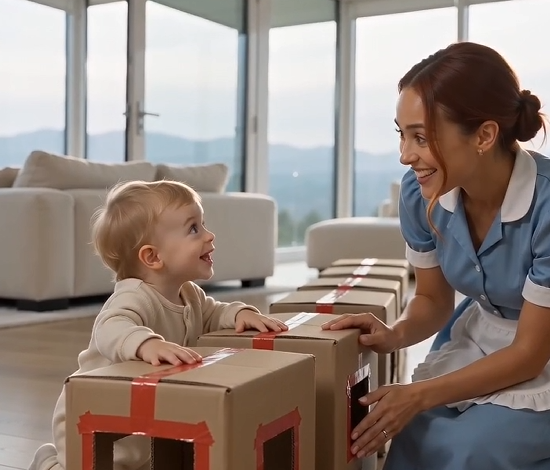
Nobody spoke for several seconds after Owen said it.
Again.It was breathy, uneven, almost swallowed by the room. But it was a word. A clear one.
Lena did the smartest thing Ethan had seen anyone do around his son.
She did not celebrate.
No gasping. No crying. No “Good job, Owen.” No stampede to make the moment bigger than the child could hold.
She just nodded once and pushed the next box toward him.
“Okay,” she said. “One more car.”
Owen took the marker from her hand.
Vanessa made a small sound of disbelief. “Ethan, say something.”
He still couldn’t.
He had spent eighteen months hearing specialists explain thresholds, trauma regression, social withdrawal, sensory protection, grief response. He knew the terms. He could repeat them like code.
But a young nanny had just gotten his son to choose, respond, and speak by making something imperfect enough to invite him in.
Vanessa folded her arms. “This is exactly the problem. There are no boundaries in this house.”
Lena kept her eyes on the cardboard. “If there had been more room for life in this house, he wouldn’t be clinging to dead routines this hard.”
Vanessa stared at her. “Excuse me?”
Ethan finally found his voice. “That’s enough.”
Vanessa looked relieved for half a second, assuming he meant Lena.
But Ethan wasn’t looking at the nanny.
He was watching Owen carefully press red tape around a cutout window, mouth slightly open in concentration. His son’s face, usually locked flat, looked almost fragile in its focus, like something thawing could still refreeze if the room got too loud.
“That’s enough pressure on him,” Ethan said quietly.
Vanessa went stiff.
Lena said nothing. She knew who that sentence was really for.
By evening, there were four cardboard train cars stretching across the sunroom. Ugly, crooked, heavily taped, and more valuable to Ethan than every imported piece of furniture in the house.
Owen sat inside the engine with both hands on a paper-plate steering wheel Lena had taped on. When the butler came in to ask whether dinner should be served on the terrace, Owen covered his ears.
Lena immediately lowered her voice. “Too much?”
He gave one small nod.
Another response. Another miracle so tiny the world might miss it if it weren’t starved enough.
She didn’t push further. She brought him dry crackers and apple slices on a plain white napkin and left them on the floor beside the train. Twenty minutes later, the crackers were gone.
That night Ethan stood outside Owen’s room and watched on the monitor as his son lined up small cardboard ticket stubs Lena had cut from an old cereal box. Usually his rituals looked like barriers. Tonight they looked like part of a bridge.
Vanessa found him there.
“She’s crossing lines,” she said. “You know that.”
“She got him to speak.”
“One word.”
“One word more than anyone else has gotten.”
Vanessa exhaled hard. “Ethan, she’s young, she’s informal, and she is already acting like this is her house.”
“No,” he said. “She’s acting like Owen is a child, not a project.”
That landed badly.
Vanessa had been around for ten months. She was polished, beautiful, deeply comfortable in expensive spaces, and very skilled at helping Ethan function in public after his wife died. She handled events, schedules, charity dinners, the right kind of sympathy, the right kind of silence.
She also hated unpredictability.
And Owen was nothing but unpredictability now.
At first she had tried. She bought him imported sensory toys, museum memberships, a tiny designer train set handcrafted in Germany. Owen never touched any of it.
The cardboard train had cost almost nothing.
That was what she couldn’t stand.
Over the next week, Lena did not try to “fix” Owen. She simply entered his patterns and widened them by inches.
Every morning she met him in the sunroom floor before anyone else interrupted. She added another piece to the train world: a ticket booth made from shoe boxes, station signs cut from old delivery cartons, a conductor’s cap folded out of brown packing paper.
She let him reject things.
She let him repeat things.
She let him stay quiet.
But she made the quiet active.
When he lined up cardboard tickets by color, she lined hers beside his, close enough to be noticed, not close enough to invade. When he knocked over the passenger car because the tape seam had bubbled wrong, she rebuilt it without calling it a setback. When he flinched at vacuum noise from the hall, she moved the whole game outside to the covered garden terrace where only wind and birds reached them.
That was when Ethan began to understand what every expensive report had missed.
Owen did not need more instruction.
He needed someone who wasn’t frightened by his way of being in the world.
Before his mother died, train rides had been their ritual. Not luxury travel. Not private anything. On Sundays she had taken him on a small scenic line that ran through the valley below the mountain. He liked the rhythm, the predictability, the windows, the repeating announcements. She liked sitting beside him and naming trees and tunnels in a soft voice.
After the crash, Ethan couldn’t bear that whole subject. He boxed up every toy train in the house after one terrible evening when Owen had screamed at the sight of one and banged his head against the floor.
The specialists had called it a trigger and recommended reducing reminders.
So Ethan had erased them.
Lena found that out by accident.
On the fifth day she asked the housekeeper whether there were any old train books or photos because Owen kept making the same two-seat arrangement in each cardboard car.
The housekeeper hesitated, then brought her a storage bin from a locked closet.
Inside were ticket stubs, a child-sized rail map, and a photo of Owen asleep against his mother’s arm on a valley train, his small hand wrapped around a paper ticket.
Lena didn’t show Owen the photo right away.
She showed Ethan.
He stared at it so long his hand trembled.
“I thought removing it all would protect him,” he said.
“You protected yourself too,” Lena replied, not harshly.
He looked up.
She kept her voice even. “He lost his mother. Then he lost every trace of the thing that connected him to her. He’s been trying to build a world he can control out of pieces ever since.”
Ethan sat down hard in the library chair behind him.
Nobody in his circles talked to him like that. Staff were respectful. Specialists were careful. Friends were vague. Vanessa avoided anything ugly and redirected him toward functioning.
But Lena had spent enough time with children like Owen to know a fact when she saw one.
“He doesn’t need to forget,” she said. “He needs somewhere safe to remember.”
Ethan closed his eyes.
For the first time since the funeral, he allowed himself to picture his wife’s laugh on that valley train platform, hair blowing across her face, Owen spinning in circles because the horn had sounded from far down the track.
The next morning he did something completely out of character.
He canceled two investor calls and came to the sunroom without his laptop.
Lena was adding a cardboard tunnel between the third and fourth cars. Owen was inside the engine, rubbing the wheel edge with his thumb.
Ethan stood there awkwardly, hands useless at his sides.
Lena didn’t rescue him with instructions right away. She let him feel it.
Then she held out a strip of blue tape. “This part needs rails.”
He almost laughed at himself. He had negotiated nine-figure deals with less hesitation than he felt over one strip of tape.
He crouched down.
Owen tensed instantly, shoulders rising.
Ethan froze.
Lena spoke lightly, not to the child, not to the father, just into the space between them. “Engine doesn’t move unless the track matches.”
Owen looked at the tape in Ethan’s hand.
Then at the cardboard floor path Lena had drawn in marker.
Very slowly, Ethan placed the tape down, following the line.
Too crooked.
He reached to peel it up.
A small hand caught his wrist.
Owen.
Not hard. Just enough to stop him.
Ethan looked at him.
Owen did not make eye contact, but he pressed Ethan’s hand downward once, as if to say leave it.
Lena smiled without showing too much of it. “Looks good to the conductor.”
That was the first time Ethan stayed.
Not watching from a distance. Not hovering in the doorway. Staying.
He spent forty minutes on the floor building a station platform with cereal boxes and old file folders. Owen did not speak again that day, but he handed Ethan two pieces of tape and a marker cap.
In Owen’s world, that was enormous.
The shift became visible to the whole house after that.
The silence changed texture.
There was sound now. Cardboard scraping. Scissors snipping. Lena making low train announcements in a ridiculous conductor voice. Once, from the kitchen, the cook heard something nobody in the estate had heard in over a year:
Owen laughing.
It was brief and startled, almost like he had fallen into it by accident when Lena’s cardboard tunnel collapsed over her own head.
The cook cried into a dish towel.
Vanessa heard about it from a staff member before she saw it herself, which made it worse.
By the weekend, she walked into the garden and found the train world had expanded outdoors. Lena had used flattened boxes to make stepping “tracks” through the grass. The mountain air was cool, and pine shadows cut across the lawn. Owen was moving from one cardboard marker to the next, not running exactly, but not frozen either.
Lena was ahead of him, calling softly, “Last stop! Last stop!”
Ethan was behind him, close enough to catch him if he panicked but not forcing pace.
It looked like a family.
Vanessa stopped dead.
“What is this?” she asked.
Nobody answered at first because Owen was moving. Every adult instinct in the scene bent around preserving that motion.
He stepped onto the next cardboard square. Then the next.
Then, seeing Lena round the rose hedge with a paper conductor hat on her head, he broke into the nearest thing to a run the house had seen from him in months.
It wasn’t graceful. His arms were stiff, his body pitched forward.
But he was chasing someone.
Choosing someone.
The image hit Vanessa like a slap.
“Ethan,” she said sharply, “this has gone too far.”
Owen flinched at her tone and stopped cold.
Lena immediately crouched by the next cardboard square, lowering herself out of threat. “No rush. Train waits.”
Vanessa threw up her hands. “This is absurd. You’re all acting like she performed a miracle because she brought trash into a million-dollar garden.”
Ethan turned then, slower than anger, colder than it.
“She brought him into the garden,” he said.
Vanessa laughed once, ugly and brittle. “So that’s it? The nanny who plays in boxes is the most important woman here now?”
It was the first honest thing she had said.
Lena stood up. “Vanessa, this isn’t about me.”
“It became about you the second he started looking for you first.”
That part was true too, and everyone knew it.
Because Owen did look for Lena first.
At breakfast, his eyes scanned the doorway until she entered.
When a thunderstorm rolled over the mountain one afternoon and the sudden crack made him drop to the floor with his hands over his ears, it was Lena he crawled toward under the console table.
When he woke from a bad sleep screaming without words, it was her rhythm on the bedframe, soft and steady like train tracks, that calmed his breathing enough for him to stop shaking.
Vanessa saw all of it as displacement.
Ethan finally saw it as trust.
The breaking point came three days later when Vanessa took matters into her own hands.
She had the staff remove the cardboard train while Owen was in speech therapy on video upstairs.
Not all of it. Just enough to “restore order,” as she put it. The garden tracks were trashed. Two cars were flattened and carried to recycling. The sunroom floor was cleared and polished to its old shine.
When Owen came down and saw the empty room, he did not scream.
That was worse.
He went completely still.
His face emptied out. He turned in one slow circle, searching for the engine, the ticket booth, the tunnel. Then he sat down on the floor and began hitting his fist softly against his thigh in a punishing rhythm.
Lena arrived from the kitchen carrying sliced pears and stopped so hard the plate tipped.
“Who did this?”
No one answered.
Ethan was on a call in the study.
Vanessa stepped in from the terrace, chin lifted. “The house was becoming a circus.”
Lena set the plate down. “You tore apart his safe place.”
“It was garbage.”
Owen made a thin sound then, a sound so low it barely counted as voice, and bent over himself.
Lena dropped to the floor in front of him, not touching him yet. “Owen. Listen.”
No response.
She looked up at Vanessa with a kind of fury that wealth could not intimidate. “You don’t get to decide what counts if you’ve never had to live inside his fear.”
Vanessa flushed. “Watch your tone.”
Ethan walked in on that line.
His gaze moved from Vanessa, to the stripped room, to his son folded on the floor.
Everything in him changed shape in that second.
“What happened?”
Vanessa answered first. “I was trying to help. This whole thing was getting excessive.”
Ethan looked at the bare stone floor as if seeing his own choices laid there too. All the cleaned-up grief. All the removed reminders. All the polished emptiness.
“Owen,” Lena said softly, still focused on the boy, “the station can be rebuilt.”
His hands kept moving.
Ethan knelt down beside them.
Vanessa stared, stunned, because this was not his usual role. He observed. He funded. He delegated.
Now he reached for a flattened shipping box still leaning against the wall, dragged it across the floor, and sat on it like it was the most natural thing in the world.
“Then we rebuild it,” he said.
Vanessa took a step forward. “Ethan—”
“No.”
Just one word.
Not loud. Final.
He looked at the house manager in the doorway. “Bring back every piece that hasn’t gone out. If it’s gone, get more boxes. Now.”
Staff moved instantly.
Vanessa stood there in the middle of the room she thought she controlled and realized she no longer had the authority to define what belonged in the house.
That afternoon became the real turning point.
Not the first word.
Not even the first laugh.
This was bigger, because it was public.
The father of the house sat on the floor in a cashmere sweater and expensive watch, cutting windows into refrigerator cartons with kitchen scissors. The nanny taped them together. The staff fetched markers, twine, cereal boxes, bottle caps for signal lights. The whole polished estate bent itself around one child’s need instead of demanding the child bend to the estate.
And Owen watched.
At first he stayed folded in himself.
Then his hitting slowed.
Then he leaned toward the box Ethan was cutting.
Lena slid a marker near his knee.
He picked it up.
Ethan kept working, careful not to look too hungry for every tiny movement.
“Need a sign,” Lena murmured. “Every station needs a sign.”
Owen touched the marker tip to cardboard.
His letters were shaky, oversized, uneven.
But he wrote: MOM’S LINE.
The room went silent in a totally different way than before.
Ethan’s head dropped.
Lena looked away to give him privacy he didn’t deserve but badly needed.
Owen pressed the marker harder and repeated the M.
Then he looked, not at Lena this time, but at his father.
His mouth worked once.
Twice.
And then he said, clearer than before, “Dad.”
Ethan made a sound that was almost pain.
He put the scissors down because his hands had started shaking too hard to use them.
“I’m here,” he said.
The child stared at him for one long second, then pointed at the half-built engine.
A request.
An invitation.
Ethan moved closer.
They finished the train together.
After that day, Vanessa’s position in the house became impossible to maintain. Not because Ethan cruelly threw her out in a dramatic scene, but because her role depended on being the person who best fit his future, and that future had changed.
He no longer wanted a woman who could decorate grief and manage appearances.
He needed honesty in the rooms where his son lived.
When Vanessa tried one last time—saying Lena had made the household emotionally dependent on an employee—Ethan answered with brutal simplicity.
“No. She taught us how absent we were.”
Vanessa left the estate two days later.
There was no screaming match. No broken glass. Just luggage rolling across stone, a driver shutting the car door, and the end of a version of Ethan’s life that had been built to avoid pain while looking composed.
Lena, meanwhile, did not suddenly become triumphant.
She kept working.
That was part of why Ethan trusted her more each day.
She expanded Owen’s world slowly. They took the cardboard train path from the sunroom into the garden, then from the garden to the lower orchard path. She introduced tiny changes and waited out resistance. A bell at the station. A second route. A “passenger” routine where Ethan had to ask for a ticket before entering.
The first time Owen corrected his father by pushing the ticket back and saying, “Wait,” Lena nearly cried. Instead she just nodded and said, “Rules matter.”
What she understood, and what Ethan finally learned from watching her, was that Owen’s rituals were not nonsense. They were scaffolding. Predictable structure made room for risk.
When the structure was respected, he could move.
When adults smashed it in the name of normalcy, he disappeared.
Weeks passed.
Then months.
A private speech therapist, this time one Lena helped choose, came in person and built around the train world instead of trying to replace it. Occupational sessions happened partly outdoors in the garden, where Owen could step from cardboard “platforms” to real stone paths. He began eating more foods if they came in compartment trays like train meals. He tolerated brief conversation if it followed a predictable sequence. Morning, ticket, seat, ride.
And every evening, unless rain made it impossible, Lena took him through the garden route at dusk.
That became the image the staff loved most.
The mountain estate behind them.
The cardboard conductor hat bent at the corners.
Owen moving faster now, not perfectly, not cured, not transformed into some easy movie child, but real and reaching. Sometimes running ahead through the flower-lined path, then turning back to make sure Lena and Ethan were following the line he had made.
One night near the end of summer, Ethan found Lena in the service kitchen after Owen had finally gone to sleep. She was patching a train car wall with fresh tape because the old one had softened from humidity.
“You should let the staff remake all of these in sturdier material,” he said.
She smiled without looking up. “He trusts these because they’re ordinary. If adults turn them into a production, he’ll feel it.”
Ethan leaned against the counter. “You always know exactly where the line is.”
“No,” she said. “She just used to know what it felt like when adults kept missing it.”
He looked at her then.
That was the first time she told him anything personal.
Her younger brother had been like Owen in some ways. Not the same, never exactly the same, but sensitive, pattern-bound, easily overwhelmed. Their mother had worked double shifts. Money was always tight. Nobody called it anything special. People just called him difficult until Lena learned, mostly by trial and error, how to reach him without trying to erase him.
“He needed someone to join his world before asking him to join ours,” she said.
“And you figured that out as a kid?”
“I had to.”
Ethan understood something else then. Lena’s power in the house had never come from charm, or rebellion for its own sake, or magical instinct. It came from lived knowledge. She knew the difference between helping and controlling because she had seen what happened when people confused the two.
He offered to raise her salary that night.
She laughed softly. “That’s the most billionaire response possible.”
“It’s not the only response.”
“No?”
He hesitated, which for Ethan Mercer meant he was being more sincere than polished.
“Stay,” he said. “Not just until the next hire. Not until things are easier. Stay because Owen needs continuity. And because I don’t want this house to go back to what it was.”
Lena finally looked at him.
This mattered to her in a way she had tried hard not to show. She had entered the estate desperate for work after a former care family moved out of state. She had expected to be tolerated at best, dismissed at worst. Instead she had become necessary in the one way that couldn’t be bought.
But she was careful. “If I stay, things change.”
“They already have.”
“I won’t be treated like disposable help when things get more comfortable.”
“You won’t.”
“I want input on his care team.”
“Yes.”
“I want him kept in real life, not hidden in systems.”
Ethan nodded. “Done.”
She studied him a moment longer, deciding whether the man who had once outsourced everything difficult could keep learning what presence actually cost.
Then she held out the tape roll.
“This is still peeling,” she said.
He took it.
Together they repaired the cardboard wall under warm kitchen lights.
By fall, Owen’s world had widened enough for the valley train trip to become possible.
Lena didn’t force it. She prepared for weeks. Cardboard schedule cards. Photos of the station. A mock ticket line in the sunroom. Practice with waiting, sitting, loud sounds, change in sequence.
The morning they finally went, Ethan nearly backed out three times.
The real station was small, wind-bright, and painfully full of memory. Lena stood beside Owen at the platform edge, one hand hovering but not grabbing. Ethan stood on the other side, pale with nerves.
When the train horn sounded through the valley, Owen flinched hard.
Then he looked at Lena.
She touched the folded paper ticket in his hand.
He looked at Ethan.
And Ethan, for once, did exactly the right thing without coaching.
He held out his hand and said only, “Ride?”
Owen considered it.
Then placed his hand in his father’s.
They boarded together.
An elderly woman across the aisle watched the boy in the window seat, the father beside him, and the young nanny in the facing seat with a cardboard conductor hat tucked halfway out of her tote. At one bend in the track, when the mountains opened and the garden-like valley spread below them, Owen leaned toward the glass and said, clear enough for all of them to hear:
“Mom liked this.”
Ethan covered his mouth with his fist.
Lena turned toward the window to hide her tears.
But Owen wasn’t done.
He touched the ticket, then pointed between them in his own careful way. “Dad. Lena. Ride.”
It wasn’t a perfect sentence.
It was better.
It was belonging.
When they returned to the estate that evening, the house no longer felt like a museum built around damage. Staff spoke at normal volume. The sunroom still held cardboard edges and marker lines. The garden still had traces of old track stations near the hedge.
And Lena stayed.
Not as a temporary patch.
Not as the girl who got lucky one afternoon with some boxes.
She stayed as the person who had entered a dead quiet house, sat on the floor, and made life visible enough for a child to come back toward it.
In time her role changed on paper too. Better pay. Formal authority in Owen’s care plan. Continuing education funded by Ethan so she could train further in special-needs support if she wanted. A real seat at decisions that once belonged only to wealthy adults with titles.
But the truest change wasn’t written anywhere.
It was in the evenings, when the mountain light went gold and Owen ran the garden path between cardboard station signs, then turned and called for the two people he trusted to follow.
And this time, they did.