THE THANKSGIVING BUBBLES THAT MADE A SILENT BOY STAND UP AND PULL HIS FATHER BACK INTO HIS LIFE

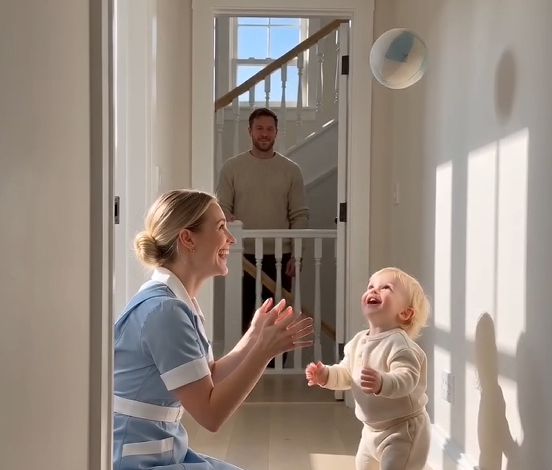
The corridor scene changed the mood in the house so fast it almost made people angry.
For the rest of that evening, James replayed it in his head. Caleb standing. Caleb stepping. Caleb turning toward him. It should have felt like relief. Instead it exposed something uglier. All the money, all the specialists, all the measured routines, and his son had responded to a six-dollar bottle of bubbles and a girl who hadn’t even finished her trial week.Vanessa recovered first.
By dinner, she was already reframing it.
“He got lucky,” she told James in the library while staff moved dishes in and out. “You know kids like Caleb can have random bursts. You can’t build a structure around circus tricks.”
James said nothing.
Vanessa leaned in harder. “Thanksgiving is in two days. This house is going to be full. We cannot have some improvised performance turning him into a spectacle.”
The problem was not hard to hear. She wasn’t only worried about Caleb. She was worried about disorder. About a young nanny becoming important in a house where importance was already allocated.
The next morning, the old system took over again.
The bubble bottle was gone from the mudroom basket. Breakfast returned to chairs, timers, tiny instructions, and careful voices. Bath time returned to bright lights, folded towels, and adults trying to position Caleb’s body correctly while speaking about him as if he were a difficult schedule.
By afternoon, the corridor might as well never have happened.
Caleb went still again.
He didn’t reach. He didn’t stand. He didn’t track anyone’s face for more than a second.
The house manager let out the kind of sigh that sounded almost relieved. “There it is. I told you not to get carried away. These children can appear to progress and then regress immediately.”
Vanessa looked at Ruby like the case had been closed. “Thank you for trying.”
Ruby did not argue with any of them.
That irritated Vanessa even more.
Ruby simply asked, “Where does he usually sit when nobody’s asking him to do anything?”
The house manager frowned. “By the west window. Why?”
Ruby nodded and walked away.
That was the beginning of what nobody in the estate understood at first. She was not trying to create bigger reactions. She was trying to create a rhythm Caleb could trust.
The next morning she sat on the floor by the west window before he was brought in. She didn’t crowd him. She lined up three things near her left knee: the bubble bottle, a folded washcloth, and a small snack cup with dry cereal in it. Not because they were magical, but because they belonged to the same sequence she was building for him.
Window. Sit. Bubbles. Pause. Washcloth in his hands. One spoon or one bite. Done.
No speeches. No pressure. Same order. Same place. Same pace.
When Caleb was placed near the window, he did not look at her at first. He folded inward, staring at the rug. Ruby sat with him in silence for nearly four minutes while other adults hovered and then drifted away, bored.
Only then did she blow one bubble.
It floated, burst against the sunlight, and disappeared.
She waited.
Then another.
Caleb’s eyes lifted.
She held out the washcloth and let it rest near his knee. He touched it. Rubbed the edge between two fingers.
Then she gave him one piece of cereal. Not to make him finish a bowl. Just one piece.
That was all.
The next day, same place. Same order.
By the fourth day, Caleb was not only watching the bubbles. He was expecting them. His body changed before they appeared. His shoulders loosened. His hands uncurled. He would glance toward the mudroom shelf where Ruby kept the bottle and then back to the patch of sun by the window.
Ruby had understood something the expensive adults had missed.
After his mother died, everything around Caleb had become managed but unpredictable in the worst way. New staff rotated in. New strategies appeared every week. Meals came with pressure. Baths came with handling. Every adult entered his space wanting proof that their method worked. Even kindness felt like demand.
Ruby gave him the opposite. Not intensity. Not surprise. A pattern he could enter without being cornered.
It spread into the rest of the day.
Bath time stopped being an event and became another rhythm. She sat on the tile floor first and let him watch the water fill. She squeezed soap bubbles onto the surface before anyone touched him. Washcloth in hand. Pause. One foot near the tub. Pause. More bubbles. No one rushing to “make progress.” Some nights he still disconnected. Some nights he let her wipe his hands. Once, after nearly a week, he let his shoe come off without pulling away.
For anyone else, these were tiny things. For Caleb, they were doors.
James started watching from thresholds.
Not participating. Not yet. Watching.
He saw things he had not noticed before because nobody had made him look. Caleb didn’t resist everything. He resisted being taken over. The boy reacted differently when he could see the next step coming. He handled touch better when it arrived inside something shared, not imposed. He ate more from Ruby’s hand during those small post-bubble pauses than he had eaten at the table in days.
James also saw himself in the ugliest role in the room: the father who knew every specialist invoice and almost none of his son’s cues.
One evening he found Ruby in the prep kitchen rinsing cups.
“Why does he do it with you?” he asked.
Ruby did not answer quickly. “He doesn’t do it for me.”
James looked at her.
“He does it when he feels safe enough to guess what’s coming next,” she said. “And when the next thing isn’t somebody testing him.”
That landed harder than anything a doctor had ever told him.
Thanksgiving morning arrived cold and bright. Cars wound up the mountain road before noon. The estate filled with family friends, polished coats, expensive boots, laughter that sounded too loud for the house. Staff moved in fast lines through the kitchen. Trays came out. Candles were lit. Vanessa floated through the main rooms correcting flower placement and asking twice whether Caleb would stay upstairs until dinner was seated.
“Less overwhelming for him,” she said.
What she meant was simpler: less embarrassing for them.
James almost agreed. That had been his move for months. Protect the event. Delegate the child.
Then he saw Caleb in the upstairs lounge, folded into himself again as strangers’ voices rose through the staircase. A noise from the foyer made the boy flinch so hard his cereal cup tipped over.
The old panic moved through James. Remove him. Hand him off. Keep things smooth.
Ruby was kneeling nearby, not reacting to the spill like it was a disaster. She set the cup upright, wiped one small circle on the floor, and looked at Caleb.
“Window?” she asked softly.
It was the first direct word James had heard her use with him all morning.
Caleb did not answer. But his eyes moved toward the long glass corridor.
Vanessa noticed it too. “No. Absolutely not. We have guests arriving through that side hall. This is not the time for hallway games.”
Ruby stayed still.
James looked from Vanessa to Caleb. The boy’s fingers had started their tight rubbing motion against his own sleeve, the one that usually came before he disappeared into himself for hours.
Then Ruby said something that changed the day.
“He already knows what comes next,” she told James. “You can interrupt it if you want. But he knows.”
Not “I know.” Not “trust me.” Just: he knows.
For once, the decision could not be outsourced.
James inhaled, hearing plates clink below, hearing voices call his name from the foyer. His whole life had been built on control, on timing, on polished execution. Thanksgiving in that house was supposed to look effortless.
Instead, he said, “Open the corridor.”
Vanessa stared at him. “James.”
“Open it.”
A staff member pulled back the pocket doors.
The corridor filled with pale afternoon light. Pines stood dark beyond the glass. From the lower level came the faint hum of guests settling into drinks and conversation.
Ruby walked to the far end of the hall and crouched.
One bubble.
It drifted toward Caleb and caught the light.
He watched.
A second bubble. Then three.
Ruby did not call him. She only moved backward, the same slow distance, the same held breath in the rhythm. Pop. Drift. Pop.
In the stairwell, two guests glanced up. A cousin paused with a wineglass in her hand. The house manager looked like she wanted to shut the whole scene down with her body.
Caleb gripped the side of the bench.
James felt every eye around him, and for the first time in months he didn’t care enough to obey it.
“Come on, buddy,” he nearly said.
Ruby lifted one hand without looking at him. Not a command. A warning to wait.
So he did.
Caleb pushed up.
His knees shook. He nearly dropped back down. Then another bubble floated past, close enough to touch but not close enough to force. He stood.
Nobody in the corridor made a sound.
Ruby took one slow step backward and blew again.
Caleb stepped after it.
There it was again. Not luck. Not accident. Not a random burst. A choice.
He walked farther this time, his gaze locked on the bubbles, one small unsteady step after another, his mouth slightly open with effort. Halfway down the corridor he hesitated. Guest voices rose from below. A platter clattered in the kitchen. His body tightened.
Vanessa whispered, “See? It’s too much.”
Ruby stopped moving. She didn’t rush to rescue him. She let the rhythm hold.
Then she looked at James.
That was the real trigger. The one none of them had understood yet.
“Last part is yours,” she said.
James actually looked behind himself, as if there might be another father in the room.
Ruby held the bubble bottle out.
For one second Vanessa gave a quiet incredulous laugh, as if this were the final humiliation. Billionaire host of Thanksgiving, standing in a glass hallway holding a toy bottle while guests waited downstairs.
James took it anyway.
His hand looked absurd around the cheap plastic ring. He wet the wand, lifted it, and blew too hard. The first bubble burst at once.
Caleb blinked.
Ruby moved beside James, low voice, practical. “Slow. Let him see it form.”
James tried again, softer.
This time one full bubble floated out, then another.
Caleb stared at them, then did something that made James’s throat close.
He held out his hand toward his father.
Not for the bubbles.
For him.
James crouched immediately. Caleb took two fast, desperate little steps and grabbed the front of his sweater. James caught him under the arms, expecting the usual stiff resistance.
Instead Caleb leaned in.
Not for long. Only a few seconds. But fully.
Then, still clutching James with one hand, Caleb pointed with the other toward the wand, asking without words for more.
A cousin at the stair landing covered her mouth. Somebody downstairs called, “James?” and got no answer.
He blew another bubble.
Caleb gave a sound then, tiny and rough from disuse, but unmistakably a laugh.
The corridor changed. The whole house changed with it.
Not because the child was cured. He wasn’t. By nightfall he was tired, shaky, and needed quiet again. But everyone who witnessed that scene had to accept the same truth at once: the failed thing was not Caleb. The failed thing was a household where every adult had been so busy managing him that nobody had joined him.
Dinner ran late.
For the first time, James let it.
He carried Caleb downstairs only when the boy was ready, sat with him in the family lounge off the dining room instead of hiding him upstairs, and stepped out twice during the meal for short bubble breaks in the side hall when noise got too big. By the second time, Caleb tugged him there himself.
Vanessa hated every minute of it.
Not dramatically. Quietly. Her face never fully cracked, but the center of power in the house had shifted, and she knew it. She had built her place there through polish, anticipation, and social fluency. Ruby had no claim to any of that. Yet in one holiday afternoon, the person Caleb trusted most in motion and the person he had just invited into that trust were standing on one side together.
That night, after guests left and the staff began clearing the last dishes, Vanessa confronted James in the study.
“This cannot become the standard,” she said. “You let the whole day revolve around his episodes.”
James looked tired in a different way now, stripped down. “No. I let the day revolve around my son.”
She crossed her arms. “And the nanny? Is she running the house now?”
James answered without raising his voice. “No. She showed me that nobody in this house knew the difference between supervising him and being with him.”
There wasn’t much left to say after that.
Vanessa stayed through the weekend, colder each day, then found reasons to return to the city more often. She was not thrown out in one dramatic scene. Real exits in wealthy houses were cleaner than that. Her opinions simply stopped shaping the center of the home.
Ruby stayed six more weeks.
She did not become family in the sentimental way people liked to post online. She became something more useful: the person who helped build a structure simple enough to survive after she left.
Every morning, Caleb had the same first rhythm by the west window. Every evening, bath time followed the same visible sequence. Meals stopped being performances with witnesses. Staff rotation around Caleb was reduced. The corridor was kept clear at two set hours each day. And on Thursday evenings, no matter what meeting tried to take the slot, James was home for the fourth parent-child session of the week.
At first he was clumsy.
He blew too hard. He talked too much. He tried to celebrate too soon.
Ruby corrected him in plain language.
“Wait.” “Don’t make him hurry.” “He already heard you the first time.” “Let him finish the step.”
James listened because now he had seen what happened when he didn’t.
Over time, Caleb began to use the routine not just to follow but to invite. He would glance at the bottle, then at James. He would press the washcloth into his father’s hand at bath time. He started taking bites during the pause after the third bubble, as if that little pattern had become a bridge his body could cross. Some days were still bad. Some days he vanished inward again, especially when schedules changed or too many people came through the house.
But now the adults around him did not read that as failure. They read it as information.
That was Ruby’s real gift. She had moved the family from control to attention.
Near Christmas, James found out why Ruby never talked about staying long-term.
She had been saving money for two years and sketching plans on the back pages of a notebook she kept in her bag. Not for a degree. Not for a wedding. For a small community childcare space in the town at the base of the mountain, a place for working parents who couldn’t afford private specialists or luxury routines but still had kids who needed patience, rhythm, and someone on the floor with them.
James found the notebook by accident when she left it on the kitchen counter beside a grocery receipt and a hardware store flyer. There were rough room layouts, cost estimates, nap schedules, notes about sensory corners, outdoor water tables, used shelves, washable rugs.
Nothing grand. Everything useful.
When he asked why she hadn’t mentioned it, Ruby shrugged. “Because this was never supposed to be forever.”
The words landed harder than he expected.
By then Caleb would stand at the corridor door at certain hours and wait for her. He ate more. He tolerated baths better. He still had long silent stretches, but they no longer looked like the house had lost him completely. And James, who had once believed payment was participation, had built his week around being physically present in ways nobody could invoice.
He wanted to ask her to stay. Maybe part of him wanted more than that. But the cleanest thing he had learned from her was not to grab at what comforted him just because he could afford to keep it.
So he asked a better question.
“What do you need to open it?”
Ruby laughed the first time, thinking he meant advice.
He didn’t.
By the time she left in January, the old carriage house near the town library had been leased in her name for three years. James funded the renovations through a foundation branch nobody in town would connect back to Thanksgiving gossip unless he chose to tell it. Ruby insisted on conditions before taking the help: local tuition had to stay low, she had hiring authority, and the place could not carry the Whitmore name like a charity trophy.
He agreed to all of it.
On her last morning at the estate, snow sat along the stone walls and the corridor glass had fogged at the corners from indoor heat. Caleb waited by the window with the bubble bottle in both hands.
Ruby knelt in front of him. “Your turn.”
He looked at the wand, then at her, then at James standing a few feet away.
Slowly, with the seriousness he brought to every hard thing, Caleb held the bottle out to his father.
James took it.
Ruby smiled once, small and tired and real. No speech. No dramatic tears.
Caleb shifted his weight, stood, and leaned one shoulder lightly against James’s leg while the first bubble floated into the winter-bright hall.
That was enough. More than enough.
Ruby left that afternoon with two duffel bags, a notebook full of plans, and the kind of future people like her usually had to build alone. She drove down the mountain in an old used car James had quietly bought from a staff member at a fair price and transferred into her name without ceremony.
At the estate, the rituals stayed.
The west window. The pause. The washcloth. The Thursday fourth session. The corridor kept clear for bubble walks when the world got too loud.
Visitors still came. The house was still expensive. The views were still beautiful. But it no longer felt like a museum arranged around a grieving child.
It felt lived in.
Months later, on the first Thanksgiving after Ruby left, James hosted again. Less staff. Fewer guests. No performance dinner. Halfway through the afternoon Caleb tugged at his sleeve, then pointed toward the glass corridor.
James smiled, took the bubble bottle from the console table where it now always lived, and went with him.
From the kitchen doorway, the house manager watched them go and said quietly to no one in particular, “Funny. We spent a year trying to make this house calmer.”
She looked down the hall as Caleb stood waiting for the first bubble.
“What it needed was life.”