WHEN THE BILLIONAIRE’S SON ONLY STARED AT THE CHANDELIER, THE YOUNG NANNY HIDING IN THE CURTAINS BROUGHT BACK HIS FIRST REAL LAUGH

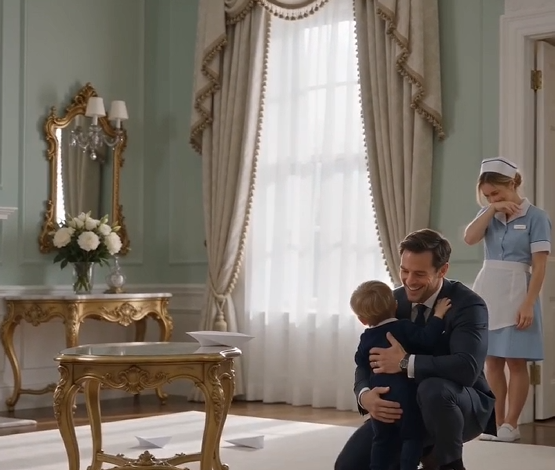
Vanessa recovered first.
She always did.By dinner, she was speaking in the smooth, careful tone people used in rich houses when they wanted something buried without looking cruel. Nora’s curtain game had been “stimulating in an uncontrolled way.” Leo needed “professional consistency.” The weekend guests would be arriving by Saturday afternoon, and the house needed calm, not improvisation.
Ethan did what he had done too many times since his wife died. He went quiet and let the more organized voice take over.
The old schedule returned the next morning.
Breakfast tray at eight. Sensory blocks at eight-thirty. Outdoor walk with the aide at nine if Leo tolerated shoes. Speech prompts at ten. Rest period at eleven. Every adult in the house knew the sequence. No one had to feel helpless if the sequence held.
Leo went right back to the chandelier.
He ignored the expensive breakfast arranged in neat little circles on a white plate. He sat in the same place on the lounge rug and stared upward while the house manager lowered her voice and said maybe yesterday had simply been “a fluke response.”
Nora heard that while folding towels in the laundry room because Vanessa had politely moved her out of Leo’s orbit.
She did not argue. That was part of why the staff started watching her differently. She was not trying to win a power struggle. She was listening.
By noon she had already figured out what the others still missed. Leo had not laughed because of novelty. He had laughed because Nora had made herself predictable in a human way.
Peek.
Gone.
Peek.
Gone.
Wait.
Plane.
Same rhythm. No demands. No questions. No hands reaching for him. No cheerful pressure to join. Just a little pattern he could trust.
His mother used to play that way with him.
Nora learned that by accident. Mrs. Delaney, the older cook, found her rinsing mugs and quietly said, “His mom used to hide behind the drapes in the breakfast room when he was little. He’d wait for her shoes to show under the hem.”
Nora turned and looked at her. “No one mentioned that.”
“No one mentions her much at all now,” the cook said.
That landed hard because it was true. The house had removed almost every rough edge of grief. Photos had been thinned out. Her robe no longer hung in the master bath. Her favorite music no longer played in the kitchen because it upset Leo. Even her name came up less and less, as if the adults had decided silence was the cleanest kind of survival.
But kids did not heal inside erased spaces. They got lost in them.
That evening Ethan found Nora in the side pantry labeling tea tins. It was work deliberately too small for the person who had reached his son.
He shut the door halfway behind him.
“Why did he respond to you?” he asked.
Nora did not rush to answer. “Because she used to do it.”
Ethan’s face tightened. “Who?”
“His mom.”
He looked like he had been struck, not by accusation but by recognition. “How would you know that?”
“The cook told me. But I guessed before that.” Nora set down the marker. “Leo doesn’t want more input. He wants something he can trust before he has to respond. The curtain, the pause, the same order every time. He’s not ignoring people because he doesn’t feel anything. He’s protecting himself because everything changed at once.”
Ethan leaned against the shelf, eyes lowered. “I bought him every support I could find.”
“I know,” Nora said.
It was not insulting. That made it worse.
“You made sure help was always available,” she continued. “But that isn’t the same as showing up in a way he can feel.”
For a long time Ethan said nothing.
Then he asked the wrong question. “So what’s the protocol?”
Nora almost smiled, but not quite. “There isn’t one.”
That should have irritated him. It didn’t. He looked exhausted enough to tell the truth for once.
“I don’t know how to do this,” he said. “Every time I sit with him, he looks through me. So I call someone better trained. Then someone else. Then another person tells me what routine we need. And at least then I’m doing something.”
Nora nodded. “That’s the problem. Everyone here is doing something to him. Very few people are doing something with him.”
Saturday arrived with staff cars lined along the service drive and flower arrangements at the front steps. The Hale estate was hosting one of those polished weekend gatherings that rich people called casual while every detail had been planned for days. Investors’ wives. A senator’s sister. School parents. Men who wanted Ethan’s attention. Women who wanted to be seen beside his future.
Vanessa moved through the house like she already belonged in it. She wore cream silk, gave orders without raising her voice, and made sure Leo would be presented neatly if he came downstairs at all. She had also made one thing clear: Nora would not be doing “that curtain business” in front of guests.
At three in the afternoon, Leo had his small navy blazer on and lasted six minutes in the family lounge before shutting down.
He stood beside the window, fingers pressed to the seam of the drape, eyes floating back up toward the chandelier in the next room. A guest knelt and asked him about school. No response. Another tried to hand him a miniature pastry. He turned his head away. Vanessa touched his shoulder and told him softly, “Use your words, sweetheart.”
His body tightened.
Nora saw it from across the room while carrying a tray of sparkling water. She saw something else too: Leo’s left hand pinching the curtain fabric once, twice, in a tiny repeated motion.
A cue.
Not random. Memory.
Vanessa noticed it a second later and gently pulled his hand down. “No wrinkling the drapes.”
Leo’s breathing changed.
Ethan saw that. He had been greeting guests near the fireplace, but now his attention narrowed to only one corner of the room. His son was standing in a room full of people and already leaving it.
Nora set down the tray.
Vanessa’s eyes flashed immediately. “No. We are not doing this now.”
But Leo had already moved. Two small steps. Then another. Until he was standing half inside the curtain, hidden from the room except for one shoe.
The room went awkwardly quiet in that subtle, expensive way where people pretend not to stare while absolutely staring.
Vanessa moved toward him. “Leo, come out. Right now.”
He did not.
His hand clutched the fabric tighter.
That was the moment the whole old order could have won again. A command, a removal, an apology to the guests, another explanation about sensitivity and process and how hard everyone was trying.
Instead Ethan heard a sound from the other side of the room.
Paper folding.
Nora had picked up a place card from the console table and was creasing it with calm, practiced fingers.
Vanessa turned sharply. “I said no.”
Nora did not look at her. She looked at Ethan.
Not asking permission for the game. Asking whether he was going to keep outsourcing this too.
For one long second, he stood between two kinds of control. The polished one everyone would understand. And the ridiculous one involving a young nanny, a curtain, and a paper airplane in the middle of his own party.
Then he said, very quietly, “Let her.”
Vanessa stared at him as if she had been publicly slapped.
Nora crouched low, not center stage, not theatrical. Just low enough to be less threatening. She disappeared behind the opposite curtain.
A few guests exchanged confused glances.
Then her head popped out.
Gone.
Out again.
Gone.
Leo’s fingers loosened on the drape.
He did not turn fully, but his body stopped bracing.
Nora repeated the rhythm. Exactly the same. No chatter. No coaxing. No “Good job, Leo.” Nothing that would force him to perform relief for the adults watching.
Peek.
Gone.
Peek.
Pause.
She sent the first paper airplane across the polished floor. It skimmed past a Persian rug and landed beside the toe of Leo’s shoe.
He looked down.
That alone changed the room. People who had spent an hour watching him vanish into himself just watched him follow a paper plane.
Nora disappeared again. The pause stretched just enough to feel familiar.
The second plane came sailing out a little wider and tapped the curtain near Leo’s hand.
His mouth twitched.
Ethan saw it. Not maybe. Not hopefully. He saw it.
Nora leaned out one more time with exaggerated suspicion, as if the curtain itself had become a tricky little creature. Then she ducked back and launched the third plane.
This one rose, dipped, and landed against Leo’s chest before sliding into his hands.
Leo looked at it.
And laughed.
Not a polite sound. Not a tiny breath this time.
A real laugh, bright and sudden and shocked out of him like it had been trapped too long.
Conversations stopped all over the room.
The senator’s sister put a hand to her mouth. Mrs. Delaney in the doorway began to cry silently. Even Vanessa froze, still smiling for the room but no longer in control of it.
Leo did something then that mattered even more than the laugh.
He looked past the curtain.
Past Nora.
Straight at Ethan.
And lifted the paper plane.
Once.
A clear little motion. Come here.
The whole room turned to the father.
This was the part no expert could do for him. No app, no consultant, no premium plan. Just a man his son still was not sure he could trust to stay in the moment.
Ethan moved slowly, as if sudden motion might break it. His face had gone unguarded in a way wealthy men almost never allowed in public. He loosened his tie with one hand and stopped a few feet from the curtain.
Leo held out the plane.
Ethan took it.
Nora remained hidden. She understood immediately. This was the final step. The child had not chosen a technique. He had chosen a person to join the pattern.
Ethan looked at the folded paper in his hand like it was more valuable than anything in the house. Then, awkwardly, he crouched.
He had no idea how to throw it.
Nora’s hand appeared from behind the curtain and made a tiny guiding motion, wrist loose, upward flick.
Ethan copied it.
The paper plane flew badly. It dipped after two feet and crashed into the hem of the curtain.
For one terrible second he looked like a man failing his son in public.
Then Leo laughed even harder.
A clean, helpless, child laugh.
And he stepped fully out from the curtain for the first time all day.
The room broke.
Not in chaos. In truth.
Because everyone saw it at once: the thing helping this boy was not status, not image, not perfect management. It was rhythm, presence, repetition, and a father willing to look foolish long enough to be let back in.
Vanessa recovered into anger.
“This is humiliating,” she said under her breath, then louder, because now she needed witnesses. “He’s being encouraged to regress. Hiding in drapes? Throwing paper? In front of everyone? This is exactly why boundaries matter.”
Leo flinched at her tone.
Ethan rose and turned to face her. For months he had avoided direct conflict by calling it stability. Now his son was standing in the open with a paper plane in his hand, still half laughing, and the old excuses sounded obscene.
“No,” Ethan said.
It was not loud. It did not need to be.
Vanessa stared at him. “Excuse me?”
“You’re not protecting him,” Ethan said. “You’re protecting what this house looks like.”
The silence after that was worse than shouting.
A guest looked down at her drink. Someone near the piano quietly walked away. Vanessa’s face hardened in stages, disbelief first, then injury, then cold anger.
“I have been trying to help this family.”
“I know,” Ethan said. “But helping isn’t the same as controlling every feeling that makes people uncomfortable.”
He looked toward Nora then, still half behind the curtain like she had no intention of claiming a scene that was never about her.
“Stay,” he said.
The word landed differently than a job order. Staff heard it. Guests heard it. Vanessa heard it most of all.
Leo moved before anyone else could speak. He walked straight to Nora, took the edge of the curtain, and pressed it into her hand like he was returning something important. Then he turned back to Ethan and waited.
It took Ethan a beat to understand.
Another plane.
Together.
So he sat on the floor of his own formal lounge in tailored clothes while guests stood around the edges of the room pretending not to witness the reordering of an entire household. Nora folded. Ethan copied. Leo watched. Plane after plane crossed the room in crooked little arcs.
That did not cure grief. It did not erase silence forever. That was not the kind of miracle this was.
But from that day on, the adults could no longer pretend Leo’s withdrawal was some sealed mystery only managed by professionals and schedules. They had seen what opened him: a repeatable human rhythm, low and simple, built from safety instead of correction.
Vanessa left the estate two weeks later.
Officially, the split was mutual. In practice, she understood before Ethan said it outright that there was no place for someone who saw connection as disorder. She had wanted to become the emotional gatekeeper of the house. Nora’s success had exposed that too clearly.
What changed after the party was not flashy, but it was real.
The chandelier no longer ruled Leo’s afternoons. Some days he still drifted toward it, especially when the house got too loud or transitions hit too fast. But now there was a way back. The curtain ritual stayed. Morning in the breakfast room. Evening in the family lounge. Peek. Gone. Peek. Gone. Plane.
Sometimes Leo laughed. Sometimes he only watched. Sometimes he reached for the paper before either adult could throw it. The point was not performance. The point was that he no longer had to disappear alone.
And Ethan changed in the most difficult way for a man like him: by becoming measurable in ordinary acts.
He blocked every Wednesday evening on his calendar, no exceptions, no assistant allowed to fill it. That became his second parent-child time each week, after Sunday mornings. No calls. No investor dinners. No “urgent” video check-ins from the study. If he had to sit in silence on the rug for twenty minutes before Leo engaged, he sat.
At first he was stiff. He watched for results. He ruined the rhythm by trying too hard. Nora would sometimes shake her head once and say, “Too fast,” or “Wait longer,” and he listened.
Weeks later, Leo began bringing him the paper himself.
That mattered more than any report.
The apology came in pieces because proud houses rarely know how to apologize cleanly.
First it was the staff shifting around Nora instead of through her. Then Mrs. Delaney started setting out tea for her during breaks at the same table where consultants had once spread charts. Then the house manager, who had originally called Nora unsuitable, asked her to explain Leo’s transition cues before rewriting the weekly family schedule around them.
The formal moment came at dinner one month after the party.
Ethan had invited only a few family members and two of the child specialists who still worked with Leo. No crowd. No spectacle. He asked Nora to sit at the table instead of eating later in the kitchen.
She almost refused out of habit.
Ethan did not let it pass as a small thing.
“In this house,” he said, with everyone listening, “the people who help my son heal will be treated with the same respect as any expert I hire. Including when that help doesn’t come in the form I expected.”
His older aunt, the kind who usually measured worth by polish, gave Nora a tight nod and then, to her credit, made herself say, “We misjudged you.”
The specialists did not look offended. They looked relieved. Good ones usually are when families stop pretending credentials can replace relationship.
Nora still wore cheap sneakers some days. She still folded paper with the speed of someone who had learned by making do. She still did not sound like the experts. No one asked her to.
By then Leo had started doing something else new. If Ethan got pulled too far into his phone while sitting with him, Leo would take the paper plane and tap it once against his father’s wrist.
Not angry. Just clear.
Come back.
And Ethan would.
That was the deepest shift of all. Leo no longer accepted being managed in place of being met.
Winter came, and the curtains in the breakfast room had to be replaced after Leo and Ethan yanked one hem loose during an overexcited game. For the first time, no one scolded the damage as if fabric mattered more than breath in the house. Ethan laughed when the designer complained and ordered stronger rods.
By spring, guests who visited the estate sometimes heard odd sounds from the sunny corner lounge: the soft swish of drapes, the whisper of folded paper, a boy’s laugh followed by a man’s worse one.
People talked, of course. Rich people always do when the script changes. Some said Ethan had become softer. Some said the young nanny had too much influence. Some said the child was finally improving.
Only one part was really true.
The house had stopped confusing polish for care.
Nora was never turned into a miracle worker or a mascot. She was given something rarer in places like that: formal respect without being forced to become someone shinier. Her pay was raised. Her title changed from trial nanny to primary developmental caregiver, though the label mattered less than the fact that everyone now understood she was not there to decorate a schedule. Ethan also paid for the early childhood education program she had once postponed because life got expensive before she got the chance.
When he offered it, he did not make it sound like charity.
“You changed this house,” he told her.
Nora answered the only honest way. “Leo did. He just needed people to follow him somewhere real.”
On the anniversary of Leo’s mother’s death, the estate did not go silent and overmanaged the way it had the year before. There were no forced coping activities. No carefully neutral distractions.
That evening Ethan took Leo to the breakfast room himself. Nora stayed nearby but out of sight.
The curtains moved.
Peek.
Gone.
Peek.
Gone.
Then a paper plane flew out, crooked and imperfect.
Leo caught it, smiled, and looked toward the doorway where Nora stood watching. He did not run to the chandelier. He did not fold into himself.
He held the plane in one hand and reached for his father with the other.
That was how the house finally began to feel whole again. Not cured. Not spotless. Whole.
And in a place where people once thought a young nanny playing behind expensive curtains was embarrassing, they learned to stand back when the game began.
Because that was the sound of a child finding his way back.