THE LEAVES BENEATH THE LONG DINING TABLE

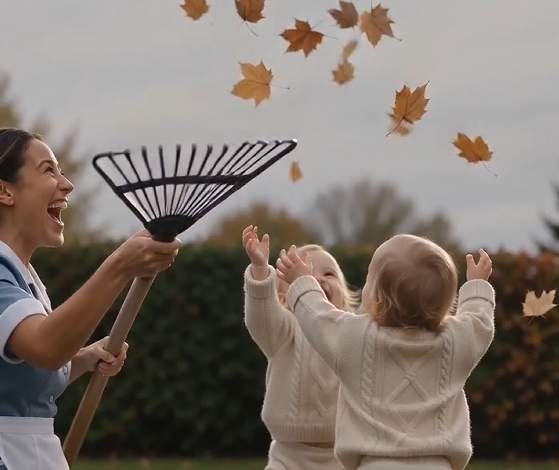
Mr. Ashford stopped at the garden steps because neither of his sons had voluntarily moved toward anyone since their mother died. The smaller boy had both fists buried in the front of the nanny’s sweater, and the older one stood close enough that his shoulder touched her knee whenever another leaf scraped across the terrace.
Aunt Evelyn’s first instinct was to restore the scene before it became memorable. She told the nanny to take the boys inside, change their clothes, and have the gardener clear every leaf from the stone before dinner.The nanny looked at the boys rather than at the aunt. “They haven’t done anything wrong.”
“They have been encouraged to leave the terrace in unsuitable conditions,” Evelyn said. “And now they are becoming attached to a person they met this morning.”
The older twin had heard the sharpness in her voice. He jerked backward so fast that his heel caught in the grass, and his brother tightened his grip on the nanny’s sweater until the fabric stretched under his fingers.
Mr. Ashford had watched that same sequence hundreds of times: a voice rose, a child recoiled, someone apologized, and then everyone spent the next hour protecting the boys from the distress the adults had caused. He had always treated the aftermath as proof that the rules were necessary.
This time, he saw the cause before the aftermath.
“Enough, Evelyn,” he said.
She turned toward him, surprised less by the words than by their volume. Mr. Ashford was usually careful in front of the children. Careful meant calm, controlled, distant, and unreachable.
The nanny eased one leaf from the older boy’s fist and laid it flat in her palm. She did not ask him to touch it. After a moment, he put his fingertip on its brittle edge, then looked at his father as if waiting to be told the experiment was over.
Mr. Ashford did not know what to do with that look. He had ordered nurseries redesigned, hired specialists recommended by friends, and attended every scheduled meeting about the twins, but he could not remember the last time he had sat on the ground near them with no instruction to give.
“Five more minutes,” he said, though he was not sure whether he meant it for the children or Evelyn.
The nanny nodded. She began making a low pile instead of tossing leaves, pulling them toward herself in slow strokes with the rake. The twins watched the rake teeth comb through the grass. Its plain rasp gave them something predictable to follow.
When the smaller twin startled at a cluster of leaves lifting in the breeze, the nanny tapped the rake handle twice against the ground. The older boy copied her by patting his own palm against his knee. A few minutes later, both boys were crouched at the edge of the pile, dropping leaves onto it one at a time.
Their father remained on the steps until the nanny glanced back at him. “You can sit there,” she said, pointing to a patch of dry stone several feet away. “Just don’t come closer because you think you’re supposed to.”
No one had spoken to him like that inside his own home for years. He nearly objected from habit, then saw his sons watching to see whether he would make her leave.
He sat.
That evening, the dining hall looked as it always had from the doorway: silver polished, chairs aligned, candles unlit in their holders. Under the long table, however, the twins had made a narrow passage from the fallen leaves the nanny had tucked into a canvas basket before bringing them inside.
Evelyn protested immediately. “Leaves in the dining hall will stain the floor.”
“They are dry,” the nanny said. “I will sweep them up afterward.”
“That is not the point.”
It was precisely the point, Mr. Ashford realized. The floor had become more important than whether his children could tolerate being in the room.
At dinner, the boys crawled beneath the table rather than taking their places in the high-backed chairs. Mr. Ashford usually instructed the staff to remove the food after ten minutes. That night he left the plates alone.
The nanny sat on the floor at one end of the tunnel and put a small piece of roast carrot on a napkin between her knees. She took a bite from another piece herself. She made no performance of it and offered none to the twins.
The older boy inched forward first. His brother followed with one hand still caught in the hem of the nanny’s sweater. When the older boy took the carrot from the napkin, Mr. Ashford heard Evelyn draw in a breath.
The boy ate it.
Not much, not quickly, but without being coaxed or distracted. His brother took the next piece and held it for a long time before nibbling one orange corner.
The nanny smiled at the floor. “Good choice,” she said softly, as though they had chosen a game rather than passed a test.
Evelyn left before the soup was served. Mr. Ashford did not stop her.
The next morning, he called the twins’ doctor, not because he believed the nanny had solved anything in a day, but because he needed someone other than himself to explain what he had seen. He described the garden, the leaves, the eating under the table, and the way the boys had moved toward the nanny after months of pulling away from touch.
The doctor did not call it a miracle or offer a quick answer. She said the twins had always been exceptionally sensitive children, and that years of treating every reaction as a problem to manage could make ordinary experiences feel dangerous. What Mr. Ashford described sounded like a child being allowed to choose the distance, the pace, and the next movement.
“They may be telling you what they need more clearly than anyone has been listening,” she said.
The sentence made him angry at first because it was too close to an accusation. Then he thought of every schedule he had approved, every caregiver told not to touch, every meal removed untouched because the clock said the attempt had ended.
He had mistaken control for protection because control was the only form of love his family had ever taught him to trust.
The nanny did not make a program for the boys. She carried the leaf basket into the dining hall after breakfast and asked whether they wanted to build a road beneath the table or a nest at its far end.
The older twin chose the road by pushing a leaf in a straight line across the marble. The smaller one chose the nest by dragging a linen throw from an unused chair and laying it over the leaves. The nanny followed both ideas, folding the throw into a low roof and leaving an opening large enough for them to crawl through.
By noon, the formal dining table had become a small world with leaf walls, a cloth ceiling, and a path from one end to the other. The boys did not speak much, but they made sounds to direct her: a tap for more leaves, two taps for a wider tunnel, a long hum when they wanted the roof lowered.
She learned their signals because she waited for them.
Mr. Ashford watched from the doorway twice that day. Each time he left before they saw him, ashamed that he could be in the same house as his sons and still feel like an intruder.
Aunt Evelyn did not hide her objections. She began speaking to staff about the nanny’s lack of polish and told Mr. Ashford the children were being allowed to “regress into disorder.” She complained that visitors could not be received with the dining room looking like a child’s hiding place.
“Visitors are not the issue,” he said.
“They are always the issue in this family,” Evelyn replied. “Your father understood that. Children settle when adults lead.”
The next afternoon, she entered the dining hall while the twins were crawling through their tunnel. The nanny was on her hands and knees at the opposite end, holding two leaves upright like a tiny gate. The boys had begun taking turns pushing the gate open and closing it again.
Evelyn reached down to pull the linen throw away.
The smaller twin froze so completely that his face seemed to empty. The older boy made a thin, frightened sound and pressed himself over his brother’s back.
The nanny did not grab Evelyn’s wrist. She said, “Please stop.”
Evelyn looked offended. “This cannot remain here.”
“It can for five more minutes,” the nanny answered. “They are playing together.”
Mr. Ashford arrived from the corridor at that moment. He had been walking toward the room because the monitor showed both boys moving fast beneath the table, their small shapes chasing each other through the cloth tunnel.
On the screen, he had seen something he had not seen in months: the older twin had reached back for his brother’s hand. It was a quick, clumsy reach, but it was not fear. It was an invitation.
He stepped between Evelyn and the table. “The tunnel stays.”
His sister stared at him. “You are letting a temporary employee overrule family.”
“No,” he said. “I am letting my sons show me what they can do.”
That decision changed the balance of the house. The staff no longer rushed to smooth every sign of the twins’ presence out of sight. The gardener left one manageable pile of leaves near the terrace each afternoon. The cook began sending small bowls of food to the dining hall instead of waiting for formal meals to succeed.
The nanny kept the changes small enough that the boys could predict them. One day they carried leaves from the basket into the tunnel. The next day they laid them in a circle and took turns standing inside it. On the third day, the older twin stepped out of the circle, then back in, while his brother watched with his hands held close to his chest.
Their father tried to join them on the fourth day and failed almost immediately.
He had brought a new basket of leaves from the garden and set it down too close. Both boys flinched. When he bent to move it away, the older one scuttled beneath the table, and the smaller one began to cry without sound, his mouth open and his body trembling.
Mr. Ashford stood up, humiliated by his own helplessness. “I shouldn’t have come in.”
The nanny shook her head. “You came in too fast. That’s different.”
He looked at her, waiting for instructions, then seemed embarrassed to be waiting.
“Sit where you sat outside,” she said. “Let them decide whether you belong in the game.”
He sat on the floor beside the far table leg, expensive trousers gathering dust from the leaves. The nanny moved to the other end of the tunnel and began sliding one leaf across the marble with a fingertip. It made a whispering sound as it traveled.
The older boy peered out from under the cloth. The leaf stopped near Mr. Ashford’s shoe.
His father did nothing.
After a long minute, the boy crawled forward, took another leaf from the basket, and pushed it toward him. Mr. Ashford wanted to say thank you, wanted to make the moment important, but the nanny had taught him that importance could be heavy.
He picked up the leaf and sent it back.
For ten minutes, father and son slid leaves across the small stretch of marble between them. The younger twin watched from the tunnel, then emerged enough to send one leaf toward his brother. The older boy sent it to their father.
Mr. Ashford missed it. His large hand closed too late, and the leaf fluttered beneath the table.
Both twins stared.
Then the older boy laughed.
It was not a loud laugh. It sounded rusty, as if he had found it in a room that had been locked for a long time. But it changed Mr. Ashford’s face so abruptly that the nanny looked away and gave him the privacy of it.
The younger twin crawled across the floor and placed his leaf directly in his father’s open palm. When Mr. Ashford kept his hand still, the boy rested his fingertips on the back of it.
Their father breathed in sharply but did not close his fingers around the small hand. He waited until the boy chose to lift it away.
From the doorway, Aunt Evelyn saw all of it.
She did not apologize. Instead, she said the boys were being made dependent on games and that their father was abandoning the discipline expected of him. Mr. Ashford heard the old fear in her voice: not fear for the children, but fear that the house, and therefore the family, would no longer look invulnerable.
He told her she could disagree without tearing down what the boys were building. He also told her the dining hall would remain theirs every afternoon, and the staff would follow the nanny’s lead during those hours.
Evelyn went quiet. Losing an argument was familiar to her; losing control of a room in the Ashford house was not.
The proof came a week later in the garden, where the nanny had made a low leaf path across the lawn. She did not ask the twins to walk it. She and their father walked it first, lifting their knees exaggeratedly and letting leaves stick to their shoes.
The boys stood at the terrace edge, holding each other’s sleeves. The smaller one looked at the grass, then at his father, then at the nanny.
Mr. Ashford nearly held out his arms. Instead, he sat down at the end of the path, just as he had sat by the table leg, and picked up a leaf.
“Your turn,” he said, softly enough that it did not sound like an order.
The older twin stepped onto the grass. His body tipped forward with uncertainty, but he kept going because his brother had loosened his grip instead of pulling him back. He took three quick steps, stopped, and looked over his shoulder.
The younger twin began to cry.
For one terrified instant, Mr. Ashford expected the old retreat: both boys back through the doors, everyone arranging the silence again. The nanny stayed where she was and did not tell the younger child to be brave.
The older twin turned around, walked back two steps, and held out a dry leaf.
His brother took it.
Together, their hands still apart except for the leaf between them, they crossed the grass. The older boy reached their father first. He did not fling himself into Mr. Ashford’s arms. He put the leaf on his father’s knee and leaned his shoulder briefly against him.
Mr. Ashford remained perfectly still until the boy stepped away. Then the younger twin reached the end of the path and chose the nanny, wrapping both arms around her waist with the same desperate certainty he had shown on the first day.
The older boy saw that embrace and did something no one had expected. He turned, ran three uneven steps through the leaves, and shouted a sound that was almost his brother’s name.
The garden monitor caught the motion from above: two small figures moving through copper leaves, the nanny turning with her arms open, and their father rising from the grass too late to hide the tears on his face.
Aunt Evelyn had been watching from the dining hall window. She lowered the blind halfway, not because the children looked improper, but because she could no longer pretend they were being harmed.
After that day, Mr. Ashford stopped asking the nanny for reports first. He asked the twins what they had made. When they answered with a hum, a tug toward the leaf basket, or a hand pointed under the dining table, he followed.
He changed his work calls when he could be home for the afternoon ritual. At first he arrived in pressed shirts and remained near the doorway. Then he began sitting on the floor without being asked, holding one end of the linen throw while the twins decided where the tunnel should go.
The nanny still guided the rhythm, but she no longer had to stand between the boys and their father. She would rake leaves into the basket while he waited for their signals. She would place the food on the floor while he learned to eat beside them without turning dinner into a lesson.
One rainy evening, wind kept them from the garden. The twins dragged the leaf basket beneath the dining table and built their tunnel with the old linen throw. Mr. Ashford came in late, saw the chairs pushed aside, and removed his shoes before either boy could flinch at the sound of him approaching.
He sat outside the tunnel with a bowl of carrots and three small napkins. The older twin crawled out, took a carrot, and placed one on his father’s napkin before returning to his brother.
Mr. Ashford ate it without speaking.
Then the younger twin pushed a leaf through the tunnel opening. Their father caught it on the first try and slid it gently back beneath the long table, where both boys waited for it to arrive.