THE BOY WHO LEARNED THE STAIRS COULD BE KIND

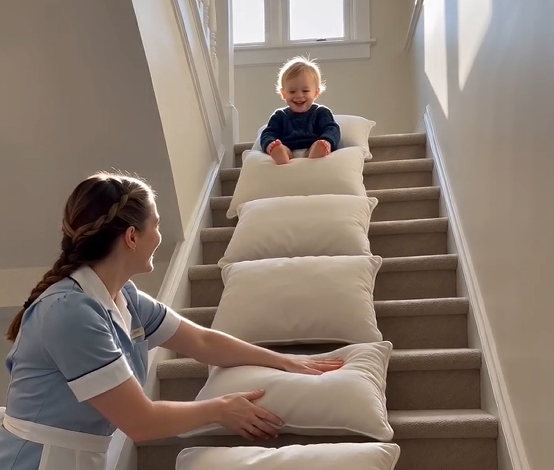
Celeste’s voice rose before Milo could decide whether to move again. She said the cushions could slip, that the stairs were not a playroom, that Daniel had hired someone to care for his son rather than turn the house into a mess.
Milo’s hand snapped back to the blue sweater. His face folded, and Daniel saw the familiar panic gathering before it became sound. Lena stayed seated on the lower step and did not reach for him.He can be carried upstairs,” Celeste said. “This is unnecessary.”
Daniel almost agreed. The words were familiar because they were the kind of words he had used to get through each day: unnecessary risk, unnecessary noise, unnecessary disruption. But Milo was not crying yet. He was watching Lena, his body angled toward the cushion between them.
Lena nodded toward the child. “He gets to choose.”
Celeste looked at Daniel for the answer. He had spent months giving answers that protected everyone from a scene, even when the scene was simply his son wanting something he did not know how to ask for.
“Five more minutes,” Daniel said.
Celeste’s mouth tightened. “Daniel.”
“Five.”
Lena slid down one more step, making a soft brushing sound against the cushion. She did not cheer or clap. She only looked back over her shoulder and said, “Your turn can be tiny.”
Milo lowered one socked foot. It landed on the cushion, then immediately lifted again. His breath hitched. Daniel moved forward, but Lena raised her palm without looking at him.
“Let him feel it,” she said quietly.
The second time, Milo kept his foot down. His other foot followed. He did not stand. He slid forward on his bottom, one careful stair at a time, his blue sweater dragging beside him.
Daniel sank onto the step behind him because his knees had stopped cooperating. Milo reached the bottom, stared at the polished floor, and put both hands on Lena’s knee.
Then he laughed once, surprised by the sound himself.
Celeste walked away before the laugh finished. Her heels struck the hallway hard enough for Daniel to hear them after the child began sliding again.
That evening, Daniel asked Lena what she thought she was doing. He asked it from the kitchen doorway while she rinsed apples at the sink and Milo sat on the floor nearby, close enough to touch her ankle but not climbing into her arms.
Lena did not answer with a speech. She cut an apple into uneven little pieces, tasted one, and offered another to Milo on her open palm. He took it.
Daniel stared. Milo usually refused food unless it came from a spoon and only when he was being held.
“My little cousins hated being told to calm down,” Lena said. “They got louder because everybody kept acting like their bodies were wrong. Sometimes you sit beside them and make room for the scary thing to be less scary.”
“You are not trained for this,” Daniel said.
“No,” Lena replied. “But I know he is watching every person here wait for him to fail.”
The sentence made Daniel angry because it was close enough to truth that he could not dismiss it. He had watched Milo’s feet as a problem to solve, his crying as a condition to manage, and every difficult hour as proof that he was failing his dead wife and their child at once.
The next morning, Celeste delivered a printed list to Lena. It covered clothes, snacks, room temperatures, acceptable play, and a line stating that Milo was never to be placed on stairs without Daniel’s written approval.
Lena read the list at the breakfast counter while Milo sat on Daniel’s lap, his cheek against Daniel’s shirt. Then Lena folded the paper once and placed it beside the fruit bowl.
“I’ll keep him safe,” she said. “I won’t make him smaller.”
Celeste told Daniel that afternoon that Lena was manipulative. She said the girl had noticed his guilt and was using it to win a place in the household. She reminded him that photographs for the foundation dinner were scheduled that weekend and that Milo needed to look settled, not wild-eyed and rumpled from sliding around the house.
Daniel wanted the argument to be simple. He wanted Celeste to be right because then he could return to the polished system that required nothing from him except signatures and money.
But when he entered the family lounge, he found Milo sitting on the rug with Lena. A row of wooden spoons lay between them. Lena tapped one spoon against an upside-down pot, slow and steady.
Tap. Tap. Tap.
Milo picked up a spoon. He watched her hand, then tapped the floor once.
Lena answered him with two taps.
Milo answered with one.
Daniel stayed behind the half-open door. He did not want to interrupt. His son’s eyes were bright with concentration, and his shoulders were no longer pulled up around his ears. The game was not a trick. It was a conversation that did not require Milo to climb into anyone’s arms or force words past a frightened throat.
That night Daniel opened old videos on his phone. In one, his wife stood on the balcony with infant Milo against her hip, singing while she shook out sheets. In another, she sat on the bottom stair and let him bang a spoon against a pan while she laughed.
Daniel watched both videos until the screen dimmed.
The next day he called Dr. Patel, Milo’s pediatrician, not to demand another plan but to ask her to come to the house and watch. He did not tell Lena in advance. Part of him was ashamed that he needed another adult to make the truth official before he trusted what he had seen with his own eyes.
Dr. Patel arrived during the late afternoon, when Lena had put two cushions on the lowest stairs. Milo was sitting beside her, blue sweater in his lap. Daniel and Celeste stood back near the foyer, both trying to look casual and failing in opposite ways.
Lena slid down one step and waited. Milo placed the sweater on the stair beside him. That was new enough that Daniel felt his throat tighten.
Milo lowered himself to the cushion, scooted down, and looked toward Lena. She moved to the floor and held out one finger instead of both hands.
He gripped it. Then, with the stair behind him and the cushion under his feet, Milo pushed himself upright.
It was only a second. His legs trembled. His free hand flew toward Daniel, and Daniel nearly ran to catch him.
But Milo did not fall. He sat down again on purpose, breathing hard, and looked pleased.
Dr. Patel crouched beside Daniel afterward. She did not call it a cure or offer a grand explanation. She said Milo had been showing them that he needed predictability, permission, and adults who could tolerate his fear without making every moment into an emergency.
“He is not difficult,” she said. “He is sensitive, and he has learned that the floor brings everyone’s alarm with it.”
Daniel heard the word learned like a door closing on his excuses. The house had taught his son to fear the very thing it claimed to protect him from.
Celeste said Dr. Patel was indulging a temporary improvement. She said one stand on a cushion did not justify changing the rules of a home. Dr. Patel only looked toward Milo, who was tapping his spoon against Lena’s palm and waiting for her answer.
“Watch what he does when no one makes a performance of him,” she said.
The foundation dinner became Celeste’s last attempt to restore the old picture. She dressed Milo in a stiff little jacket and asked Lena to keep him upstairs until the guests had settled. Daniel knew the plan. Milo would be brought down for ten minutes, placed on his father’s lap, photographed near the fireplace, and carried away before anyone saw him cry.
Lena did not argue in front of Milo. She took him to the balcony with a basket of warm towels and clothespins, because the laundry had come back from the cleaners and the air was mild.
Milo helped her pull one towel from the basket. He could not carry it far, but he held one end while Lena held the other. Together they walked it to the railing, taking three slow steps across the balcony tiles.
Daniel found them there when he came upstairs to look for his son. The party murmured below. On the balcony, a sheet snapped gently in the wind, and Milo was standing with both feet flat, one hand around a clothespin and the other wrapped around Lena’s thumb.
“Daddy,” he said.
It was not the first word Milo had ever spoken. It was the first time he had said it while standing on his own.
Daniel crossed the balcony too quickly. Milo startled, knees bending, and Lena looked directly at Daniel.
“Slow,” she said.
Daniel stopped. He had spent a year rushing toward every cry, then rushing away from the parts of himself that cried with it. He took one breath, then another, and crouched several feet away.
“I’m here,” he said.
Milo looked from Lena to Daniel. He let go of Lena’s thumb. He took one uneven step toward his father.
Daniel did not grab him. He held out his hands and waited until Milo made the second step. When Milo finally tipped into his arms, Daniel pressed his face into his son’s hair and cried without trying to hide it.
Celeste appeared in the balcony doorway in her evening dress. Behind her, two guests had drifted up the stairs after hearing Daniel’s voice. She saw the sheet, the laundry basket, the child’s rumpled jacket, and Daniel on the tiles with Milo clinging to him.
“This is exactly what I was trying to prevent,” she said.
Daniel looked up. “What, my son walking?”
“You know what I mean. This isn’t appropriate. People are waiting. This house cannot run on whatever she decides feels authentic that day.”
Lena began gathering the towels. She had learned enough about the house to know that arguments around Milo turned him rigid. But Daniel reached for the basket before she could lift it.
“No,” he said to Celeste. “The house has been running on what looks right. Look where that got him.”
Celeste’s face changed, not into cruelty but into fear. She had imagined a life with Daniel that was quiet, admired, and controlled. Milo’s needs had always seemed like a storm that might tear through the rooms she was arranging. Lena had made the storm visible, and Daniel was finally looking at it.
“I was trying to help you,” Celeste said.
“I know,” Daniel answered. “But you keep asking him to disappear so we can look peaceful.”
He did not ask her to leave that night. He asked her not to manage Milo’s schedule, clothes, or routines anymore. He told her the foundation guests could wait or go home. When she went downstairs alone, Daniel knew the life she wanted with him had changed, and he did not chase after it.
The next weeks were not smooth. Milo still cried when a new surface felt too wide. He still woke at night reaching for the blue sweater. Some mornings he wanted to be carried from bedroom to balcony, and Lena carried him without turning it into defeat.
But the house began to make room for ordinary work. Lena washed berries with Milo at the kitchen sink. Daniel let him drop socks into the laundry basket, one at a time. On dry afternoons, they carried cushions to the back stairs and practiced sitting, sliding, standing, and coming back up.
Daniel changed his own schedule before he asked Lena to change hers. He stopped booking late meetings on the anniversary of Milo’s mother’s death, the date that had become unbearable in the house. Every year, the adults had tried to make that day quiet enough not to hurt: flowers delivered in silence, a meal sent away untouched, doors closed before Milo could wander near his mother’s bedroom.
This year, the date arrived with rain against the balcony doors. Milo woke early and refused breakfast. When Daniel tried to lift him from the bed, Milo cried so hard that his feet kicked at the blankets.
Daniel felt the old panic rise. He could have called for Lena and stepped away, as he once would have. Instead, he sat on the floor beside the bed.
Lena came in a few minutes later carrying the blue sweater, freshly washed and still warm from the dryer. She did not take Milo from Daniel. She spread the sweater over a pillow, then brought in a basket of clean sheets.
“Your mom used to make the balcony into a windy fort on rainy days,” Lena told Milo softly. “Not a fancy fort. Just sheets and clips.”
Milo stared at her. Daniel remembered the video on his phone, his wife laughing as linen billowed around them. He had treated those recordings like evidence of a life he could not enter again.
Together, they carried the sheets to the balcony. Daniel held Milo at first. Lena clipped one corner high and another low, making a small tent against the glass doors. The rain stayed outside, and the sheets moved with the air.
Milo refused to be set down until Lena placed a cushion inside the tent. Then he slid from Daniel’s arms, not gracefully, but by choice. He crawled across the cushion, reached for a clothespin, and tapped it against the floor.
Daniel found a wooden spoon in the laundry basket. He tapped back.
Tap. Tap.
Milo answered with one quick tap, then looked at Lena. She joined the rhythm by drumming on the side of the basket. The three sounds met under the moving sheets, awkward at first and then steady.
Milo stood when the song reached the line Lena remembered from his mother’s balcony days. He held the blue sweater to his chest, took Daniel’s hand, and walked two steps to the railing.
Below them, the wet garden shone dark and green. Milo pressed his palm to the glass and said, “Mama’s rain.”
Daniel could not answer for a moment. He had feared the anniversary because grief seemed to make Milo smaller. Now he understood that shutting every memory away had made the day heavier, not safer.
He knelt beside his son. “Yes,” he said. “She loved rain.”
Milo leaned against him, still standing.
Later that morning, Celeste came to collect the last of her things. She had stayed in the guest wing for several days, telling Daniel she needed time to decide whether the house still had a place for her. She found the balcony tent before she found him.
Milo saw her in the doorway and froze. Daniel felt Lena beside him go still, ready to protect the child without making him a weapon in an adult dispute.
Celeste looked at the sheets, the cushions, and Daniel sitting on the floor in work clothes with a wooden spoon in his hand. Then she looked at Milo’s feet planted on the balcony tile.
“He’s standing,” she said.
“Yes,” Daniel replied.
Celeste swallowed. “I kept thinking if everything was perfect enough, none of us would have to feel how broken it was.”
Daniel did not forgive or punish her with a speech. He told her that he hoped she found a life where she did not need a child to be convenient. She nodded once, set her keys on the entry table, and left the balcony door open behind her.
That evening, Daniel canceled the household rules that had made every room feel borrowed. He asked Lena to stay, not as a miracle worker and not as someone who would replace Milo’s mother, but as the person who had reminded them how to live in a house together. Lena agreed only after he promised that he would be part of the work.
At dinner, no one arranged Milo for a photograph. Daniel served pasta badly and let sauce land on the table. Lena tore basil over the bowls while Milo sat in a small chair between them, his blue sweater folded beside his plate instead of clutched in his fist.
When Milo wanted the spoon, Daniel placed it on the floor beyond the chair. He did not command him to get it. He waited.
Milo slid down, held the table edge, and stood. His legs shook once, then steadied.
He took three small steps, picked up the spoon, and tapped it twice against the cabinet. Lena answered from the counter with the handle of her own spoon. Daniel joined from the table.
The kitchen filled with their uneven rhythm while rain ticked so