THE SHEETS THAT CHANGED THE FORMAL LIVING ROOM

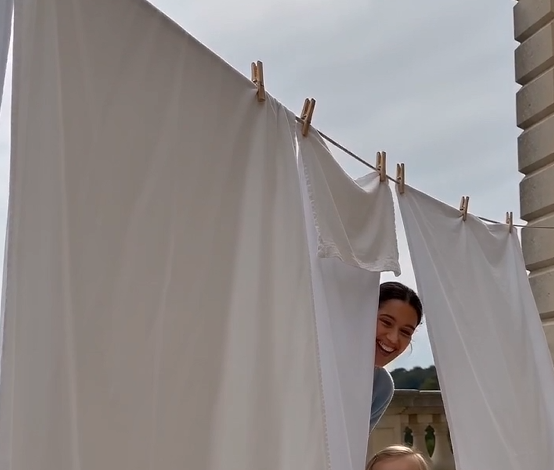
Celeste’s order remained in the air while the balcony sheets lifted and settled in the afternoon wind. Owen’s fist stayed closed around Mara’s cardigan, and Grant noticed that his son was not looking at the damaged-looking room at all; he was looking at Mara’s face.
Mara did not argue with Celeste. She lowered herself until she was at Owen’s height and said, “The wind is getting stronger. We can let the last one fly for one more minute, then I will fold them.”Celeste gave Grant a look that asked him to correct the young woman. He had corrected staff all his life without thinking, but June was now reaching toward a white sheet with both hands, and Lila had stepped away from the wall for the first time that day.
“One minute,” Grant said.
Celeste turned to him. “Grant, they are dragging clean linens across the balcony floor.”
“They are standing,” he answered, more sharply than he intended.
Mara made no victory of it. She let the minute become a small game, pressing a corner of cloth toward each child and waiting until they decided whether to take it. Owen pulled the fabric across his shoulders, and Lila followed him underneath. June peered through the moving cotton, then smiled so suddenly that Grant made a sound in his throat and had to look away.
He went to his study before anyone saw his eyes fill. There, surrounded by schedules and invoices for people who had promised solutions, he stood with both hands on his desk and understood how little he knew about the ordinary shape of his children’s days.
The sheets came down before dinner. Mara folded them in the living room rather than retreating to the laundry, and the triplets sat nearby, each holding a clothespin like a small prize.
Celeste did not mention the smile again. She had dinner served precisely at six, placed the children in their assigned chairs, and asked Mara to keep the atmosphere quiet.
But quiet had never been the same thing as peace in that house.
The family friend who had changed expression at the dinner table was Mrs. Vale, Grant’s mother. She had arrived for her weekly meal prepared to offer the same advice she always offered: fewer disruptions, stricter routines, better people. Instead, she watched Owen slide off his chair, cross the rug with hesitant steps, and stop beside Mara’s elbow.
Mara had not invited him. She was buttering a roll for June, and when Owen stood there, she broke off a warm piece and held it out without looking directly at him.
He took it.
Mrs. Vale set down her glass. “He is eating that?”
Grant nodded once.
Celeste’s mouth tightened. “We should be careful not to create dependencies.”
Mara kept her attention on Owen. “He can have another piece if he wants one.”
The child did not take another piece. Instead, he carried the first back to his sisters, and Lila nibbled its edge. June watched them, then pushed her plate toward Mara, not because she wanted the arranged chicken, but because she wanted help making it feel less frightening.
That was the first new fact that no one could explain away: the children were beginning to choose contact rather than merely endure it.
The next morning, Celeste told the house manager that balcony access was no longer permitted during Mara’s hours. She said it was a sensible safety rule, and she made sure the rule appeared on a typed page with the other household instructions.
Mara found the page on the kitchen counter. She read it, folded it once, and placed it beside the bowl of fruit without comment.
When Owen came to the formal living room after breakfast and looked toward the balcony doors, Mara did not take him there. She carried three cushions from a storage closet, spread a clean sheet over the backs of two chairs, and made a low white passageway between them.
The staff would have called it inappropriate furniture use. Mara called it a tunnel.
The triplets watched from the doorway. Mara crawled halfway inside, sat down, and began pairing socks from the laundry basket.
“This one has no partner,” she said, holding up a tiny blue sock. “I guess it can wait with me.”
June crawled through first.
Lila came after her, not smiling, but close enough to touch the hem of the sheet. Owen stayed outside until Mara rolled the blue sock gently toward him. He picked it up, then pushed it back through the opening with a movement so deliberate that Mara did not praise him or turn it into a lesson.
She only rolled another sock.
By lunch, all three children were inside the tunnel, resting their heads against the cushions and watching the cloth rise whenever air moved through the room. The formal living room had always been staged for guests. For the first time, it had a purpose that belonged to the people living there.
Grant came home late that evening and found a single clothespin on the mantel. It was such a small thing that he might once have asked someone to remove it. Instead, he put it in his pocket.
Celeste met him at the foot of the stairs. “This cannot be allowed to spread through the house. The children need professional consistency, not improvisation from a girl who turns linen into toys.”
Grant was tired enough to answer honestly. “The professional consistency did not get Owen to walk across a room.”
“And what happens when she leaves?” Celeste asked. “They will be worse. You are letting them attach to a stranger because it makes you feel less guilty.”
The words landed because Grant knew there was truth inside the cruelty. He had paid strangers to absorb every hard moment, then told himself his children were cared for.
He did not sleep much that night.
The following afternoon, Mrs. Vale came early without warning. She found Mara in the formal living room with a basket of towels, not a lesson plan. The triplets sat around her on the floor, and Mara was folding each towel into a small square before placing it over a cushion to make a row of soft doors.
“Are you rebuilding the balcony?” Mrs. Vale asked.
Mara looked up, startled. “Only until they are ready to ask for it.”
Mrs. Vale had spent decades believing that children benefited from being shaped by adults who knew better. But Lila now leaned out from beneath a towel, saw Mara, and gave a quick crooked smile before hiding again.
Mrs. Vale sat down carefully on the carpet, a place she had not sat in that room since Grant was a boy.
Celeste entered moments later and stopped short. “Mrs. Vale, you cannot encourage this.”
The older woman rose slowly. “I have encouraged enough rules in this family.”
She did not join the game, and Mara did not ask her to. Still, Celeste saw that the old alliance had changed. She began to press in quieter ways.
She moved the cushions back into storage after the children went to bed. She asked the house manager to schedule cleaning during Mara’s afternoon hours. She reminded Grant that a family dinner was coming, one attended by a few people from his company and their spouses, and that the formal living room must look presentable.
Grant agreed to the dinner because agreement was easier than deciding what he wanted. The next day, he found Mara carrying the cushions back from storage while the triplets followed in a slow uneven line.
“Celeste said these were put away,” he told her.
“They were,” Mara said.
Owen stood beside a chair with the blue sock in his hand. He looked at Grant, then at the cushions, as though the answer belonged to the adult who had always had someone else make it.
Grant felt the question without being asked.
“Leave them,” he said.
It was not a grand decision. But the house manager heard it, and so did Celeste from the doorway.
That evening, Grant took the triplets upstairs himself because Mara had gone home for the night. He had no idea how to begin. He knew the order of their baths because it appeared on a chart. He knew which pajamas belonged in which drawer because the labels were printed. He did not know what to do when June began to cry at the sight of the bathwater or when Lila sat frozen beside the bed.
He almost called Mara.
Then he saw the clothespin he had kept in his pocket. He set it on the carpet and placed a light blanket over two low chairs, making a crooked little passageway that sagged in the middle.
“I don’t know if this is right,” he said, speaking more to himself than to them. “But it can be here for a minute.”
June stopped crying first.
Owen crawled under the blanket, then turned back toward his father. Grant stayed outside the tunnel, afraid that moving too quickly would end it. Lila put one hand on the sheet, then another, and followed her brother.
For several minutes, Grant did nothing but sit on the floor while three children breathed beneath a blanket he had hung badly.
When Owen emerged, he did not go to the wall. He walked to Grant, placed the blue sock in his open hand, and leaned against his knee.
Grant bent over, and the composure that had made him successful in every room except this one finally failed him. He covered his face with one hand and cried silently while Owen stayed there, steady and warm against him.
Mara arrived the next morning expecting to find the children withdrawn after a difficult night. Instead, she found Grant sitting on the floor of the formal living room before work, wearing an untucked shirt and holding a cushion while June tried to place it on top of another.
He looked embarrassed when Mara walked in. “I made it too narrow. They got frustrated.”
Mara set down her bag. “You stayed?”
“I stayed.”
That was the second fact that changed the household’s balance. Grant had not simply approved Mara’s presence; he had begun doing the awkward, ordinary work himself, and the children had answered him.
Celeste heard about the night from the house manager and demanded a private conversation. She said Grant was turning the children into a spectacle and letting Mara set the terms of the home.
Grant listened without interrupting. Then he told her that the terms had already been set for years, and those terms had given him three children who had stopped expecting anything from him.
“This is not about linens,” Celeste said.
“No,” Grant replied. “It is about whether they are allowed to be children in their own house.”
Celeste did not apologize. She asked for the formal living room to be restored before the dinner, arguing that Grant’s guests would judge the family and that the children should not be encouraged to interrupt adults.
Grant did not cancel the dinner. He moved it.
The company guests were served in the dining room, where they belonged, while the formal living room remained a room the triplets could enter. The pale chairs were pushed back. Mara laid a sheet across a pair of low tables, and the children made a long tunnel with cushions placed like stepping stones beneath it.
Grant’s mother arrived early again. She stood at the threshold and watched the three children carry folded napkins from the dining room, each treating the task as part of the game.
Owen reached the tunnel entrance, paused, and looked toward Mara. She did not call him through. She merely held the far edge of the sheet so it would not fall.
He stepped in by himself.
At dinner, one of Grant’s colleagues commented that he had never seen the children so lively. Celeste attempted to laugh it off as a temporary phase, but June chose that moment to climb into Mara’s lap with a napkin tucked under her chin like a cape.
Lila carried a dinner roll to Grant and held it up until he tore it in half. Owen stood between them, smiling openly at his sisters.
No one in the room needed an explanation for what Celeste had been wrong about. The proof moved between the chairs on unsteady little feet.
After the guests left, Celeste retreated upstairs. She had lost influence over the rooms she once controlled, but Grant did not punish or humiliate her. He made one change that mattered: household rules concerning the children would now be discussed with him and Mara together, and no one would remove their play things to preserve an appearance.
Mara objected to being placed above staff. “I am here to care for them,” she said.
“Then we need to hear what care requires,” Grant told her.
He said it in front of the house manager, his mother, and Celeste, because private gratitude had never changed the machinery of that home.
In the weeks that followed, Mara kept her rituals small. She aired sheets whenever the weather allowed, and on rainy days she made soft passages in the living room from towels and chair backs. The triplets helped clip clothespins into a bowl. They brought her socks that needed partners. They began to wait for Grant at the front window, then to meet him at the door.
Grant started leaving work before bedtime twice a week, then more often because he discovered the company did not collapse when he delegated a meeting. His first efforts remained clumsy. He mixed up pajamas, folded towels badly, and once let the tunnel fall on all four of them.
The children laughed so hard that Mara had to turn away to hide her own smile.
One Saturday, the formal living room filled with sun. Fresh sheets moved across the open balcony doors, and the cushions were scattered in a way Celeste once would have called ruinous.
Mara sat near the laundry basket while Owen, Lila, and June clipped the last corners of a small sheet to the lowest line. Grant stood beside them, waiting for Mara to show him where to hold it.
“A little higher,” she said.
He raised his arms, and the sheet caught the breeze.
The triplets rushed beneath it together, then turned back to make sure both Mara and their father were following. Mara did not need to lead them through. She only held one clothespin in her palm while the children ran past, their smiles flashing and vanishing behind the warm white fabric.
Grant looked at Mara before taking the clothespin from her hand, not as an instruction from a servant, but as advice from someone the family had finally learned to trust.