THE TOAST FACES BENEATH THE LONG DINING TABLE

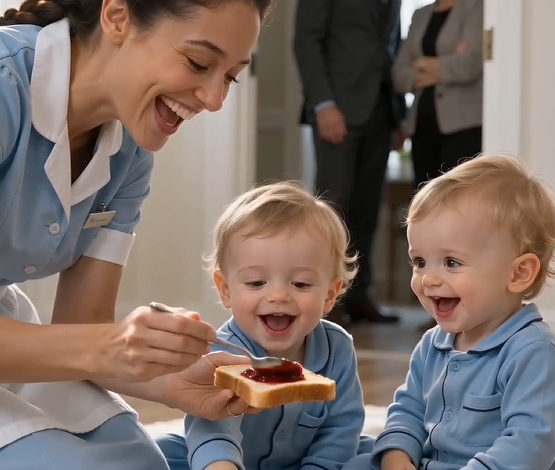
The girlfriend crossed the dining hall before the father could move. She lifted the jam jar from the floor as though it were evidence of a serious offense, while the first twin pulled his hand back under the table and the second tucked himself against him.
The nanny did not argue. She wiped a red smear from the floor with a napkin, left the unfinished toast where the boys could see it, and said that she would clean the table later. Her calm mattered because neither boy had been grabbed, scolded, or asked to perform the sound again“Sugar before noon, on the floor, in this room,” the girlfriend said. “You have been here two days.”
“It was one bite,” the nanny answered. “He chose it.”
The father stepped into view then, and both boys stared at him as if he were another sudden change to survive. He had heard the small sound, but he had also heard the warning in the way their bodies tightened when adults filled the doorway.
His girlfriend turned toward him. “Tell her this cannot happen again.”
For a long moment, he said nothing. Then he told the nanny to finish the morning as she saw fit, provided she stayed with the boys. It was not a defense, exactly, but it was the first time anyone in the house had been permitted to make room for them instead of making a plan around them.
The girlfriend left the jam jar on the sideboard with a sharp click. The twins watched her go, and neither of them cried until the dining-room doors shut.
The next day, the nanny returned to the same patch of floor with two slices of toast. She did not call it a lesson or announce breakfast. She made one face for each boy and placed the ingredients far enough away that they could reach them without being reached for.
The first twin chose a cream smile. His brother waited, rigid and watchful, until the first had eaten a small corner. Then he slid a finger from his brother’s sleeve, touched the jam, and made one red dot on his own toast.
The nanny gasped softly at the dot as though it were a masterpiece. “That one has a very serious cheek.”
The second boy’s mouth moved. No word came, but a faint breath of a laugh did.
She did not try to trap the moment by asking for another sound. At home, before family bills had sent her looking for any steady work, she had learned that younger cousins did better when nobody turned their small courage into a demand. When a child came near, she stayed near. When a child went quiet, she let quiet be quiet.
By the end of the first week, the twins still spent most of their time below the table. Yet the tunnel had changed. A plate appeared there at lunch, then a folded towel, then a few blocks the nanny rolled back and forth between the chair legs.
The boys accepted food only from her hand, but they began to point. One pointed to cream. The other pointed to the jam. Their father started leaving his office door open during meals, though he never entered unless the nanny nodded that it was safe.
The girlfriend noticed every change and called each one temporary. She had spent months arranging the house into something effortless: flowers changed before they faded, meals served where they looked best, a family image that suggested the father had recovered from loss without anyone seeing the mess beneath it.
The twins beneath the table made that image impossible. The nanny, with her crumbs and ordinary patience, made it harder still.
One afternoon, the girlfriend invited a family friend for tea without telling the nanny. She had the long table set with the twins’ favorite fruit, placed in little glass dishes, and asked the boys to sit in their usual chairs for ten minutes.
They would not.
The first twin began to shake before he reached the chair. When the girlfriend tried to guide him by the shoulder, he dropped to the floor. His brother followed him beneath the table, and both boys began the familiar, breathless crying that made adults want to fix the room fast.
The family friend looked away. The father stood by the window, helpless in the old way, waiting for someone else to know what came next.
The nanny arrived from the kitchen carrying a plain plate. She did not tell the boys to stop. She crawled only as far as the edge of the tablecloth and began spreading cream over toast where they could see her hands.
“Two guests came to tea,” she said quietly, making a face with worried jam eyes. “This fellow thinks he has to sit in a fancy chair.”
The first twin’s crying broke around a tiny sound. The second boy pushed his face against his brother’s shoulder and watched.
The girlfriend hissed that the nanny was rewarding bad behavior. The father heard it, but he also saw the first twin reach out. The boy touched the toast face, then pointed at the empty chair above them.
The nanny looked at the chair and shook her head. “Not today.”
She put the toast on the floor.
The boys ate beneath the table while the tea cooled untouched above them. The family friend did not offer advice. Before leaving, she told the father that his sons had made more eye contact in that room than she had seen in months.
It was a small observation, but it changed the balance of power. The girlfriend’s version of events required everyone to believe the nanny was making things worse. Now someone else had witnessed the boys becoming less frightened because the nanny had refused to force them into the picture.
That night, the father found the nanny at the dining table after the boys were asleep. She was scraping dried jam from a plate with the care of someone who expected to be blamed for every mark she left behind.
He asked why she never corrected them when they hid.
“Because hiding is what they know how to do,” she said. “They do not need to be praised for it. They need to learn somebody can find them without pulling them out.”
He sat down at the far end of the table, not beside her. “Their mother used to make breakfast with them.”
The nanny paused, then nodded. She did not say she understood his grief. She only said, “Then maybe breakfast is not the enemy.”
The father looked toward the dark space under the table. For the first time, he admitted that he had avoided the dining hall because it was where his wife had laughed the loudest. Rules had been easier than hearing what was gone.
The next morning, he tried to carry on with work. A call was waiting, documents were spread across his desk, and his girlfriend had sent a message asking him to replace the nanny before the trial made the house impossible to manage.
Then he heard a thump from the dining hall, followed by the high, panicked crying of both boys.
He found the nanny on the floor with them. A delivery had arrived unexpectedly, a door had shut too loudly, and the twins had scrambled under the table. One had knocked over the plate, and cream streaked the floor.
The nanny was not trying to distract them quickly. She was breathing slowly, tapping two fingers against the underside of the table in a steady pattern. After a minute, the first twin tapped back.
The second twin did not. He clung to his brother and cried harder whenever the nanny shifted.
The father stopped at the doorway. Every instinct told him to clear the mess, dismiss the staff member who had allowed the noise, and make the boys behave before the next crisis arrived.
Instead, he remembered the tiny mustache drawn in jam. He remembered his son asking for more cream without looking at him. He took off his watch, set it on the sideboard, and lowered himself to the floor several feet from the table.
The nanny looked at him once. “Do not talk yet,” she said.
He nodded.
She pushed a clean slice of toast toward him, then the cream and jam. His hands were clumsy. He spread the cream too thickly and made eyes that slid down the bread.
The first twin saw it through the chair legs.
The father added a red mouth, then tried to make a nose. The jam blob was enormous.
For a second, nobody moved.
Then the first twin made a small, broken sound that was not crying. “Big.”
The father’s hand shook over the toast. He looked toward the table, and the nanny gave the smallest warning shake of her head. So he did not rush in. He only nodded at his own ridiculous creation.
“Big,” he repeated, his voice rough.
The second twin lifted his face from his brother’s shoulder. He reached for the plate, but stopped halfway, frightened by the distance between them.
The father set the toast down and moved his hand away. The first boy took it, broke off a piece, and held it toward his brother. The second accepted it from him.
Their father put one hand over his mouth. The nanny kept her eyes on the boys, allowing the moment to belong to them rather than to his relief.
The girlfriend arrived just as the first twin crawled out from under the table. He was still wary, still close enough to dart back, but he walked to the father and pressed the toast face against the father’s knee.
“Big,” he said again.
The father froze.
The girlfriend stared at the cream on the floor, the father sitting in it, and the twins looking at him instead of fleeing. “You are encouraging this,” she said to the nanny. “You are turning them into children who cannot function anywhere except under a table.”
The nanny started to answer, but the father stood before she could. He did not raise his voice. He said the boys had not functioned under the old rules either, and that pretending otherwise had cost them too much time.
His girlfriend’s face hardened. “So I am the problem now?”
“No,” he said. “The problem is that I let a house run as though being present was the same as caring.”
She left the room without another word. She did not come back for dinner.
The father did not celebrate her absence. He had helped create the polished emptiness she preferred, and he understood that sending her away would not erase what his sons had learned about being inconvenient. But he told her the staged family meals were over, and he asked her not to direct the boys’ days anymore.
The next Monday was the last day of the nanny’s trial. The father’s assistant had prepared the usual paperwork for another temporary arrangement, because temporary arrangements had always felt safer than promising a person a place in the damaged house.
The nanny did not ask about it. She packed her canvas bag at the end of the morning, wiping the last of the jam from the table legs. The twins had been more unsettled all day, sensing the change before anyone explained it.
When she went to say goodbye, the first boy put his arms around her neck. The second gripped her hand, then dragged his brother beneath the table with him, making room in the tunnel between their small bodies.
The nanny sat on the floor outside it. “I have to go home tonight,” she said. “But I can come back tomorrow if your father wants me to.”
The first twin looked toward his father, who was standing with the unsigned papers in his hand. The boy did not speak. He simply pushed a piece of toast, already covered in a crooked cream smile, through the chair legs toward him.
The father understood the invitation because the nanny had taught him to wait long enough to see one.
He set the papers on the table, took off his jacket before kneeling down, and accepted the toast. Then he asked the nanny what she needed to stay beyond the trial.
She looked surprised enough that he could see how accustomed she was to being treated as temporary. She told him plainly about the bills at home and the hours she could work. He listened without turning her need into a favor he could display.
They agreed on a real position, steady pay, and a room in the household where she could rest between long days if she chose. The father also changed the schedule: no forced meals, no surprise visitors around the boys, and no photographs meant to prove a happiness they had not yet built.
The adjustment did not make the twins easy. Some mornings they still hid when a door slammed. Some nights they woke crying and would accept comfort only if the nanny sat nearby until their breathing slowed. The father still made mistakes, talking too soon or reaching too fast, then stopping when the boys flinched.
But he began returning to the dining hall before work. At first he sat at the far end while the nanny made toast faces on the floor. Later, after the boys had watched him fail gently enough times, they gave him the cream spoon.
The girlfriend moved her things out over several quiet days. She did not apologize, and no one chased her for one. Her loss of ground came from the same fact she had refused to see: the boys grew steadier when they were allowed to be real, and the father no longer wanted a home built around pretending.
Weeks later, the formal table still bore faint marks where jam had found its way into the grain. The housekeeper had offered to have it refinished, but the father asked her to leave it until the boys no longer needed the table as a tunnel.
At dinner, two small chairs stood beside him, though neither twin used them for long. The nanny set toast, cream, and jam in the middle of the table, and the father waited while the boys decided what kind of faces to make.
The first twin drew a huge red nose. The second added two dots for freckles. Then both boys looked at their father, and he spread his hands across the table, ready to learn what they meant next.