THE WINDOW CHILD AND THE CLOTHES THAT MADE A DOOR

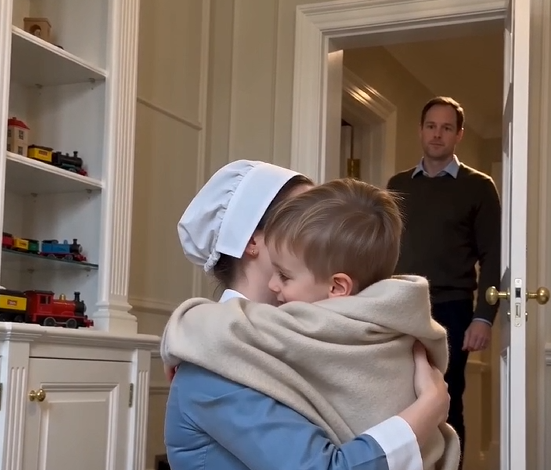
Owen’s father did not step into the playroom at once. He stayed beside the open door, watching his son hold the faded scarf with one hand and the young nanny’s fingers with the other. The sound Owen had made was not loud, but it was enough to make his father grip the doorframe.
His aunt recovered first. She crossed the threshold without looking at Owen and lifted the linen shirt from the floor by two fingers. “These are castoffs,” she said. “They do not belong in this room, and certainly not on him.”The nanny looked at Owen before she answered. He had gone still beneath the felt hat, but he had not retreated to the window. “They are soft,” she said. “He chose the scarf.”
“That does not make it appropriate.”
Owen’s father finally entered, his face arranged in the careful way he used in meetings. “Put things away for now,” he said. “We can discuss expectations tomorrow.”
The nanny nodded because the trial job did not belong to her yet. She did not pull the cape off Owen. Instead, she sat beside him until he let her unbutton the shirt and folded it loosely around the scarf in his lap.
His aunt watched that small permission with open displeasure. She had spent years visiting a house where every surface shone and every child photograph showed a pressed collar. Her brother’s second wife had made the rules strict after Owen’s mother died, insisting that routine was the only way to keep a sad household from falling apart. Owen’s father had accepted the arrangement because it gave him something he could call a plan.
The plan had made the boy quieter.
That evening, Owen’s father found the nanny in the kitchen rinsing a teacup. The sewing tin sat near her bag. He asked why she had brought old clothes into the playroom.
“My grandmother kept a basket by the back door,” she said. “Shirts too worn for work became pirate coats, curtains became tents, and scarves became whatever a kid needed them to be.”
“That is not an answer.”
“It is the only one I have. He was staring at the window, so I sat with him. He kept touching that scarf. I gave it somewhere to go without taking it away.”
Owen’s father glanced toward the hall, where the house had returned to its usual hush. “He does not usually allow anyone to touch him.”
“I noticed.” Her voice stayed even. “I did not ask him to allow it. He put my hand there.”
He wanted to say that one moment could mean nothing. He had learned to distrust small improvements because each new caregiver had presented them like a victory, then left another report on his desk when Owen stopped responding. But he had seen his son’s hand close around someone else’s. He had heard the laugh.
“You have eleven days left,” he said.
The next morning, Owen’s stepmother sent a message from a business trip: no improvised activities, no clothing outside the approved drawers, no exceptions to meal times. The nanny read it at the kitchen counter, then put the phone face down. She followed every instruction that kept Owen comfortable and ignored the part that demanded she remove the faded scarf.
In the playroom, she did not bring out more costumes immediately. She sat by the window and repaired a loose button on an old denim shirt from the household donation box. Owen remained on his rug, his eyes fixed outside, but his hand kept finding the scarf around his shoulders.
The nanny made the button disappear beneath her palm, then revealed it again. Owen watched. She repeated it, slower, and placed a second button in the center of the rug.
After several minutes, he crawled over and covered the button with his own hand.
She did not praise him, call for help, or turn it into a lesson. She simply put a red thread through the buttonhole and let him tug the end while she guided the needle safely through the fabric. His shoulders drew tight at first, then eased when nothing was demanded of him.
By lunchtime, he was wearing the repaired denim shirt over his usual clothes. He would not sit at the dining table, so she made a small place for him on the playroom floor, near the window. She set out apple slices, cheese, and crackers without insisting on an order.
Owen moved one apple slice into a line. Then he took a second one and held it toward her.
She accepted it with both hands, as though he had handed her something important.
The aunt saw that exchange from the hall. Her mouth tightened. “He will never function if every refusal becomes a private ritual.”
The nanny did not look up. “He ate something.”
“He ate because you made a game of basic manners.”
Owen pulled the scarf higher against his chest. The aunt noticed and took one step toward him. The nanny did not block her, but she moved closer to the floor beside Owen. He leaned into her hip instead of shrinking toward the window.
That was the first time the aunt looked uncertain.