WHEN A BILLIONAIRE SILENT DAUGHTER MOVED FOR THE FIRST TIME, IT WAS TOWARD A LAUNDRY BASKET

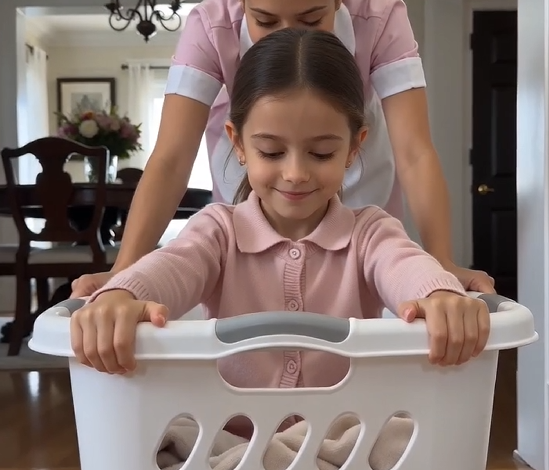
Henry stood in the playroom doorway with his coat still on.
Ruby did not celebrate. She did not clap or call Chloe brave. She simply sat beside the blocks and began lining them up in a loose path across the floor.”Boat goes here,” she said.
Chloe looked at the path.
Then she looked at the basket.
Ruby waited.
That was the part Henry had not seen from the therapists. Everyone else had been waiting for Chloe to perform. Ruby seemed to be waiting for Chloe to decide.
Vivian stepped into the room behind him.
“Henry, this is exactly what I meant,” she said. “She is encouraging regression. Chloe needs structure. Tomorrow we have your family arriving. She cannot be dragging a laundry basket through the penthouse.”
Ruby’s face went red, but she kept her voice calm.
“She didn’t have to get in it,” Ruby said. “She chose to.”
“She doesn’t know what she is choosing.”
Henry should have agreed with Vivian. For months, he had agreed with anyone who sounded certain. He had spent money like action could replace time. He had approved every schedule sent to his phone, every specialist invoice, every new plan for teaching Chloe how to return to normal.
But he had just watched his daughter move across a room because a young woman with a blanket and a laundry basket had made the room feel safe enough to move through.
“Let Ruby finish,” he said.
Vivian stared at him.
It was not a loud sentence. But it landed hard.
Ruby pulled the basket only a few more feet. Then she stopped. Chloe crawled out and put one block down at the end of the path.
Ruby added another.
Chloe added another.
By the time dinner was served, there was a crooked blue-and-yellow trail from the playroom to the garden doors.
Henry ate alone in his office that night. On his laptop, numbers moved across the screen. His company was closing a major deal the next morning. Normally, that would have held all of him.
Instead, he kept thinking about Chloe’s small hand on the basket rim.
He had not been there the day she stopped speaking at preschool.
He had been in Boston when her mother was admitted to the hospital for the last time.
He had been on a flight when Chloe came home from the funeral and refused to sleep in her own room.
He had told himself he was working for Chloe. He had told himself the money would protect her.
But in the quiet of his office, Henry finally understood something ugly.
He had built a life where every person around Chloe was paid to handle what he could not bear to sit beside.
The next morning, Ruby found Chloe in the playroom before breakfast.
The laundry basket was in the middle of the floor.
Chloe was standing next to it, holding the blanket.
Ruby sat down without speaking.
Chloe pushed the blanket toward her.
“Boat,” Ruby said.
Chloe’s lips moved.
The sound was barely there.
“Buh.”
Ruby smiled, but she did not make a big deal of it. “Boat.”
For the next four days, the game stayed almost exactly the same.
Ruby would fold the same two blankets into the basket. Chloe would choose one block from the toy bin. Ruby would pull the basket slowly along the same route: playroom, hall, garden doors, back to the playroom.
At first, Chloe stayed inside the basket the whole time.
Then she began getting out at the block path.
Then she began placing blocks before Ruby could ask.
On the third day, Ruby added a small paper flag to the side of the basket. She had painted it from a brown grocery bag with a red marker. Chloe watched her make it, then pressed her palm beside Ruby’s, leaving a faint red handprint.
The penthouse slowly began to sound different.
There was the rattle of basket wheels over wood floors. There was Ruby’s low humming. There were blocks clicking together. Once, there was a short breathy laugh from Chloe when the basket bumped gently over the threshold.
Henry heard that laugh from the kitchen.
He froze with a coffee cup in his hand.
Ruby was kneeling by the garden doors. Chloe was standing a few steps away, holding the little paper flag. The rooftop garden beyond the glass was cold and bright, with winter herbs in square planters and a narrow strip of grass running along the city view.
Ruby held one end of the blanket like a finish line.
“Captain has to park the boat,” she said.
Chloe looked at the basket.
Then she took three unsteady steps toward it.
Henry watched his daughter move toward something because she wanted to, not because an adult had pulled her.
Chloe reached the basket, touched the paper flag, and turned toward the doorway.
She saw Henry.
For a second, Henry expected her to go still.
Instead, she lifted the flag toward him.
Ruby looked over her shoulder. “She wants another passenger.”
Henry did not move.
He had no idea what he was supposed to do. He could negotiate a billion-dollar acquisition without notes. But standing in front of a laundry basket, he felt helpless.
Chloe held the flag out again.
Henry set down his coffee.
He took off his shoes because Ruby had taken off hers. Then he sat on the floor beside the basket.
Chloe placed the paper flag in his hand.
Vivian walked in just as Henry was helping Ruby tuck the blanket around Chloe’s knees.
Her expression hardened.
“Henry,” she said, “you cannot seriously be participating in this.”
Chloe’s shoulders rose at the sharpness in her voice.
Ruby immediately stopped pulling the basket.
Henry saw it. He saw Chloe’s fingers twist in the blanket. He saw the old stillness trying to take over.
“Lower your voice,” he said.
Vivian looked offended. “I am trying to protect her. Thanksgiving is tomorrow. Your mother, your investors, half the family will be here. Chloe needs to be prepared. She needs to sit through dinner. She needs to greet people. She cannot be treated like a toddler in a basket.”
Henry looked at his daughter.
Chloe was seven. She knew the room had turned dangerous. She did not know why, but her body knew.
“She doesn’t need to perform for them,” Henry said.
Vivian laughed once, without humor. “That is easy to say when you are not the one keeping this house from falling apart.”
Ruby quietly stood up. “I can take Chloe to the playroom.”
“No,” Henry said.
Both women looked at him.
He swallowed. “No. Chloe stays where she is.”
Vivian left without another word.
That afternoon, Henry found Vivian in the formal dining room, removing the small paper handprint Ruby had taped near the kitchen entrance.
“It doesn’t belong there,” Vivian said.
“It belongs to Chloe.”
“It is a paint-stained grocery bag, Henry.”
“It is the first thing she made with someone.”
Vivian placed the flag on the table.
For a moment, she looked tired instead of angry.
“Do you know what people say when they see her?” she asked. “They look at her and then look at you. They look at this house and they wonder what is wrong. I have spent a year trying to make things steady for you.”
Henry understood what she meant. Vivian had been there after his wife’s death. She had arranged meals, canceled events, managed calls from family, and made sure Henry had clean shirts when he could barely remember what day it was.
But somewhere along the way, steady had become silent.
“Chloe isn’t an embarrassment to organize,” Henry said.
Vivian’s eyes filled, but her jaw stayed tight. “And Ruby is not family.”
Henry had no answer to that.
Not yet.
Thanksgiving morning arrived with rain sliding down the glass walls of the penthouse.
Caterers moved through the kitchen. Flowers came up in private elevators. Henry’s mother arrived early, dressed in cream wool, already asking whether Chloe had practiced saying hello.
Vivian had replaced Ruby’s breakfast plan with a printed schedule taped to the refrigerator.
9:00 a.m. breakfast at table. 10:00 a.m. dress rehearsal in formal clothes. 11:00 a.m. quiet rest. 12:00 p.m. guest greeting. 1:00 p.m. Thanksgiving lunch.
No basket. No blocks. No rooftop garden.
Ruby stood in front of the refrigerator reading it.
Henry came in behind her.
“Vivian made a plan,” Ruby said softly.
Henry rubbed a hand over his face. He had a call in twenty minutes. His legal team was waiting. His mother was in the living room. The entire penthouse was filling with people who expected him to take charge.
The old Henry would have looked at the schedule and approved it because it was neat.
“Do what Chloe needs,” he said.
Ruby nodded once.
But Henry still took the business call.
By the time he returned forty minutes later, Chloe was sitting at the formal breakfast table in a velvet dress Vivian had chosen. Her plate held untouched toast cut into perfect squares.
Vivian sat beside her, speaking gently but firmly.
“One bite, Chloe. Then we can go see Grandma.”
Chloe was staring at the wall.
Ruby stood near the kitchen counter, her hands folded in front of her. The laundry basket had been pushed into a utility closet.
Henry knew the look on Chloe’s face. It was the look that came before she disappeared into herself.
“Where’s the boat?” he asked.
Vivian’s head snapped up. “Henry, please. Not today.”
Chloe did not react.
Ruby looked toward the utility closet.
Henry opened it.
The basket was upside down behind cleaning supplies. The blankets had been folded into a stack. The little paper flag was missing.
He felt anger rise in him, quick and unfamiliar.
“Who put this here?”
Vivian stood. “I did. Because this is a holiday dinner, not an art camp. She needs to learn that the world will not stop and become a game every time she is uncomfortable.”
Ruby’s eyes went to Chloe.
Henry followed her gaze.
Chloe had slid halfway out of her chair. One shoe had come off. She was trying to make herself smaller.
Then Ruby did something Henry had not expected.
She did not argue.
She took the basket from the closet, set it right in the middle of the polished kitchen floor, and put one blanket inside.
Vivian stepped forward. “Ruby, don’t you dare.”
Ruby looked at Henry, not Vivian.
“Yesterday, Chloe chose the boat,” she said. “Today everybody else chose for her.”
The doorbell rang. Henry’s first guests had arrived.
His mother called from the hall. “Henry? They are here.”
For one terrible second, he almost told Ruby to put the basket away.
Then Chloe’s bare foot touched the floor.
Ruby crouched beside the basket and began humming the same low tune she had used the first day.
No bright voice. No command. Just the rhythm.
Chloe’s face did not change.
Ruby pulled the basket one inch.
Then another.
The plastic wheels rattled across the kitchen tile.
Henry’s mother appeared at the doorway with two guests behind her. Vivian looked mortified.
“This is inappropriate,” she whispered.
Ruby kept humming.
Chloe’s fingers loosened from the edge of the chair.
Ruby stopped at the first block of the old path. She had placed it near the pantry door without anyone noticing. Yellow. Then blue. Then red.
She did not touch Chloe.
“Captain,” Ruby said quietly. “The boat is waiting.”
The kitchen held its breath.
Chloe looked at the basket.
She looked at Ruby.
Then she looked toward the garden doors, where the rain had slowed and the wet grass gleamed above the city.
Slowly, Chloe slid out of the chair.
Her knees shook.
Henry moved instinctively toward her, but Ruby lifted one hand, asking him to wait.
Chloe took one step.
Then another.
Her velvet dress brushed the floor. One bare foot pressed against the cold tile. She walked past the untouched toast, past Vivian’s printed schedule, past the adults who had spent a year deciding what she should do.
She reached the block path.
She picked up the blue block and placed it in front of the basket.
Then she turned to Henry.
Her hand opened.
Henry knew what she wanted.
Not Ruby.
Him.
The room went silent in a way the penthouse had never been silent before. This was not the old silence, the empty silence Henry had accepted because it was easier than grief.
This silence was waiting.
Henry removed his suit jacket. He loosened his tie. Then he got down on the kitchen floor beside his daughter.
Vivian whispered his name.
He did not look at her.
Ruby handed him the blanket.
“She likes it around her shoulders first,” Ruby said. “Then she gives you the flag.”
Henry looked around. “Where is it?”
Chloe pointed toward the dining room.
Henry saw it on the sideboard beneath a silver tray. Vivian had tucked it there with the other things that did not match.
He walked over, picked up the brown paper flag with its red handprint, and brought it back.
Chloe took it from him.
Then, for the first time since her mother died, she spoke clearly enough for everyone in the room to hear.
“Dad boat.”
Henry’s face broke.
He sat behind the laundry basket because there was barely room for him, and Chloe laughed again when his knees bumped the plastic sides.
Ruby stood at the front and took hold of the rim.
“No,” Chloe said.
Ruby paused.
Chloe pointed to Henry.
“Dad.”
Henry looked at Ruby.
She stepped aside.
“Slow,” she told him.
Henry nodded.
He pulled the basket one inch.
Chloe tightened the blanket around herself.
He pulled it another inch.
The wheels rattled over the tile, onto the wood floor, then toward the rooftop garden doors. Chloe held the paper flag out in front of her like it mattered more than every crystal glass waiting in the dining room.
Behind them, Henry’s guests watched without speaking.
His mother began to cry quietly.
Vivian did not.
She stood with her arms crossed, her face pale and angry, as Henry pulled his daughter toward the garden.
At the doors, Chloe climbed out of the basket.
She did not run. She was not suddenly healed. Her legs were still uncertain. The rain had left small puddles between the planters.
But Chloe walked to the wet grass.
Ruby had placed the blocks there in a loose line, leading toward a little open space beside the rosemary bushes.
Chloe followed them.
Henry stayed a few steps behind, letting her set the speed.
At the end of the line, she turned back and lifted both arms.
Ruby was already coming, but Chloe looked at Henry.
He understood.
He picked her up.
Chloe put her arms around his neck and held on.
Not because she had been told to.
Because she chose him.
Thanksgiving lunch was delayed nearly an hour.
Henry did not apologize for it.
He canceled the investor call he had planned to take between courses. He told the caterers to keep the food warm. He let the guests sit in the dining room without forcing Chloe to enter.
Ruby set up the laundry basket at the edge of the rooftop garden with blankets, blocks, and the paper flag. Chloe moved between the basket and the grass while Henry sat on the floor nearby.
His mother eventually came out and sat beside him.
“Your wife used to sit on the kitchen floor with her,” she said.
Henry looked at her.
“Before she got sick,” his mother continued. “She said Chloe hated being rushed. She said Chloe needed to know the next thing would not hurt.”
Henry shut his eyes.
He had forgotten that.
Or maybe he had buried it under meetings and doctors and arrangements because remembering his wife had felt like being split open.
Ruby heard the words but did not interrupt.
She just moved a block closer to Chloe.
Later, Vivian came to the garden door with her coat in her hands.
“Henry,” she said, “we need to talk.”
He stood and stepped inside with her, leaving Ruby and Chloe where they were.
Vivian’s voice shook.
“This is not fair,” she said. “She came in here for three days and suddenly you look at her like she understands your daughter better than everyone else.”
“She does understand something I missed.”
“And what about me?” Vivian asked. “What happens when Chloe wants Ruby, and you want Ruby, and there is no place left for anyone else?”
Henry looked toward the garden.
Ruby was sitting in the wet grass without caring about the stain on her jeans. Chloe was placing blocks around the laundry basket. She was building something small and uneven. Ruby was letting her.
“I don’t know what happens next,” Henry said. “But I know what cannot happen. Chloe cannot keep losing herself because the house needs to look controlled.”
Vivian swallowed.
“You are choosing a nanny over me.”
“No,” Henry said. “I am choosing to be Chloe’s father.”
Vivian stared at him for a long time.
Then she left the penthouse before lunch was served.
Henry did not chase her.
The following weeks were not simple.
Chloe still went quiet when strangers entered the home. She still could not manage a full school activity. Some mornings she would only sit beside the laundry basket and hold the blanket against her cheek.
But Henry stopped treating those moments as failures.
He changed his schedule. Every Thursday evening, no matter where his company wanted him, he was home for what Ruby called the sixth parent-child time of the week.
There were no consultants at those sessions.
No chart on the refrigerator.
Just the same rhythm.
Blankets in the basket.
A block path.
The slow pull through the hall.
A stop at the rooftop garden.
Sometimes Chloe rode in the basket. Sometimes she walked beside it with one hand on the rim. Sometimes she pulled it while Henry sat inside, pretending to be the world’s worst passenger.
The first time Chloe pulled him all the way to the garden, Ruby laughed so hard she had to sit on the floor.
Henry laughed too.
It felt strange at first. Then it felt like the sound their home had been missing.
Ruby stayed after her trial period ended.
At first, she was still the nanny. Henry made sure she had clear hours, time off, and the respect Vivian had never given her. Ruby began painting in the small studio room near the garden when Chloe slept. Her work filled with bright blocks, city windows, red handprints, and crooked little boats.
Chloe started helping.
Months later, at a small family dinner, Chloe walked into the dining room on her own. She carried the brown paper flag, now taped carefully to a wooden stick Henry had made with her.
She did not greet everyone.
She did not need to.
She crossed the room, climbed into Henry’s lap, and held the flag between them.
“Boat after,” she said.
Henry kissed her hair.
“Boat after,” he promised.
Years passed slowly, the way healing did in that home.
Ruby did not become Chloe’s replacement mother. Nobody asked her to. Chloe’s mother remained in photographs, in stories, in the little blue scarf Henry kept folded in a drawer for the days Chloe wanted to hold it.
But Ruby became part of the family because she never tried to erase what had been lost.
She made room for it.
Henry and Ruby were careful. They did not turn gratitude into a rushed romance. They did not make Chloe carry their adult choices.
They built trust the same way Ruby had built the first block path: one clear piece at a time.
By the time Henry asked Ruby to marry him, Chloe was old enough to understand what it meant.
They were in the rooftop garden. The old laundry basket sat nearby, cracked at one corner but still in use. Chloe had painted a new flag for it, blue this time, with three red handprints across the middle.
Henry knelt in the grass.
Ruby covered her mouth.
Chloe stood between them, holding the flag.
“Family boat,” she said.
Ruby looked at Chloe first.
Then she looked at Henry.
And she said yes.
The penthouse was still beautiful. It still had glass walls, expensive art, private elevators, and a dining table long enough for people who barely knew one another.
But it no longer felt like a museum built around grief.
There were blankets draped over chairs. There were blocks under the sofa. There was paint on the garden floor. There was laughter near the kitchen.
And every Thanksgiving, before any guest arrived, Henry pulled an old laundry basket slowly across the penthouse floor while Chloe walked beside it, Ruby held the paper flag, and the family remembered the day a little girl finally moved because someone stopped asking her to be perfect and gave her a safe place to begin.