THE SILENT LITTLE GIRL WHO SPOKE ONE WORD AFTER A YOUNG NANNY TURNED OFF THE LIGHTS

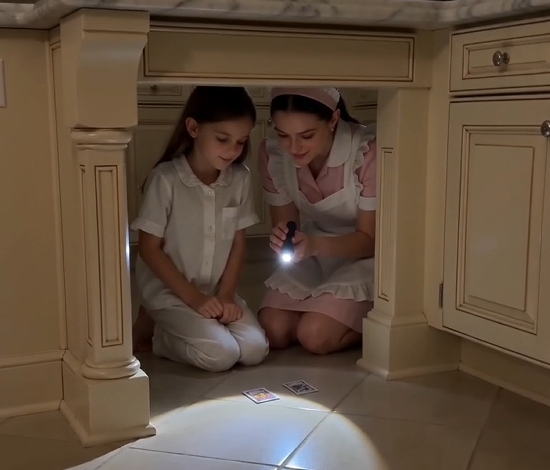
James did not move.
The kitchen had gone silent except for the hum of the refrigerator. On the wall, the flashlight circle rested above a framed photograph of Mia’s mother, who had once filled that same room with music and burnt toast.
Mia kept pointing.
“Again.”
The word came out louder this time.
Maya looked at James, not Claire.
“He can do the last step,” she said.
James had been asked to do many things in his life. Sign mergers. Fire executives. Speak to cameras. Buy companies before breakfast.
He had never been asked to move a circle of light across a wall for his daughter.
His hand closed around the flashlight.
Mia immediately pulled her knees to her chest.
James stopped.
Maya held up three fingers. “Three taps. Then the light moves.”
He looked at her as if she had handed him an instruction manual written in a language he did not know.
She tapped the spoon once.
James tapped twice.
Mia watched him.
Maya moved the light a few inches. James followed with his own flashlight. Two circles crossed the wall, separated, then met beside the pantry door.
Mia’s mouth opened.
No scream came.
She crawled forward and placed one hand on James’s shoe.
It was the first time she had touched him since the funeral.
James’s face tightened, but he did not reach down. He understood that one sudden movement could send her back under the table.
Maya kept the rhythm steady.
Tap. Tap. Tap.
The lights moved.
Mia followed.
For eleven months, every adult in the house had been trying to pull Mia out of fear. Maya had noticed something simpler. Mia did not need to be pulled. She needed to know exactly what would happen next.
The flashlight clicked on.
The spoon tapped three times.
The light traveled to the pantry.
Then everyone waited.
Mia looked at Maya. She looked at James. She pointed at the wall.
“Again.”
James swallowed.
“Again,” he repeated.
Mia touched his hand.
Claire stepped into the light.
“That is enough,” she said. “This is getting ridiculous. The child should be in bed.”
Mia jerked away from James.
The flashlight circle jumped across the wall.
Claire’s voice sharpened. “Mia, come here. Now.”
Mia bit her lip.
James saw the change. Her shoulders rose. Her fingers curled. The small connection that had taken ten minutes to build began disappearing in less than ten seconds.
Maya turned off her flashlight.
The room became dark again.
“Not another command,” she said quietly.
Claire stared at her. “You are not qualified to overrule this household.”
“No,” Maya answered. “But the pattern is right there.”
James looked from Claire to his daughter.
Mia had gone still. Her eyes were fixed on the floor. The old household pattern had returned: emotion, correction, pressure, shutdown.
James told Claire to leave the kitchen.
She laughed once, without humor. “After one word?”
“Leave.”
That night, James sat outside Mia’s bedroom until dawn. He did not enter. He did not call a specialist. He did not ask the night staff to watch the monitor.
At three in the morning, a thin beam of light appeared beneath the door.
Maya was inside, sitting on the rug.
Tap. Tap. Tap.
The light crossed the baseboard.
Mia followed it with one finger.
The next six days were built from the same small pieces.
The lights went off after dinner. Maya tapped the spoon three times. Mia followed the beam from the kitchen to the hall, from the hall to the foot of the stairs, and back again.
Nothing was rushed.
Maya never demanded eye contact. She never asked Mia to explain her feelings. She never praised her like a trained animal when she made a sound. She simply kept the rhythm predictable.
On the third night, Mia ate two bites of toast while following the light.
On the fourth, she let Maya wash jam from her hands.
On the fifth, she slept with the flashlight beside her pillow instead of gripping it until morning.
On the sixth, James joined the game without being invited.
He wore a suit because he had come straight from work. He removed his watch and set it on the counter. Then he sat on the kitchen floor beside Maya.
Mia watched him for a long time.
James tapped the spoon three times.
Maya moved the light.
Mia followed.
The next morning, Claire changed the routine.
She had spoken to James’s family and to the house manager. Everyone agreed that Maya was creating dependency. They said Mia was old enough to understand limits. They said the flashlight game was embarrassing, childish, and impossible to maintain.
Claire had the kitchen lights turned on before Mia entered.
The flashlights were removed.
The spoon was put back in its drawer.
When Mia came downstairs and saw the bright kitchen, she stopped at the bottom step.
Maya was not there. She had been sent to collect laundry from the east wing.
Claire placed a plate in front of Mia.
“Sit properly.”
Mia bit her lip.
“Use your words.”
Mia’s hands began to shake.
Claire pushed the plate closer. “No hiding. No games.”
Mia shoved the plate away.
It hit the floor and broke.
By lunchtime, Mia had not spoken. By dinner, she had stopped eating. She spent the night inside the linen closet with the door locked from the inside.
James arrived home to find a behavioral chart on the counter.
Claire had marked the day as a complete regression.
“She only spoke because of the novelty,” Claire said. “The game gave everyone false hope.”
James stared at the chart.
He remembered Mia’s hand on his shoe.
He remembered the way she had said again.
Then he remembered how quickly she had vanished when the adults brought back the old rules.
Maya returned from the east wing carrying a basket of towels. She saw the broken plate, the chart, and the closed closet door.
She did not ask what happened.
She set the basket down, picked up the same wooden spoon, and sat on the floor.
The kitchen lights stayed on.
Maya tapped the spoon three times.
No beam appeared.
She waited.
Tap. Tap. Tap.
From inside the closet came one soft knock.
James looked at Claire.
Maya tapped again.
The closet door opened two inches. Mia’s face appeared. Her teeth were pressed into her lip.
Maya did not move closer. She turned off the kitchen lights.
The house manager protested from the doorway, but James raised one hand.
In the dark, Maya switched on the flashlight.
The circle of light landed on the floor.
Mia crawled out.
The beam moved to the chair.
Mia followed.
The beam moved to the wall.
Mia followed.
The old rhythm returned, but the first night did not. Mia stopped halfway. Her breathing became uneven. Her face turned toward the hallway, where Claire stood watching.
Maya lowered the flashlight.
“Same room,” she said. “Same three taps.”
Mia looked at the spoon.
James sat down beside Maya.
Claire shook her head. “James, this is exactly how you lose control.”
James removed his jacket.
The room watched him place it on the floor.
Then he picked up the second flashlight.
Mia stared at him.
James tapped once.
Maya tapped twice.
The two beams met on the wall.
Mia stepped toward them.
It was not a miracle. It was a choice made in a room that finally stopped pushing.
Mia touched the light with one finger. Then she turned toward James and pulled at his sleeve.
James leaned closer.
Mia pointed to the flashlight.
Her lips trembled.
“Again.”
She had spoken the word before. But this time she had asked him.
James’s eyes filled.
He moved the light across the wall, slowly, exactly as Maya had shown him.
At the end of the path, Mia reached for his hand.
Claire left the kitchen.
The following week, James took Mia to the children’s hospital for her scheduled follow-up. The appointment fell on the date of the accident that had killed Mia’s mother.
The hospital waiting room was full of bright lights, rolling carts, and strangers who spoke too loudly. Mia sat beside James with both hands locked under her thighs. She would not answer the nurse. She would not remove her coat. Her mouth stayed clamped shut.
The nurse glanced at James.
“Has she been communicating at home?”
James looked at Maya.
Maya had come because Mia had refused to enter the hospital without her. She carried the small flashlight in her coat pocket.
“She has,” Maya said.
The nurse smiled gently. “Can she show that today?”
James almost gave the old answer. He almost promised to arrange another evaluation and another specialist.
Then the overhead lights flickered.
Mia’s breathing changed.
Maya did not touch her. She sat on the floor beside the waiting-room chair and tapped her fingers against her knee three times.
Tap. Tap. Tap.
Mia looked down.
Maya took out the flashlight, but she did not turn it on yet. She pointed toward the blank wall beside the vending machines.
James noticed the date on the appointment card in his hand.
He knew why the hospital felt different to Mia. Her mother had been brought through these doors after the crash. Mia had waited in a plastic chair while adults spoke over her head. Since then, hospitals, bright lights, and closed doors had become one memory in her body.
The nurse began to call for security.
James stood.
“Give her a minute.”
The nurse looked surprised. James Whitmore was famous for making people move faster.
Maya tapped again.
Mia’s fingers came out from under her thighs.
Maya turned off the lamp beside the chair.
She clicked on the flashlight.
A small circle appeared on the wall.
Mia followed it with her eyes.
Maya moved the beam to the floor.
Mia slid down from the chair.
The waiting room had gone quiet around them. A mother holding a baby watched. A technician paused beside the hallway. Nobody understood the game, but everyone could see Mia trying to stay in the room.
James crouched beside her.
Maya tapped three times.
James copied her.
His first tap was too hard. The sound cracked through the room.
Mia flinched.
James lowered his hand.
Maya waited.
Mia looked at him, then placed her fingers over his.
She guided his hand down.
Tap. Tap. Tap.
This time, the rhythm was right.
The flashlight moved toward the examination-room door.
Mia stood.
Her knees shook. James did not lift her. He simply walked beside the beam.
At the door, Mia stopped.
The date card slipped from James’s hand.
Maya pointed the light to the door handle.
Mia reached for it, then turned back to James.
She pulled his sleeve.
James bent down.
Mia pointed at the flashlight, then at him.
“Again.”
The nurse covered her mouth.
James understood the request. Mia was not asking for the light alone. She was asking for the three of them to repeat the safe path together.
He took the flashlight from Maya.
Maya gave him the spoon from her bag.
The hospital hallway was too bright for a real beam, so James used the flashlight against the floor. Maya tapped the spoon softly against the wall. James moved the circle forward. Mia walked between them.
At the examination room, Mia climbed onto the chair without being lifted.
She answered the doctor with a nod.
Then, when the doctor asked who had helped her come inside, Mia pointed first to Maya.
After a pause, she reached for James’s hand.
The doctor said Mia still needed time. There would be difficult days. There would be shutdowns, fear, and moments when the word disappeared again.
James listened.
For the first time, he did not ask how quickly the problem could be fixed.
He asked what Mia needed from him when the word disappeared.
That evening, Claire packed her things.
She told James he was letting a young nanny run the house. She said Maya had crossed a line by turning private grief into a game. She said a child needed discipline, not darkness and floor games.
James stood in the foyer beneath the chandelier.
Behind him, Mia held the flashlight against her chest.
“The house needed someone to listen,” James said.
Claire looked at the little girl. “And when Maya leaves?”
James glanced at Maya.
Maya had never promised to stay forever. She had responsibilities outside the mansion, a life that did not belong to James, and no interest in becoming another expensive object the family kept nearby.
So James changed the question.
He asked Maya to stay through the end of the school year, with fixed hours, clear pay, and no expectation that she would replace Mia’s mother or carry the family alone.
Maya accepted only after James agreed to attend the hospital sessions, keep the lights low during transitions, and stop turning every difficult moment into a report.
He agreed.
More importantly, he followed through.
Every Wednesday evening, James came home before dinner. He put away his phone. He sat on the kitchen floor. Maya tapped the spoon three times, and James moved the flashlight.
Sometimes Mia joined immediately.
Sometimes she stayed under the table.
On those nights, James stayed on the floor and waited.
The mansion changed slowly. The staff stopped correcting every sound. The kitchen became noisy again. Mia began eating at the counter, then at the table. She still held the flashlight during storms. She still bit her lip when a door slammed.
Healing did not make the house perfect.
It made the house honest.
Months later, James and Maya were still careful with each other. There was no sudden wedding, no replacement mother, and no claim that love could erase what Mia had lost.
There were family dinners. Hospital visits. School forms signed by both adults. A small bedroom prepared beside Mia’s, not as a performance, but because Maya had become part of the child’s daily safety.
James kept his promise of one weekly father-daughter hour. Maya kept the flashlight in the kitchen drawer. Mia kept the wooden spoon beside it.
One rainy evening, James returned home and found the lights already off.
A beam moved across the wall.
Tap. Tap. Tap.
Mia stood in the center of the kitchen, holding one flashlight. Maya held the spoon. James removed his coat and took the second flashlight without being asked.
Mia looked at both of them.
Then she smiled.
“Again.”
James moved the light.
Maya tapped the spoon.
Mia stepped between them.
The old house had not brought back the mother it lost. Money had not repaired the wound. Rules had not made the child feel safe.
But in that kitchen, with the lights low and three people following the same small rhythm, Mia no longer had to face the dark alone.
And James finally understood that a family was not built by owning the right house or hiring the right people.
It was built by showing up for the same child, in the same room, as many times as she needed.