THE SHADOWS THAT MADE THREE SILENT CHILDREN STEP TOWARD THE LIGHT

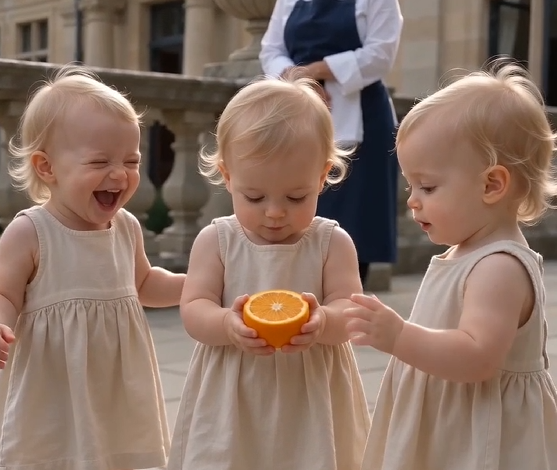
The aunt called for the house manager before the balcony door had fully closed. She said the children had been allowed outside without proper shoes, the tiles had been marked, and the new nanny had turned a private family home into a playground just as important visitors had departed.
The father did not answer her at first. Theo was still standing beside the nanny, one hand gripping the seam of her canvas tote, while Milo traced the edge of his own shadow with a cautious shoe and June watched the light change around all of them.For months, the father had been trained by disappointment to distrust the first sign of anything. A caregiver once got Milo to swallow two bites of soup, and by dinner he would not come near the table. Another had made June smile at a puppet, then left four days later because the schedule was impossible to keep.
So he told himself that three children on a balcony did not prove a thing.
But the nanny did not announce a success or look toward him for approval. She simply held out her hand to Theo, palm up, and waited while the last gold light moved across the tiles.
Theo placed the orange peel in it, then touched the small sun shape the nanny had folded earlier. His finger lingered there. The father saw that he was not merely standing near her; he was choosing what happened next.
The aunt saw it too, and it made her voice sharper.
“They need dinner, a bath, and their proper routine,” she said. “Not this wandering about after guests have had to hear them.”
The nanny looked toward the father instead of arguing. “They can have dinner. I just think they should come in while they still want to follow something.”
The father almost said that dinner was already twenty minutes late. He could hear his stepmother’s usual correction in his own head, the one about small deviations becoming bad habits. Yet Theo had not walked toward a person in so long that the father could not remember the last time he had seen it.
“Show them,” he said.
The nanny lowered her arm. Her shadow made a long path from the balcony door toward the nursery. Milo followed it, stopping when it broke across the threshold. She made the shadow jump with a quick bend of her knees, and Milo gave the same startled little sound he had made outside. June caught hold of Milo’s sleeve and stepped after him.
The father followed at a distance, afraid that his presence would turn the fragile thing into another demand.
At the nursery table, the nanny did not seat the children in their usual high-backed chairs. She laid a clean cloth on the floor near the balcony doors where there was still a stripe of light, then set down three small bowls of plain rice and roasted carrots. She used a spoon to make three lopsided circles in the rice and told the children that their shadows had gotten hungry.
The aunt inhaled as if she had seen a deliberate insult.
“Food does not belong on the floor,” she said.
“Neither do tears,” the nanny replied, still calm, “but this is where they have been having them.”
The father should have stopped the exchange. In that house, staff did not speak to family members that way. But Milo had crouched beside one bowl. He pinched a grain of rice, examined it, and dropped it into the circle the nanny had made.
June copied him.
Theo sat down close enough that his knee touched the nanny’s ankle.
They did not eat much that night. Milo licked carrot from his thumb. June took two grains of rice and chewed them slowly. Theo accepted a tiny piece of orange from the nanny’s hand. Still, no one screamed, no plate was forced toward a turned face, and no one carried a child away for refusing.
Afterward, the father stood alone in the dining room, looking at the polished table that had become the center of every daily fight. Three small chairs waited beneath it, perfectly aligned and utterly useless.
His stepmother found him there. She had not gone upstairs, but the aunt had already reported every detail.
“This woman is making them perform for her,” she said. “Children respond to novelty. It does not mean she understands them.”
He wanted to agree because agreement would let him return to the system he knew. Instead, he said, “Theo walked.”
“Once,” she answered. “Do not build your life around one accidental walk.”
The father looked at the three empty chairs. He knew she was right about one thing: an afternoon could be an accident. But he also knew that the old routine had been happening for months, and it had not produced even one accidental walk.
The next morning, he watched from the nursery doorway before leaving for work. The nanny had hung a bedsheet from two low chairs and clipped fabric scraps along its edge with clothespins. The result was crooked and bright against the expensive wallpaper.
She did not call it a lesson. She sat underneath the sheet and pushed a button across the floor, making it disappear under the cloth and reappear on the other side.
June crawled after it.
Milo stayed near the wall at first, but when the nanny made the button’s shadow dance beneath the sheet, he moved closer. Theo came last, carrying the orange peel in his fist. The nanny made room without telling him where to sit.
Their father canceled his first meeting and remained outside the door.
He watched the triplets build a little world together from scraps that should have been thrown away. June held up a flowered square and the nanny tied it to the sheet. Milo chose a blue strip and draped it over the entrance. Theo placed the orange peel sun on the floor inside, where the light made it glow.
The children did not suddenly become easy. When the cook brought breakfast, Milo still turned his head at the smell of eggs. June pushed her bowl away. Theo began to whimper when a spoon clicked against china.
The nanny did not correct them. She moved the bowls just outside the sheet tent and placed one soft roll on the cloth. Then she put a small piece of roll into the shadow of the blue fabric and pretended to search for it.
Milo reached for it first.
He did not eat it. He held it in his palm, studying it as though food had become a new object. The nanny waited. After a long moment, he put it in his mouth.
The father did not step into the room until Milo had swallowed.
He wanted to seize the moment, praise him too loudly, call the cook, call his stepmother, record the time. The nanny saw all of that rise in his face and gave the smallest shake of her head.
So he sat on the floor outside the tent and said nothing.
That became the first rule he changed: no one would turn a small act into a test.
The aunt considered this an attack on the household. She began making her objections in practical language, because practical language sounded less cruel. The nursery was becoming cluttered. The children were losing their manners. The staff could not clean around improvised games. Visitors would think the father had stopped caring about standards.
She did not say what frightened her most. In the old order, every room showed that the family could survive loss with its posture intact. The sheet tent, the fabric scraps, and three children eating on the floor showed something else: that the house had been too proud to notice how badly it was failing them.
At the end of the week, she arranged a small luncheon for relatives who had not seen the triplets in months. She told the father it would be good for the children to be observed in a normal setting. The nanny heard the word normal and understood exactly what was being planned.
She asked the father whether she should keep the children upstairs.
His first instinct was relief. If they stayed upstairs, there could be no scene. No turned faces. No awkward questions. No aunt silently measuring every lapse in table manners.
Then he looked through the nursery door. June was fastening a clothespin onto Milo’s shirt. Theo was crouched beside the sheet tent, trying to position the orange-peel sun so its shadow landed inside.
“They should not have to hide because adults are uncomfortable,” he said, though his voice lacked certainty.
The luncheon began badly. The aunt had set the dining table with flowers the children were not meant to touch and placed three small formal settings at the far end. The triplets sat stiffly in their chairs for less than a minute before Milo pushed backward, June covered her ears, and Theo looked at the window as if he could leave through it.
A relative murmured that perhaps they were tired. The aunt answered that the children had been indulged by an inexperienced employee.
The nanny did not defend herself. She carried the three unused cloth napkins to the open balcony doors and tied them low along the railing, where the afternoon sun could pass through them.
She made a small shape with her hands against the cloth.
Theo slid from his chair.
The aunt rose halfway from her seat. “Absolutely not. This is a family luncheon.”
The father looked at the relatives watching him. He could restore the room in one sentence. He could tell the nanny to take the children away, apologize for the interruption, and let his aunt call the day civilized.
Instead, he stood and opened the balcony doors wider.
The children did not run wild. Milo walked to the first hanging napkin and touched the shadow of its hem. June held a flower petal near the light and watched its shape tremble on the tile. Theo put his orange-peel sun under the railing and laughed, a clear sound that made every adult at the table go still for a different reason.
The father did not feel proud at first. He felt ashamed that the sound had startled him.
One of the relatives leaned toward the aunt and said quietly, “They look happier out there.”
The aunt replied that happiness was not the same as being raised properly. But the sentence landed thinly now, because all three children had begun to look toward the nanny whenever she changed the shape of her hands.
The father asked the cook to bring lunch onto the balcony.
His aunt stared at him. “You cannot mean that.”
“I mean they are going to eat where they can breathe,” he said.
The cook brought small pieces of chicken, warm bread, and sliced pears. The nanny spread a cloth on the tile, and the children settled around it while the napkins fluttered over them. June took a pear slice from the nanny and then offered one to Milo. Milo held his piece toward Theo until Theo accepted it.
That was the first time the father saw his children share food rather than defend themselves from it.
The aunt left before dessert. She did not slam a door or make a scene. She gathered her handbag, told the father she would not participate in the dismantling of the family, and went downstairs through the quiet rooms that had once agreed with her.
After the guests left, the father found the nanny gathering clothespins from the balcony railing. He thanked her with the stiff, formal language he used whenever feeling threatened him.
She kept folding the napkins. “You did the hard part.”
“I opened a door.”
“You let them be seen when it was inconvenient,” she said. “That is harder than opening a door.”
He did not know how to answer that. He had spent months believing that keeping the children away from scrutiny protected them. It had also left them alone with every adult who wanted them quiet.
That evening, his stepmother came to his study. She had heard that lunch had moved to the balcony and that the aunt had gone home early. Her expression was controlled, which was worse than anger.
“This family has endured enough embarrassment,” she said. “You are letting a temporary employee rewrite the way this house functions.”
He almost told her the nanny was not temporary, but he stopped. He had not yet decided anything permanent. He was still afraid of trusting a change that might disappear.
Then he heard a soft tapping in the hallway.
Theo stood outside the study door in his pajamas, holding one of the fabric scraps from the tent. He had never come looking for his father there before. The father crouched, unsure whether to reach.
Theo placed the blue strip in his hand.
The father followed him to the nursery. The nanny was kneeling on the floor with Milo and June, who had pulled the sheet tent down by accident and were trying to lift it again. Theo tugged his father’s sleeve, then pointed toward the fallen fabric.
The nanny looked at him. “He wants you in there.”
His first thought was that he would get it wrong. He did not know how tight to tie a corner or how much talking would be too much. In the world he understood, uncertainty was a reason to hand the task to someone better prepared.
But Theo was waiting.
The father took the blue strip and knelt beside the chair. He tried to fasten it with a clothespin, missed twice, and finally caught the fabric crookedly. The sheet sagged at one side.
Milo made a small laugh.
The father looked up, startled, and Milo laughed again, louder this time. June crawled under the sagging edge, then reached back for Theo. Theo did not hesitate. He went in after her.
The father remained outside the opening because he thought he should leave them room. Theo turned, reached both arms toward him, and made a sound that had the shape of one clear word.
“Da.”
The father went still.
The nanny did not say that it counted. She did not rescue the moment with a smile or an explanation. She just shifted farther back, leaving the small dark space open.
The father crawled into the tent.
He was too large for it. His shoulder knocked a chair, and the sheet collapsed briefly over all four of them. For one terrible second, he expected crying.
Instead, June squealed. Milo pushed the sheet upward with both hands. Theo pressed his face against his father’s sleeve and held on.
The father began to laugh, clumsily and then without stopping. He had not laughed inside that nursery since his wife was alive. The triplets answered him with their own uneven sounds, and the nanny sat outside the tent with tears in her eyes that she wiped away before anyone could make them important.
The next day, the father changed the household schedule. He did not throw out every routine. The children still needed meals, sleep, and care. But he removed the charts from the nursery wall, ended the rule that the balcony had to remain unused except for linens, and told the staff that the children would not be corrected for making harmless messes while learning to eat and play.
His stepmother called it surrender.
For once, he did not confuse surrender with failure. “I surrendered the idea that control was helping them,” he told her.
She left the room without answering. She did not stop visiting, but she stopped directing the nursery. The aunt did not return for several weeks. When she did, she stood at the threshold and watched rather than rearranging anything.
The nanny’s work remained ordinary and hard. Some meals still ended with untouched food. Some mornings, one child would wake crying while another refused to leave the tent. On rainy days, the shadows did not come, and the children grew restless.
So the nanny found other ways to keep the same game alive. She used a lamp against the hallway wall. She held a tea towel in front of it and let the children make shapes through the cloth. She turned the father into a tall, awkward shadow when he came home, and the triplets began waiting for him near the balcony doors.
He changed too, in small inconvenient choices. He began leaving work before dinner twice a week. He learned that Milo would try a bite when no one watched his face, that June wanted to carry the napkins herself, and that Theo needed the blue fabric tied near his bed before he could settle.
The proof he had needed did not arrive in a report or a grand declaration. It arrived one evening when the cook set warm rolls on the balcony cloth and all three children came when the father called them.
Milo carried the orange-peel sun, now dried and brittle, in one careful hand. June dragged a basket of clothespins behind her. Theo held the father’s finger until the light stretched their shadows across the tiles.
The aunt stood inside the open door, dressed for another formal dinner that had been quietly canceled. She watched the father kneel to spread the cloth, watched the nanny hand him the bowls without taking over, and watched the triplets settle close enough that their knees touched.
No one asked the children to perform.
The father broke a roll into small pieces and placed one in the shadow of the blue napkin, just as the nanny had done on the nursery floor. His hands were uncertain. He made the little shadow disappear, then reappear.
Milo reached first, then June. Theo took the final piece and held it toward his father.
The father accepted it from his son’s hand.
Below them, the mansion still had its glass, its stone, and its carefully kept rooms. But above the terrace tiles came the scrape of little feet, the clatter of a dropped bowl, the nanny’s low laugh, and the triplets calling out to the long shapes that followed them home.