The Lonely Old Man Thought Nobody Noticed Him Anymore — Then Two Tiny Hands Grabbed His Wheelchair and Refused to Let Go

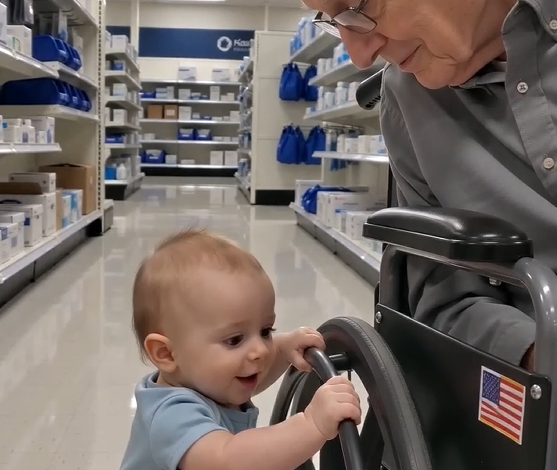
Marcus only looked away for four seconds.
He was standing in aisle four of the medical supply store, comparing prices on shower chairs, doing the tired math of a man whose whole month had been rearranged by his mother’s hip surgery. Physical therapy schedules. Insurance calls. And a stubborn seventy-one-year-old woman who cried at her own kitchen table because she couldn’t carry her grandson anymore.
His one-year-old, Theo, stood balanced against the shopping cart, holding on the way cruising babies do.
Four seconds. That’s all a cruising baby needs.
When Marcus turned back, the cart was empty air. Panic flashed hot for half a heartbeat — and then he spotted him. Six feet down the aisle, wobbling triumphantly on bare little legs, both hands locked around the big silver wheel of a stranger’s wheelchair like a tiny mechanic inspecting his work.
“Theo! Oh my god — sir, I am so sorry—”
“Don’t you dare apologize.” The old man in the wheelchair held up one hand without ever taking his eyes off the baby. “This is the best conversation I’ve had all week.”
His name was Walter. Eighty-nine. A Korea-era veteran with a small flag sticker on his chair frame and hands that shook a little when they weren’t resting on the armrests. He’d come to buy new seat cushions — his third solo trip since spring, when a stroke had put him in the chair for good.
He was there alone. Marcus would learn later just how alone. A wife, Ruth, gone two years. A son on the other coast who called on holidays. Days measured out in doctor’s appointments and grocery deliveries and a quiet apartment where the television talked so the silence wouldn’t.
Theo, of course, knew none of this. Theo had simply seen the most interesting machine in the entire store, driven by the most interesting man in it, and made an executive decision.
He bounced on his bent little knees — that springy, whole-body baby bounce — gripped the wheel rim, looked straight up into Walter’s face, and delivered a very serious address:
“Ba! Dadada… ba!”
Walter leaned forward, his weathered face folding into a grin Marcus suspected hadn’t been used at full strength in a while.
“Well, that’s a fine argument, young man,” he said gravely. “Very persuasive. But what exactly are we shopping for today?”
And here’s the thing that Marcus will tell people for the rest of his life.
Theo answered.
He let go of the rim with one hand — still anchored with the other, because a professional never loses contact with the vehicle — and pointed. Deliberately. Past Walter’s shoulder. At the display shelf behind him.
At a walker. The rolling kind, with hand brakes and a little built-in seat.
Marcus felt his face go hot. “Sorry — my mom. His grandma. She had hip surgery three weeks ago. We were looking at those earlier, he must have remembered—”
He stopped mid-sentence. Because it landed on him, all at once, what he was actually looking at.
Theo had been there last Sunday when Grandma tried to walk to the mailbox and had to stop, white-knuckled, gripping the fence. Theo had watched her wave away the walker brochure the hospital sent home. “I’m not shuffling around behind one of those old-lady contraptions, Marcus. I’d rather sit.” And she’d meant it — she’d been sitting ever since, in the chair by the window, shrinking a little every day, refusing the one thing that would give her back her kitchen, her garden, her grandson.
The whole family had argued with her. Her doctor had argued with her. Nobody had won.
And now her one-year-old grandson stood in a medical supply store, holding a stranger’s wheelchair, pointing at a walker with the calm certainty of a man concluding a business deal.
“He’s shopping,” Walter said quietly. “The little guy’s shopping for his grandma.”
“He can’t even talk yet,” Marcus managed.
“He’s talking fine.” Walter’s eyes didn’t leave Theo. “You’re just not fluent.”
Then the old man was silent for a moment, and his eyes went glassy behind his lenses.
“My Ruthie,” he finally said, “was ashamed of this chair. When I first got it — before she passed — she’d park me facing away from the window so the neighbors wouldn’t see. Like it was something to hide.” He tapped the armrest twice. “Took me months to figure out what to say to her. You know what finally worked?”
Marcus shook his head.
“I told her: Ruthie, it’s not a contraption. It’s freedom with wheels. The shame isn’t in the machine. The shame would be in staying put and letting the world go on without me.” He nodded at the shelf. “Your mother’s not refusing a walker, son. She’s refusing to admit the world changed. That’s not stubbornness. That’s grief. Treat it like grief and you’ll get somewhere.”
Marcus stood in aisle four of a medical supply store and felt his throat close, because a stranger had just explained his own mother to him better than three weeks of family arguments had.
“Buy the red one,” Walter added, businesslike, wiping one eye with a knuckle. “Nobody feels old in red. And you tell her an old soldier said a machine that gets you back to your grandbabies isn’t a machine for the weak. It’s a machine for people who have somewhere to be.”
Theo, sensing consensus, slapped the wheel rim twice like a gavel.
Marcus bought the red one.
He also got Walter’s phone number — pried it out of him, really, over the old man’s protests that he didn’t want to be anybody’s charity case. “It’s not charity,” Marcus said. “My son doesn’t grab just anyone’s wheelchair. He’s very selective.”
When Grandma opened her front door that evening and saw the red walker — bow on top, Theo slapping its little seat like a used-car salesman closing the deal of the year — she started to say no. Marcus watched the word form.
Then he told her what the old soldier said. All of it. Freedom with wheels. Somewhere to be.
She looked at the walker for a long moment. Then at Theo, who was now attempting to test-drive it into the hallway.
“Red,” she finally said, wet-eyed, in the voice of a woman losing an argument on purpose. “Well. At least it’s not beige.”
That was six months ago.
There’s a photo on her fridge now: Grandma and her red walker on the park path, Theo marching beside her holding the side rail with one little hand — “helping.” She walks to the mailbox every day. She walked to his birthday party. Last month, slowly, triumphantly, she walked him to the duck pond and back, and called everyone she knew about it.
And every other Sunday, they pick up Walter.
He and Grandma argue about card games and politics and whose grandson Theo actually is at this point. His apartment television stays off a lot more than it used to. The staff at the diner know his order.
Theo still greets him the same way, every single time. Both hands on the wheel rim. One firm bounce. Full eye contact. And the complete report:
“Ba! Dadada!”
And Walter always leans down, grins like a man with somewhere to be, and gives the same answer:
“You don’t say. Well — tell me everything, partner. We’ve got all the time in the world.”