The Housekeeper’s Little Girl Drew on a Millionaire’s Classic Car. What He Found in the Drawing Changed Everything

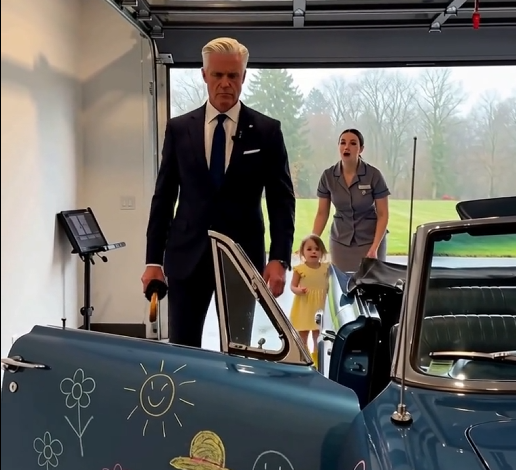
Nobody on the Whitaker estate touched the blue car.
It sat under the garage lights like a museum piece: a 1962 convertible, restored bolt by bolt, its paint so deep it looked wet. The staff dusted around it. The gardeners walked the long way past it. Even the mechanic who came twice a month spoke about it in a low voice.
So when Nora Hale stepped into the garage that Tuesday morning and saw her four-year-old daughter kneeling beside it with a fistful of sidewalk chalk, she forgot how to breathe.
“Mia.”
Mia looked up, delighted. Pink chalk dust covered her hands, her cheeks, and the front of her yellow dress. Behind her, across the whole driver’s side door, bloomed a garden of lopsided flowers, a smiling sun, and two figures standing side by side. One of them wore a large, round yellow hat.
“Mommy, look! I made it pretty.”
Nora had worked for Theodore Whitaker for six months. She cleaned his house, cooked his quiet dinners, and lived with Mia in the small cottage behind the main building. The job had arrived at the worst point of her life, a year after a divorce that left her with a car that barely ran and a stack of unpaid bills. It came with a salary, a roof, and a school nearby for Mia.
In all that time she had heard exactly one rule about the blue car: Mr. Whitaker doesn’t want anyone near it.
“Sweetheart, we have to clean this. Right now.”
She grabbed a soft towel from the shelf, but before she could touch the door, a voice spoke from the entrance.
“Don’t.”
Theodore Whitaker stood in the doorway. He was sixty-one, tall and silver-haired, a man who had built half the office towers in the city and now rarely left his own property. People in town called him cold. The staff called him private. Nora had never decided which word fit better.
He walked slowly toward the car. Nora pulled Mia close.
“Mr. Whitaker, I’m so sorry. It’s only chalk, it’ll come right off, I promise. She got out of the cottage while I was folding laundry. It won’t happen again.”
He didn’t answer. He was looking at the woman in the yellow hat.
“Who is this?” he asked quietly.
Mia pointed proudly. “That’s the lady from the big picture. In your hallway.”
Nora’s stomach sank. The portrait in the main hallway showed a laughing woman in a wide yellow sun hat, standing in a flower garden. Nora had dusted its frame every week without ever asking who she was.
“And this one?” Theodore pointed to the second figure.
“That’s you,” Mia said. “Because she looks lonely in the picture by herself. So I put you next to her. And I gave her flowers, because she likes flowers.”
For a long moment, the only sound in the garage was the hum of the lights.
Then Theodore Whitaker sat down on the step stool beside the workbench as if his legs had decided for him.
“Her name was Evelyn,” he said. “My wife. This was her car. She restored it with her father when she was nineteen. She used to drive it to the flower market every Saturday with that hat on.”
Nora didn’t know what to say. “I’m very sorry.”
“She passed three years ago.” He looked at the chalk flowers. “I haven’t been able to drive it since. I couldn’t sell it, either. So it just sits here.”
Mia studied him seriously. “You can drive it now. It has flowers again.”
Nora opened her mouth to apologize again, but Theodore raised a hand. Something in his face had loosened, the way ice cracks in early spring.
“Leave the drawing,” he said. “At least for today.”
That evening, Nora was drying dishes in the main kitchen when Theodore came in, which he almost never did.
“Your daughter,” he said, “notices things.”
“She does,” Nora admitted. “Sometimes more than I’d like.”
“I’d like to ask her something. With your permission.”
Mia was at the kitchen table, coloring on actual paper this time. Theodore sat across from her.
“Mia, you said you came into the garage this morning. Have you been in there before?”
Nora stiffened. Mia glanced at her mother guiltily, then nodded.
“Only to look. Not to touch. Except today.”
“When?”
“At nighttime. When I can’t sleep, I look out my window. And the garage light goes on.”
Theodore’s expression didn’t change, but his voice became very careful. “Who turns it on?”
“The car man.”
“The mechanic? Mr. Doyle?”
Mia nodded. “He comes when it’s dark. He takes boxes out of the little room in the back. And he puts them in his truck.”
Nora felt a chill. The back room of the garage was locked. She had never been inside.
Theodore stood without a word, took a ring of keys from a drawer, and walked out. Nora hesitated, then picked up Mia and followed.
The storage room behind the garage smelled of cedar and old paper. Shelves lined the walls, and on them sat labeled boxes: Evelyn — Garden Journals. Evelyn — Jewelry. Evelyn — Paintings.
Theodore opened the jewelry box first. It was nearly empty.
He opened the next one, and the next. A set of watercolor paintings was missing. So were a silver tea service, two antique clocks, and a velvet case that, according to its label, had once held Evelyn’s grandmother’s pearl necklace.
Theodore stood very still.
“I haven’t opened these since the funeral,” he said. “I couldn’t. Doyle knew that. He’s the only other person with a key to this room. I gave it to him so he could store car parts.”
Nora set Mia down gently. “I’m so sorry.”
“Don’t be.” He looked at the little girl. “If she hadn’t drawn on that car, I would never have walked into this garage. And I would never have known.”
The next morning, Theodore called the police and his attorney. A detective came by that afternoon, took photographs and a list of missing items, and asked Nora a few gentle questions. Mia, clutching her stuffed bear, told the detective about the garage light, the boxes, and the truck, and even drew a picture of the truck, complete with its dented back bumper.
Within a week, the detective called back. Several of Evelyn’s paintings had turned up at an auction house two towns over, consigned under Doyle’s name. The pearl necklace was recovered from a pawn shop. Doyle was charged, and most of what he had taken was returned in sealed evidence bags that Theodore signed for in his front hall, beneath his wife’s portrait.
When the detective left, Theodore stood in front of the painting for a long time. Nora watched from the doorway, unsure whether to leave him alone.
“Nora,” he said at last, without turning around. “Do you know how to drive a stick shift?”
She blinked. “My father taught me. A long time ago.”
“Good. Because I haven’t driven that car in three years, and I suspect my hands are shaking too much to do it alone.”
That Saturday, the blue convertible rolled out of the garage for the first time since Evelyn’s funeral. Nora drove. Theodore sat in the passenger seat with the window down. Mia sat in her car seat in the back, wearing a yellow sun hat that Theodore had found in one of the recovered boxes and given to her with a small, uncertain smile.
The chalk flowers were still on the driver’s side door. Nobody had washed them off.
At the flower market, the vendors recognized the car before they recognized the man. An elderly woman selling peonies put her hand over her heart.
“Theo Whitaker,” she said. “We wondered if we’d ever see this car again. Evelyn used to buy every white peony I had.”
Theodore bought every white peony she had.
Mia carried the smallest bunch back to the car, holding it like treasure.
A month later, Theodore asked Nora into his study. She came in nervously, still half-expecting that the whole episode would somehow end with her being let go.
Instead, he slid a folder across the desk.
“I’m reopening Evelyn’s garden,” he said. “The big one behind the east lawn. It’s been overgrown for three years. I’ll need someone to manage the household full time and help oversee the restoration. The position comes with a raise, and the larger cottage by the garden, if you want it.”
Nora read the offer twice. The salary was nearly double what she earned.
“Mr. Whitaker, I don’t know what to say.”
“Say yes.” He paused. “And there’s one more thing. Evelyn and I always meant to fund something for children in this town. We never got around to it. I’ve set up a small scholarship fund in her name for local families who need help with school costs. The first recipient is already chosen, when she’s old enough.”
Nora’s eyes filled. “You don’t have to do that.”
“I know.” He looked out the window, toward the garage. “Your daughter looked at a car I couldn’t bear to look at and saw flowers instead. I owe her more than a scholarship.”
That spring, the east garden bloomed for the first time in three years. There were roses and lilies, rows of white peonies, and a small patch near the gate that belonged entirely to Mia, who planted it herself, mostly in crooked lines.
On Saturdays, the blue convertible still went to the flower market. And on the driver’s side door, protected now under a thin clear coat that Theodore had applied by hand, a faded chalk garden still bloomed beside two figures and a big yellow hat.
People who visited the estate sometimes asked why a car that beautiful had a child’s drawing on it.
Theodore always gave the same answer.
“Because that drawing is the reason I started driving again.”