THE LITTLE BUBBLE TOY EVERYONE MOCKED MADE THE HEIRESS TAKE HER FIRST REAL STEPS TOWARD LIFE

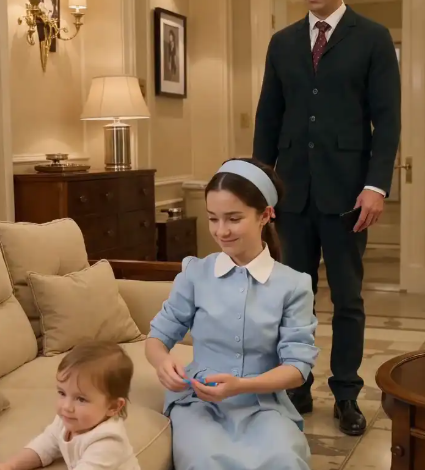
Lucas saw the reach before he understood it.
It wasn’t a full step. It wasn’t some movie miracle. Aria still clung to the end table with one hand, knees stiff, body tilted like she might retreat at any second.
But her free hand opened toward Sophie.
Not toward Lucas. Not toward Olivia. Toward the woman with the dollar-store bubble wand.
Olivia recovered first. “Okay,” she said sharply, forcing a smile that sounded nothing like one. “That’s enough excitement for today.”
Aria flinched.
Sophie lowered the wand at once. “She doesn’t have to keep going.”
That answer irritated Olivia even more. “Exactly. She needs calm. Predictability. Not… this.”
“This” was a few soap bubbles hanging in late afternoon light.
Lucas should have ended the moment there. That was what he usually did when conflict showed up in his home: pick the smoother voice, restore order, move on to the next call.
Instead he heard the pediatrician’s warning again. Your daughter does not need more management. She needs a reason to trust movement.
So he said, “Sophie stays until the trial week is over.”
Olivia looked at him like he had sided with a stranger over family.
Maybe he had.
That night, Aria was brought upstairs as usual when Lucas had two investors over for drinks. It was almost automatic by then. Staff moved quietly. Toys disappeared. The nursery monitor stayed on. The grown-up world stayed glossy downstairs.
Lucas didn’t question it until he passed the open nursery door and saw Aria standing in her crib, not crying, not calling, just awake and watching the hallway like someone who had been removed from her own life again.
He stood there longer than he wanted to admit.
The next morning, Sophie didn’t bring out anything fancy. No charts. No reward stickers. No expert language.
She brought back the same bubble wand and the same pinwheel.
She sat in nearly the same spot on the rug.
Aria was by the sectional this time.
Sophie blew three bubbles. Waited. Spun the pinwheel twice. Waited. Tapped the bubble bottle lightly against the floor. Waited.
The rhythm was so plain it almost looked stupid.
But Aria’s shoulders loosened.
Sophie was not trying to make her perform. She was making the room familiar.
On day three, she added one new thing: a plastic bowl from the kitchen turned upside down like a drum. Bubble, spin, tap-tap. Bubble, spin, tap-tap.
Aria’s eyes started tracking not just the bubbles, but the pattern.
On day four, Aria took two sideways furniture steps before Sophie even opened the bottle.
That was when Lucas understood the real difference.
Every expert had entered the room trying to extract a response.
Sophie entered like she had all day.
She didn’t stare Aria down. She didn’t celebrate too fast. She didn’t close the distance when Aria got brave. She showed the game first, let the game stay the same, and left a small opening inside it.
Choice.
That was what had disappeared after Aria’s mother died.
The accident had taken Emily in seconds. After that, every adult around Aria had become obsessed with preventing the next bad thing. No slipping. No stairs. No uneven surfaces. No reaching too far. No frustration. No risk. Lucas had told himself that was care.
He could see now what Aria had learned from it.
If everyone acted like movement was dangerous, then movement was dangerous.
Sophie never argued that point out loud. She just built a different truth, one repeatable minute at a time.
By the end of the first week, Aria would hold onto the coffee table and track Sophie from one side of the living room to the other. Once, she even made a tiny impatient sound when Sophie took too long unscrewing the bubble bottle.
Lucas laughed before he could stop himself.
Aria froze at the new sound.
Sophie glanced at him. “Soft reactions,” she said.
Nobody had ever spoken to him that way in his own home.
And somehow he didn’t mind.
He nodded once. “Right.”
Olivia minded enough for both of them.
At first she attacked politely.
“She’s getting dependent on one person.”
“This is not a real therapeutic method.”
“She should be learning proper routines.”
Then she attacked structurally.
When Sophie arrived on Monday, the rug was gone from the living room.
The bubble toy and pinwheel had been moved from the low cabinet Sophie used to the top shelf of a pantry closet.
The afternoon slot Sophie and Aria had fallen into was suddenly blocked with “scheduled language enrichment” through a video program on a mounted screen.
Aria sat in a tiny upholstered chair while a bright animated voice said, “Can you point to the apple?”
She did not point.
She did not move.
She folded back into herself so quickly that even Lucas, halfway through an email, felt it in the room like a temperature drop.
Sophie watched in silence until the session ended. Then she asked, very evenly, “Who changed her schedule?”
Olivia answered before Lucas could. “I did. This household needs consistency.”
Sophie looked at Aria, not Olivia. “Consistency with what? What shuts her down?”
Olivia’s chin lifted. “Excuse me?”
Lucas should have stepped in sooner. He knew that later.
But he was too busy seeing the truth unfold in ugly, simple detail.
Aria had spent four days becoming more alive. In one afternoon of polished, approved programming, she had disappeared again.
Sophie didn’t storm out. She didn’t argue for status she didn’t have.
She went to the kitchen.
A minute later she came back with the plastic bowl, a wooden spoon, and the bubble wand.
Olivia said, “No. We are not doing that now.”
Sophie crouched several feet away from Aria and began the pattern anyway.
Bubble.
Spin.
Tap-tap.
Bubble.
Spin.
Tap-tap.
No demand. No command.
Aria’s thumb stopped rubbing the chair seam.
Bubble.
Spin.
Tap-tap.
Aria lifted her head.
Olivia looked at Lucas. “Say something.”
He did. But not what she wanted.
“Let her continue.”
Olivia went cold. “You’re letting the nanny overrule me?”
Lucas’s jaw tightened. “I’m watching what helps my daughter.”
Aria made it out of the chair by herself that day—not into open space, not dramatically, but enough to grab the side of the console and start the sideways journey back toward the game.
Sophie did not praise too loudly.
Lucas did not move.
Olivia left the room.
After that, the power struggle stopped being subtle.
Olivia began referring to Sophie as “staff” whenever Lucas was around.
She told the housekeeper not to leave “plastic junk” in the common area.
She suggested that Aria’s grandparents would be distressed if they saw the child encouraged to “shuffle around furniture like that.”
That sentence landed harder than she expected, because Lucas’s parents were coming that Saturday.
Since Emily’s death, those visits had become performances.