THREE SILENT CHILDREN CHOOSE A STRANGER REFUGE WHILE A FROZEN MANSION MUST CHOOSE ITS FATE

The silence that followed the crash of the tray was so dense it seemed to press against the walls of the gallery.
Ernesto remained rigid in the doorway, fingers trembling, his eyes fixed on the plates scattered across the Persian rug. Julián Aldama didn’t move from his place beside the mahogany railing.
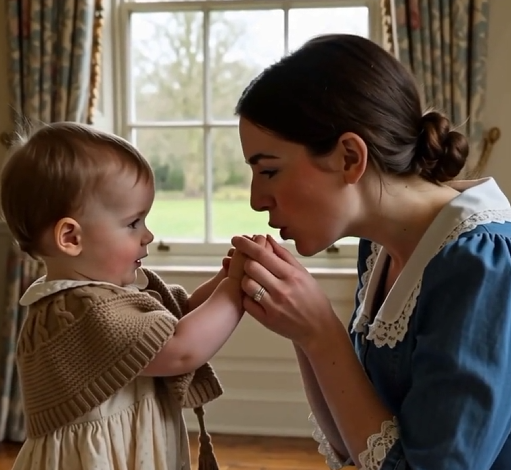
In her arms, Clara held Mateo, Lucas, and Leo with a natural steadiness that seemed to have always existed.
The little ones had their fists closed, gripping the young woman’s simple blouse.
None of the three was crying with the blind tantrum of before; they breathed in the same rhythm as she did, seeking the warmth of her neck as if it were the only solid certainty in a hostile world.
Julián took a step toward the center of the room, but his patent-leather shoes crunched over a splinter of porcelain.
Noticing the movement, Mateo turned his head slightly, fixed his dark eyes on his father, and hid his face again against Clara’s shoulder with an unmistakable tremor.
That silent rejection hurt more than any spoken reproach.
“Señor Aldama,” Ernesto interjected, recovering his posture and gathering the tray with calculated clumsiness.
“This is an inadmissible breach of the standards of conduct that you yourself laid down for this residence.”
“Garments belonging to your late father have been used for vulgar games, and the afternoon rest schedule has been completely violated.”
Valeria appeared at the end of the corridor, dressed in an impeccable cocktail gown, a glass of champagne still in her left hand.
“What is all this commotion upstairs, Julián?” she asked with a tight smile that didn’t reach her eyes.
“Our guests are still in the winter garden, and from down there you can hear noises unbefitting this house.”
Seeing the children wrapped in scraps of velvet and frayed scarves, her expression hardened into a grimace of disgust.
“For God’s sake, they look like beggars in their own room.”
“I told you that hiring a village woman without formal letters of recommendation would only bring disorder into our family.”
Clara didn’t lower her head or apologize.
She calmly stroked Leo’s back, his heart beating fast against his ribs.
“They are not beggars,” Clara answered in a soft voice, yet charged with a serenity that disarmed the arrogance of the room.
“They are children who have spent three years feeling that everything they touch in this house must remain untouchable.”
“Worn fabrics smell of time lived, not of disinfectant and empty solemnity.”
“For the first time, they haven’t been afraid to get their hands dirty.”
Valeria let out a short, contemptuous laugh that cut through the air.
“So now a trial employee intends to lecture us on child psychology?”
“Julián, dismiss her this very night before she ruins next week’s charity dinner.”
“My uncles will be attending, and your father’s name cannot be made a laughingstock because of a nanny who looks like she came out of a flea market.”
Julián looked at his fiancée, then turned his gaze back to his three sons.
For two years he had paid renowned neurologists, occupational therapists, and pedagogues who charged fortunes to issue ambiguous diagnoses in leather folders.
They had all agreed on the same thing: the triplets lived inside an insurmountable sensory wall and would probably never tolerate ordinary affectionate contact.
And yet there they were, all three, melted into an embrace with a woman who had been under his roof barely four days.
“The trial period stipulated two full weeks, Valeria,” Julián said in a grave voice, surprising himself at the lack of deference in his tone.
“Ernesto, clean this floor and remove the broken glass.”
“No one will leave this house until the signed term expires.”
Valeria gripped her glass until her knuckles went pale, turned on her heels, and disappeared down the hallway without uttering another word.
That night, the storm struck the great windows of the attic with relentless fury.
Julián couldn’t fall asleep in his ground-floor suite.
He poured himself a glass of whiskey in the study but left it untouched on the oak desk.
The quarterly financial reports lay spread out before him, but his eyes saw only the exact instant when three pairs of hands had reached for Clara instead of for him.
Near two in the morning, a deafening thunderclap shook the foundations of the property.
Julián climbed the spiral staircase, driven by a bitter premonition.
He expected to hear the sharp screams and rhythmic banging against the floor with which Mateo usually reacted to loud noises.
Reaching the upper gallery, he discovered that the door to the wide covered balcony was ajar.
The balcony was a tall space, ringed by arched glass windows that looked out onto the crowns of the century-old chestnut trees in the garden.
Clara had strung ropes between the white stone columns and hung three old sheets of pure linen, forming a kind of floating tent that the night wind stirred gently.
Inside the improvised tent, a small oil lamp cast warm shadows across the fabric.
The triplets sat in a circle on a rug of wool blankets Clara had rescued from the service trunk.
Clara held a flat mother-of-pearl button and a thick blunt-tipped needle threaded with emerald green.
She didn’t speak to them in complex sentences or use a condescending tone.
She simply hummed an old lullaby, keeping time with her bare heel against the wooden floor.
Tap, tap, tap.
Lucas, who had never held a tool without hurling it against the walls, extended his small fingers and pressed the button against the cloth of his old shirt.
Leo imitated the movement with a strand of blue wool.
Mateo rested his forehead against Clara’s knee and closed his eyes, lulled by the monotonous cadence of the sewing.
Julián stayed hidden behind the shadow of the stone arch, holding his breath so as not to break that moment of everyday miracle.
For the first time he understood the root of the tragedy suffocating his sons.
He had tried to cure them with structures, protocols, and specialists in white coats who measured their reactions with precision stopwatches.
He had surrounded them with wildly expensive but untouchable furniture, with imported toys that had to be kept on transparent shelves, and with staff who feared disorder more than they feared sadness.
Clara, by contrast, offered them the beauty of the imperfect.
The following day, the tension in the mansion became unbearable.
Ernesto placed his written resignation on Julián’s desk at nine in the morning.
“Señor, I cannot run a house where the staff’s schedules are ignored and where the children are allowed to eat fruit with their hands on the balcony.”
“Valeria has informed me that if this situation continues, the family foundation’s charity gala will not be held under this roof.”
Julián held the letter between his fingers for a long minute.
He remembered his father’s gaze, a man who had governed the family with an iron fist and a sickly obsession with social appearances.
He himself had grown up in that same mansion, afraid of spilling a drop of milk on the Belgian linen tablecloths, learning to silence his emotions so as not to disgrace the family name.
“Leave the letter on the table, Ernesto,” Julián ordered with cold serenity.
“And prepare to receive the gala guests this coming Saturday.”
“The children will be present.”
Ernesto’s eyes widened in contained astonishment.
“Present, señor? The triplets have never been exposed to an event of that magnitude; the doctors said a crowd would trigger a complete sensory collapse.”
“They will be present because this is their home,” Julián declared without raising his voice.
“And Clara will handle preparing them.”
In the days leading up to the party, Valeria’s resistance turned into a covert campaign of harassment.
She had the boxes of fabric Clara kept in the laundry room removed.
She ordered the cook not to provide snacks outside the strict schedule.
She even tried to lock the little ones in the nursery whenever Julián left for his board meetings.
But every attempt to restore the old order collided with an unforeseen barrier: the children no longer retreated into terror.
When Valeria tried to snatch from Leo a strip of linen he wore knotted around his wrist like a protective bracelet, the boy didn’t throw himself on the floor and beat his head.
He stepped nimbly aside, ran down the corridor toward the balcony, and took refuge behind Clara’s legs, looking back at her with defiance.
Clara never confronted the fiancée.
She simply sewed small patches shaped like animals into the hems of the children’s clothes.
A golden fish on Mateo’s sleeve to remind him he could breathe underneath the water of fear.
A swift deer on Lucas’s pocket to teach him his legs could carry him wherever he wanted.
And a small anchor on Leo’s chest to hold him steady when the world seemed to lurch.
They were ordinary objects, common threads any wealthy family would have thrown out as useless junk.
But to the triplets, they were the anchors that tied them to reality.
Friday afternoon, Julián decided to witness the progress for himself, with no intermediaries and no onlookers.
He canceled his last conference call and climbed to the balcony with a resolute step.
Clara was kneeling on the floor, teaching Mateo to join two scraps with a simple sailor’s knot.
Julián stopped a meter away, feeling absurdly clumsy inside his tailored Italian suit.
“They’ve never let me touch them without a storm breaking out,” he confessed quietly, with a vulnerability he had never shown anyone.
Clara raised her eyes and smiled at him with sincere gentleness.
“Because you always came close in order to correct them, Señor Aldama.”
“You tried to lift them the way one lifts a fragile vase that’s about to break.”
“Sit on the floor with them.”
“Take off your tie and let them discover whether you have anything to offer them besides fear.”
Julián hesitated for a fraction of a second.
Then he undid the button at his collar, removed his fine shoes, and sat down on the wooden boards of the balcony.
The silence that descended over the space was absolute.
Lucas looked up, drawn by the gleam of his father’s gold belt buckle.
Clara delicately picked up one of the old ties Julián had discarded years earlier and offered it to him.
“Tie it around your wrist, señor.”
“Let them see that you too are willing to play with what is broken.”
Julián followed the instruction with trembling hands.
Mateo crawled toward him slowly, sniffing the air like a cautious little animal.
He extended one finger and touched the blue fabric of the tie.
Julián didn’t try to lift him into his arms or force a caress.
He simply breathed deeply, closing his eyes to hold back the tears burning behind his lids.
Mateo laid his open palm on his father’s knee.
There were no screams.
There was no fleeing.
It was the first consented contact between a father and a son in three long years of desolation.
Saturday night arrived with the cold splendor that characterized the social events of the provincial elite.
Nearly a hundred benefactors, businessmen, and relatives of good lineage filled the main hall among crystal chandeliers and the music of a string quartet.
Valeria reigned at the center of the floor, radiant beneath the lights, assuring local journalists that the Aldama family was enjoying its finest moment.
“Julián has been an admirable pillar,” she said in a melodious voice over a cut-crystal glass.
“Soon we will formalize our engagement, and the children will begin a specialized boarding-school program in Switzerland to guarantee their definitive well-being.”
At that instant, the double doors of the great hall swung wide open.
Julián appeared in the doorway in a sober suit, but without the suffocating rigidity of other nights.
To his right walked Clara, dressed modestly but with dignity, holding Leo’s small hand.
Behind them came Mateo and Lucas, walking on their own feet, dressed in dark linen suits with discreet embroidery on the lapels and cuffs.
The entire hall fell silent.
The quartet’s music stopped as the conductor registered his surprise.
No one in that social circle had ever seen the three Aldama heirs walk in public without an escort of nurses and therapists.
Valeria approached quickly, her smile frozen into a mask of contained rage.
“What is this farce, Julián?” she hissed through her teeth so the guests wouldn’t catch her venom.
“You bring this servant into the main hall in front of all my people?”
“The children are going to have an episode any moment now — look at the way they’re staring at the lights.”
Julián didn’t give an inch.
“Clara is not a servant, Valeria.”
“She is the person who gave my sons back their voices when the rest of us had given them up for lost.”
At that precise moment, an inexperienced server tripped on the edge of a rug near the drinks table.
A tower of champagne flutes crashed to the marble floor with a brutal clatter that echoed through the vaults of the ceiling.
Several women screamed.
Valeria leapt backward, covering her dress with her hands.
The whole room held its breath, bracing for the inevitable catastrophe the triplets would unleash at such a shock.
Mateo shuddered violently.
Lucas took a false step backward, searching for something to steady himself.
Leo squeezed Clara’s hand with all his childish strength.
But the instinct that governed the three brothers in that unguarded second was not isolation.
Clara immediately knelt on the floor, opening her arms with infinite calm.
Mateo didn’t shut himself down on the ground.
Lucas didn’t run toward the dark corners.
All three ran to her in a desperate dash, throwing their arms around her neck — but this time Leo turned his head and with his free hand pulled at the leg of Julián’s trousers.
The boy tugged insistently, forcing his father down to his level.
Julián dropped to his knees on the polished floor of the hall, ruining the composure of his formal suit in front of a hundred astonished witnesses.
The three brothers wrapped Clara and their father in a single trembling but indestructible embrace.
Mateo lifted his small face, rested his cheek on his father’s shoulder, and spoke his first clear word in front of the entire gathering:
“Papá.”
The murmur that swept the hall was unanimous and shattering.
Valeria took two steps back, feeling the ground beneath her feet crumble forever.
No one was looking at her dress.
No one was commenting on the Swiss boarding school or her impeccable standing.
Every eye was fixed on the most powerful man in the region, weeping on his knees in the middle of the room while his sons accepted him as part of their refuge.
“This is a ridiculous display, unworthy of your class,” Valeria muttered, trembling with humiliation.
Julián rose slowly, holding Leo in one arm and letting Mateo cling to his right hand with a new strength.
“The only ridiculous thing in this house has been believing that coldness was a mark of distinction,” Julián replied with implacable firmness.
“Our wedding will not take place, Valeria.”
“Ernesto will ask your driver to load your belongings tonight.”
The woman turned and left the hall with her head down, while the murmurs of the attendees swelled into a wave of admiration no one dared contradict.
The butler, standing by the main door with his hands crossed behind his back, lowered his gaze.
For the first time in thirty years of rigid service, Ernesto felt a tear run down the corner of his wrinkled cheek.
That same night he withdrew his resignation and promised his employer he would learn to serve breakfast without watching the clock.
The two weeks of the trial contract came to an end on an autumn Tuesday.
The morning sun came in golden through the arches of the balcony, lighting the baskets of wool and the old garments that were now a natural part of the home’s décor.
The triplets played on the floor with wooden blocks, but they no longer lined them up in mute, anguished rows.
They built imperfect bridges, laughed when a tower collapsed, and passed the toys from hand to hand with an ease that filled the room with life.
Clara came down the staircase with her canvas bag over her shoulder.
Julián was waiting for her beside the lit fireplace in the entrance hall.
On the coffee table lay a permanent employment contract with a salary that multiplied any market offer tenfold.
Beside the papers were a signed blank checkbook and the deed to a commercial space in the city’s historic quarter, so she could set up her own artisan design workshop.
“Stay, Clara,” Julián asked her, his voice tinged with sincere pleading.
“This house needs you in order to keep breathing.”
“I need you in order to learn to be the father they deserve.”
Clara looked at the documents on the table and then raised her eyes toward the upper gallery, where Mateo, Lucas, and Leo were watching her, leaning on the wooden railing.
None of the three was crying.
They wore their small fabric amulets knotted to the collars of their shirts.
Leo raised his right hand and waved his fingers in a goodbye that was clear, serene, and unafraid.
They had learned to trust the world.
They had learned that love does not disappear when a person walks through a door.
“They don’t need me in order to keep breathing, Señor Aldama,” Clara answered with a soft smile overflowing with gratitude.
“My job here was not to become their owner or their only lifeline.”
“My task was to open the door you had locked with seven keys.”
“Now you know how to sit on the floor.”
“Now you know that a broken tie is worth more than a spotless family name if it serves to dry a tear.”
Julián understood the weight of her words with a mixture of pain and reverence.
He took the young woman’s hand and pressed it between his own with absolute respect.
“At least accept the sewing workshop,” the man insisted, deeply moved.
“Not as payment, but as testimony that things made by hand can save an entire family.”
Clara nodded slowly, taking up the keys to the shop with humble pride.
She walked toward the oak front door, which for the first time in years stood open to the fresh air of the park outside.
Before stepping out, she looked up one last time.
Julián climbed the stairs two at a time until he reached the landing where his three sons waited.
He knelt among them, wrapped them in both strong arms, and pressed them against his chest while the triplets buried their small faces in his jacket.
Ernesto held the door open with a compassionate smile on his lips.
Clara crossed the threshold under the golden breeze of the morning, knowing that the Aldama mansion would never again be a frozen palace.
The miracle was complete: the house now knew how to love on its own.