THE BILLIONAIRE ORDERED HIS GARDEN CLEANED EVERY MORNING TO ERASE HIS LATE WIFE MEMORY BUT THE UNTRAINED NANNY BURIED HIS TRAUMATIZED DAUGHTER IN DEAD LEAVES UNTIL SHE FINALLY BROKE HER SILENCE

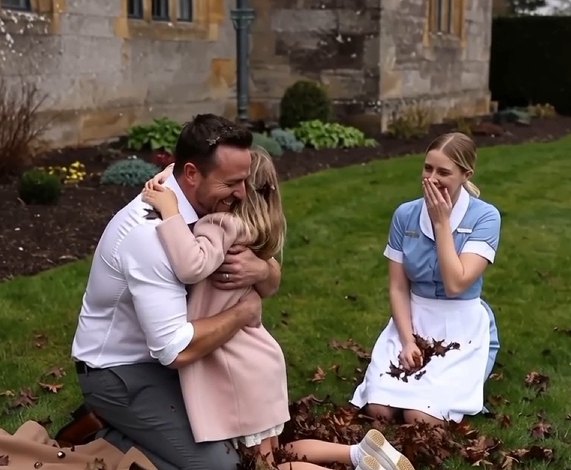
She dropped straight to her knees on the floor, curled her small body into a tight, trembling ball under a heavy mahogany console table, and clamped her hands over her ears.
For a moment the room did the thing rooms do — the collective flinch, the one woman’s nervous laugh, the caterer scrambling for the shards. Then forty people turned and saw a child on the floor underneath the furniture, and the laughter died.
Victoria reached her first.
“Ella. Ella. Get up.” She crouched, her emerald silk hitching, and took hold of the girl’s upper arm. “Darling, everyone can see you. We talked about this. Up. Up, now.”
Ella made a sound. Not a scream — worse. A thin, airless keening, the noise of a creature that has learned that screaming brings people closer.
“She’s doing it for attention,” Victoria said over her shoulder, to the room, with a brittle smile. “Grief response. Perfectly manageable.” And to the dressing assistant: “Help me get her up before the Mitchells see.”
“Don’t.”
Ruby came through the crowd in a flannel shirt and work boots, having been in the staff corridor, having been told explicitly not to enter the house during the dinner, having heard the glass from two rooms away.
Victoria’s head snapped around. “You were instructed—”
“Let go of her arm.”
“I beg your—”
“She can’t hear you,” Ruby said. “Her hands are over her ears and her heart rate is somewhere around one-eighty and you’re pulling on the only part of her body she can’t get away from. Let go.”
Something in the flatness of it made Victoria’s hand open.
Ruby did not go under the table.
That was the part that confused everyone watching, including Ethan. She stopped about six feet short of the console, and she sat down on the hardwood floor among the broken glass in front of forty of the most powerful people in the city, and she did nothing at all.
She didn’t speak to Ella. She didn’t reach for her. She sat cross-legged with her hands open on her knees and she breathed, slow and audible, in through the nose and out through the mouth, the way you breathe when you want someone to borrow your rhythm.
The chamber musicians had stopped. Nobody told them to start again.
Thirty seconds. A minute. A board chairman stood holding a plate of oysters with no idea where to put it.
Ruby reached into her shirt pocket.
What came out was a single dried oak leaf, brown and curled at the edges, the kind the lawn crew blew off the grounds before sunrise every morning of the year.
She set it on the floor in front of her. Then she flicked it with two fingers, gently, so it skittered across the boards and came to rest about a foot from the dark gap under the console.
She breathed. She waited.
Nothing.
She took out a second leaf and did it again. It landed short. She didn’t correct it, didn’t adjust, didn’t lean closer.
“Ethan, this is grotesque,” Victoria whispered. “She’s playing while your daughter is—”
“Be quiet,” Ethan said.
It was not loud. It carried anyway.
On the fourth leaf, a hand came out from under the table.
Small, shaking, white at the knuckles. It closed around the leaf and dragged it back into the shadow. A second later came the dry, unmistakable crunch of a child crushing a leaf in her fist.
And then — in a drawing room containing four Fortune 500 directors, two senators, and the entire acquisitions board of Vance Holdings — Ella Vance’s hand came back out and threw a fistful of crushed oak leaf into the air, where it caught the chandelier light and came down in a small brown snow over the polished floor.
Somebody in the back of the room said, “Oh my God.”
Ruby threw her own handful up. It drifted down.
The hand came out again.
Ethan Vance set his glass on a side table, walked across his own drawing room, and sat down on the floor.
He didn’t go under the table either. He sat down beside Ruby in a four-thousand-dollar suit among the broken crystal, and he put his palm flat on the boards, and he waited, exactly as she had, because for the first time in fourteen months he understood that the waiting was not the obstacle. The waiting was the entire thing.
“Don’t pick her up,” Ruby said quietly. “She came down on her own. She has to come up on her own.”
“I know,” Ethan said. His voice was not steady. “I’m learning.”
It took nine minutes.
Nine minutes with forty people standing in silence around a father and a hired girl sitting on a floor flicking dead leaves across hardwood, while a six-year-old came out from under a console table one inch at a time, dragging her patent-leather shoes, her bun collapsing, her face swollen and wet.
She did not go to Ruby.
She crawled the last three feet, climbed into her father’s lap with her whole body, pressed her forehead into his shirt collar, and cried — out loud, wet, undignified, inconsolable, the way six-year-olds are supposed to cry.
It was the first sound she had made in fourteen months that wasn’t silence.
Ethan held his daughter on the floor of his drawing room and wept into her hair, and nobody applauded, because Ruby had said to him once, on a terrace, whatever you do, don’t clap. She’s not performing.
“The Mitchells left at seven,” Victoria said in the study at eleven. “The Hendersons. Your entire west-coast table. You sat on the floor, Ethan. There were photographs.”
“Good.”
She stared at him. “What?”
“Richard Henderson called me at nine-thirty. His grandson is four and hasn’t spoken since March. He wanted Ruby’s full name.” Ethan was standing at the window with his tie gone and glass dust still on his knees. “He asked what she did. I didn’t have an answer for him. She sat on the floor and she waited. That’s it. That’s the whole technique.”
“She humiliated this family.”
“She got my daughter out from under a table.”
Victoria’s jaw worked. “I have spent eight months trying to—”
“I know you have.” And he did know; that was the hardest part. She had walked into a house full of catastrophe and been handed a wrecked man and a silent child and done the only competent thing she knew how to do, which was make it all look correct. She had genuinely believed correct and well pointed the same direction. “I asked you to hold this house together. You did. I never once asked whether holding it together was the right thing to do, and that’s mine, not yours.”
“Don’t be gracious at me.”
“Today a girl in work boots put a dead leaf on my floor and my daughter laughed,” Ethan said. “I’d have traded the entire west-coast table for it. I’d have traded the company.”
She left on Saturday. There was no screaming. There rarely is, in houses like that — just garment bags, the Peloton, the framed photograph from the hall table that was mostly of her.
The landscaping order was changed on Monday morning. The crew was instructed to blow the drives and the walkways and to leave the east lawn entirely alone from September through December.
By the second week of the following autumn there was a drift of red maple under Sarah’s tree eighteen inches deep, and the grounds manager, who had worked there eleven years and had never once been thanked for anything, told his wife it was the proudest thing he’d ever not done.
It did not get easy.
That’s the part nobody repeats at dinner parties, where a billionaire sits down on a floor and a silent child cries and everyone goes home improved.
There were months of regression. There was a night in January when a car backfired on the drive and Ella went flat on the hallway carpet and stayed there forty minutes while her father lay down on the boards beside her — not touching, just there, breathing loud enough to be heard — until her hands came away from her ears.
A new psychologist came in the spring, found by the pediatrician rather than by a board member’s wife. She spent her first session on the playroom floor doing almost nothing, and afterward told Ethan: She isn’t mute. She’s braced. Those are completely different problems and someone’s been treating the wrong one for a year.
He wrote the sentence down. It’s still in his desk.
The first word came in February. It wasn’t Daddy and it wasn’t her mother’s name. It was “again,” said flatly to Ruby on the lawn, holding out her two cupped hands.
Ruby nearly dropped the rake and had the enormous presence of mind to react not at all. She filled the small hands with leaves. She said “okay.” She went on raking, and waited until the child had gone inside before she sat down against the tree and cried into her sleeve.
She explained it to Ethan that night when he asked whether they should mark it somehow, tell the grandparents, call someone.
“No,” Ruby said. “The whole point is that nothing happens when she talks. Same as nothing happened when she came out from under the table. She’s checking whether the world stays ordinary.”
So nothing happened. Every time Ella spoke, for weeks, absolutely nothing happened.
Which is exactly why the words kept coming.
Sarah’s things came out of storage that March.
Not all at once, and not as a shrine. Ruby’s only suggestion was that Ella choose, and that nobody in the house flinch at whatever she chose, which turned out to be a green canvas gardening jacket with a torn pocket and a pair of leather work gloves far too large for anyone under thirty.
Ella wore the gloves to rake in. She wore them for two full autumns, and then one year she didn’t, and nobody said anything about that either.
Ruby stayed three years.
She was not a saint and would have hated the version of this where she is. She was twenty-three, late most Mondays, played her music too loud in the mudroom, and once let Ella eat cereal for dinner four nights running because the sound of the spoon in the bowl was the only thing working that week.
She left for a developmental psychology program upstate, which Ethan paid for under an arrangement she made him rewrite twice until it stated in plain language that it required nothing of her: no return, no further employment, no obligation of any kind, and that Ella was not a condition of any part of it.
She came back most Novembers anyway. Ella would hear the truck on the gravel and come down the staircase far too fast.
The Thanksgiving dinner happened again the following year.
Same house, same caterers, fewer guests, and no ice sculpture. Richard Henderson came, and brought his grandson, who was five now and said about nine words and liked to get under things.
At some point in the late afternoon a serving dish went down in the hall with a crash, and the room did that collective flinch.
Ella — seven years old, in a sweater she’d picked herself, no bun — looked at the Henderson boy already sliding off his chair toward the dark space beneath the console table.
She went out through the terrace doors without asking anyone.
She came back with both hands full of red maple, sat down on the hardwood about six feet from the table, and threw a fistful up into the chandelier light.
And waited.