The Teddy He Would not Let Anyone Else Carry

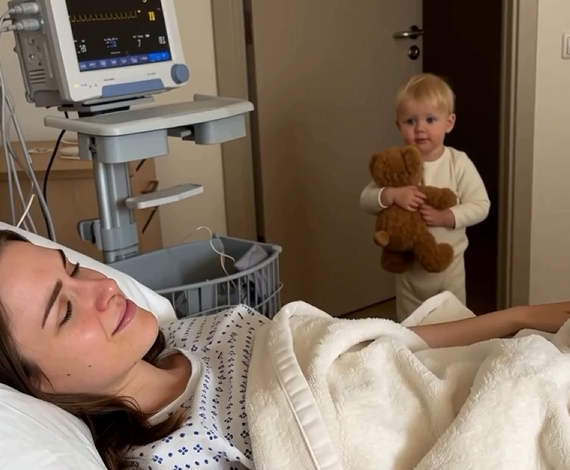
What they understood later, and did not understand then, is that he was not refusing.
He was eighteen months old. He had been in that building twice before and both times it had smelled like this and both times his mother had not come home with him afterward. He didn’t have the words for hospital or sick or for a while longer, sweetheart. He had the smell, and the beeping, and the fact that the last two times he’d come here, something had gone wrong.
So he stood in the doorway and worked it out, the way you work something out when you are a year and a half old, which is slowly and entirely with your body.
His grandmother said afterward it was maybe thirty seconds. The nurse at the station said closer to two minutes. Either way it felt to everyone watching like something you could not interrupt.
Then he took one step.
Not a run. Not the stumbling charge he did at home down the hallway. One deliberate step onto the hard floor, and a pause, and then another, with the bear still clamped against his chest with both arms so that he couldn’t put his hands out for balance and wobbled badly the whole way.
The bed was high. He got to the side of it and could reach the blanket but nothing above it. He stood there with his face level with the mattress and his mother’s hand lying a foot above him, still lifted, shaking a little now.
And then he did the thing nobody expected.
He pushed the bear up onto the bed.
Not handed. Pushed — both arms over his head, shoving it up onto the white sheet beside her hip, the way a toddler gets anything onto a surface too tall for him. It went up crooked and flopped onto its side and he patted it twice, flat-handed, the way she patted him.
Then he put his forehead against the side of the mattress and held on to the blanket with both fists.
His mother made a sound that the nurse in the corridor would remember for the rest of her career.
Here is what the adults in the room had not known.
The bear was hers from childhood. It had sat on the shelf by her bed through three house moves, a marriage, and a pregnancy, and the rule in that house — a soft rule, a joke-rule, the kind families have — was that it was Mama’s and nobody else got to hold it. For eighteen months that had been the one object in the entire apartment the boy was not given when he reached for it.
Which meant he knew exactly what it was.
He knew whose it was. And he had spent two days in a strange house with his grandmother, in a routine that had come apart, and on the morning they told him he was going to see his mother, he had gone and got the one thing in the world that belonged to her and carried it the whole way without letting anyone else hold it, including when he got tired, including in the car, including when the lift doors opened and he got frightened.
He hadn’t brought his own comfort object to a scary place.
He had brought hers to her.
She was in that room another eleven days.
They got better at the visits. He stopped pausing in the doorway by the fourth one; by the sixth he came through it at a wobbling run and had to be caught by the rail. The bear stayed on the bed the entire time, because he left it there every evening — the first night his grandmother tried to bring it home with them and he arched his back and shrieked in the corridor, and she understood, and took it back in and put it on the blanket, and he went quiet immediately.
A nurse put a note on the whiteboard: Bear stays. Do not launder.
It got moved to the chair during one bad night. It got moved back.
His father, who had been doing the thing that fathers do in these situations — which is to say staying functional, handling the logistics, speaking calmly to the consultants, and not once sitting down — was the one who found him on the ninth day asleep on the hospital floor, wedged between the chair leg and the bed rail, with one hand up through the gap holding the edge of the blanket.
That was the day he stopped being functional. He sat down on the floor beside his son with his back against the bed and put his face in his hands, and his wife reached down and put her hand on the top of his head and didn’t say anything, because there was nothing to say that wasn’t already happening.
She came home on a Thursday.
She came home. That’s the part that matters, and it is also the part that is easy to make too much of, because it was not a miracle and nobody got a speech — it was a long illness with a good outcome, which is something that happens to some people and doesn’t happen to others for no reason anyone can satisfactorily explain.
What was different afterward was small and permanent.
The bear came home in a carrier bag and went back on the shelf by the bed, and the rule changed. It stopped being Mama’s. It became the thing the boy was handed whenever anything hard was about to happen: injections, the first day of nursery, the week she went back in for scans and they all pretended not to be counting the hours.
He carried it the same way every time. Both arms. Chest height. Not so he could hold on to it.
So he could give it to somebody.
He’s nine now, and he has absolutely no memory of any of it.
He has seen the video — thirty-one seconds, shot vertically and badly by his grandmother from the corridor, frame tilted, the room’s flat ceiling light making everyone look slightly ill. A toddler in a cream outfit standing in a doorway with a bear. A woman’s head turning on a pillow. A hand lifting a few inches off a blanket.
He watched it once, when he was seven, and said: “Why am I just standing there?”
His mother said, “You were deciding.”
“Deciding what?”
And she said what she has said every time since, which is the only thing she has ever been able to come up with that is both true and sayable to a child:
“Whether it was safe to come in. And then you came in anyway.”