My Son Didn’t Smile for Six Months. Nobody Thought to Check His Eyes.

The number, when it came, was minus eleven.
Both eyes. Severe congenital myopia, the kind that almost always runs in a family and in this case ran in nobody, picked up by nothing, because you cannot ask a baby to read a chart and because a baby who has never seen clearly has no way to tell you that the world is wrong.
The consultant explained it to them in a flat gray room in a way they both remember word for word.
“He can see light. He can see shapes if they’re close. Past about twenty centimetres, everything is a blur of color and movement.” A pause. “He’s never seen your face. Not properly. He’s seen a sort of pale smudge that comes toward him and makes a familiar sound.”
His mother said, “He doesn’t smile at us.”
And the consultant said: “No. He wouldn’t. There’s nothing there to smile at.”
The glasses took nine days to come.
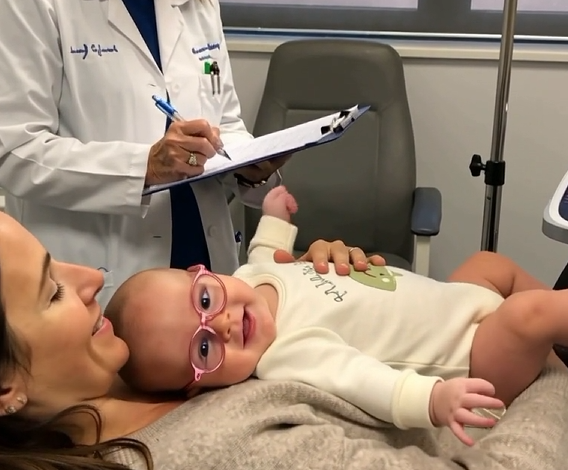
They were pink, because that was the smallest frame the lab had in stock and nobody was prepared to wait another two weeks for a different colour. Wire, with a soft strap that went round the back of the head so a six-month-old couldn’t fling them across a room, which he would.
The fitting was on a Thursday. His father filmed it on a phone with eleven percent battery, sitting in a plastic chair by the window, filming sideways like everybody does.
The optometrist — fifties, short dark hair, white coat over a blue shirt — lifted the little frames in both hands and brought them toward his face.
His eyes followed them in and crossed.
She stopped an inch from his nose. He blinked twice. She settled them onto the bridge and ran the strap round behind his head with both hands and let go.
And he went completely still.
A full second. His whole body locked — not frightened, just stopped — and his eyes moved up and found her face and stayed on it.
Stayed.
For the first time in his life, something in front of him had edges.
And then he smiled.
Not a flicker. Not a wind-smile that you talk yourself into. His whole face came apart with it, mouth open, both arms flying up, one leg kicking out — the enormous, unmistakable, delighted smile of a baby looking at a person.
At a woman he had never met.That’s the part that destroys everyone who watches it, and his mother has never once been able to explain it without her voice going.
The first face her son ever saw properly belonged to a stranger in a white coat.
She was standing four feet away, behind the camera, and she watched her six-month-old look at somebody else and light up like a house.
She has been asked, kindly, by several people, whether that was hard.
“For about two seconds,” she says. “And then she turned him toward me.”
Because that’s what the optometrist did. The video keeps going — his father’s phone was at eleven percent and it lasted another ninety seconds — and you can see her hands come in and turn the chair gently, forty-five degrees, toward the window.
Toward the two people sitting in the plastic chairs.
And the baby’s eyes travel across the room, slowly, the way you’d scan a landscape, because everything in that room was brand new and had never had an outline before. The lamp. The wall. The gray window.
And then they land.
You can hear his mother on the audio. It’s not words. It’s a sound.
He looked at her for a long time. Longer than he’d looked at the optometrist — four, five seconds, which is an eternity for an infant — and his mouth moved and his eyebrows went up and his hands opened and closed.
And then he smiled at his mother for the first time in his life, at six months and eleven days old, and she went down on her knees on a clinic floor.
His father stopped filming at that point. He has said since that he doesn’t know why; he just stopped. The last frame of the video is the ceiling.
The optometrist’s name was Frances. She’d been doing it thirty-one years.
She told them — later, while writing up the notes, in the matter-of-fact way of someone who has learned to be matter-of-fact about this specific thing — that she sees it about twice a year.
“And it’s always the same,” she said. “They don’t look at their mum first. They look at whoever’s nearest. People think that means something. It doesn’t. It just means I’m the one holding the glasses.”
Then she said the thing they wrote down in the car and have kept since:
“Go home and show him everything. He’s six months behind on faces. You’ve got some catching up to do.”
They did.
For about three weeks they did nothing else. They held him up to the mirror and he screamed with laughter at himself. They took him round the house pointing at things. They put him on the floor in front of the cat, which he had apparently believed was a moving smell.
He smiled at everybody. At the postman. At a woman in the queue at the chemist, who got visibly emotional and had no idea why she’d been chosen.
He flung the glasses off roughly forty times a day for the first fortnight, and then one morning stopped, and never really did it again, and nobody knows what changed except presumably that he worked out the trade.
He’s four now.
Minus eleven doesn’t go away; it gets managed. He’s in his sixth pair. The current ones are blue and have a dent in one arm from an incident involving a slide. He will almost certainly wear glasses or lenses for the rest of his life, and he has absolutely no feelings about this whatsoever, because he has never known anything else.
He has been told the story so many times he can tell it himself, with the confident inaccuracy of a four-year-old.
“I couldn’t see and then the lady gave me glasses and then I saw Mummy and Mummy cried.”
That’s basically right.
The first pair is in a box at the back of a wardrobe, with the hospital band and a scan photo. Tiny pink wire frames, smaller than the palm of a hand, with a soft strap gone slightly gray.
His mother takes them out roughly once a year, which is more than she admits to anybody.
She says the thing she thinks about isn’t the smile.
It’s the second before it. That full second where he went completely still and didn’t move at all — a six-month-old who had never in his life seen a human face, holding absolutely still while one arrived.