The Baby Slapped the Boots, and Then He Patted His Father the Same Way

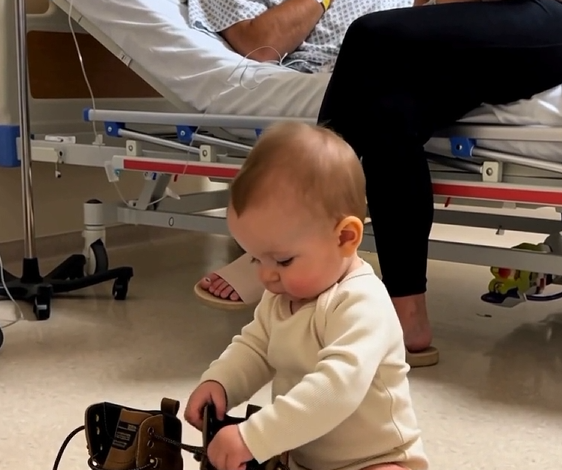
The thing about a long hospital stay is that it hollows out the room’s meaning.
Everything in there belongs to the hospital. The bed, the sheets, the jug, the chair, the blanket — it’s all institutional, all beige, all the property of a building. After three weeks a family stops seeing it.
The boots were the only thing in room 9 that belonged to the man in the bed.
That’s why she couldn’t take them home, and that’s what she worked out, eventually, sitting there watching her son try to pick one up.
They were the only object left in the room that came from before. Mud from a real walk, on a real Sunday, in a life that had still been going on three weeks ago. Everything else in there was the aftermath.
And her son — who had been handed to nurses, passed between grandparents, held up to a bed rail, and generally shuttled around a situation nobody had explained to him because nobody could — had crawled across a hospital floor and found the one thing in it that smelled like his father.
He was not playing with boots.
He’d gone looking for the right smell and found it, and then he’d sat down next to it.
She picked him up at some point and put him on the bed, which she wasn’t really supposed to do, and nobody said anything because by week four the staff on that ward had stopped saying anything about much.
He crawled up the blanket as far as his father’s hip and stopped and patted it.
Flat-handed. Twice. Exactly the way he’d patted the boots.
And the man in the bed opened his eyes.
Not dramatically. There was no gasp, no squeeze of the hand, nothing anyone would put in a film. He had been drifting in and out for days; this was just one of the outs.
But his eyes went down and found the baby on the blanket, and stayed there a few seconds, and then his mouth moved and nothing came out of it.
His wife said, “He’s been playing with your boots.”
And her husband made a sound that was almost a laugh and shut his eyes again.
That was the whole thing. Eleven seconds. It is not even in the video — the video is forty-three seconds of a baby hitting footwear and ends before any of it.
He came home in November.
The boots went home before he did, in the end — she took them out to the car on day thirty-one and this time she didn’t bring them back in, and she sat in the hospital car park for a while afterward because it had turned out, just as she’d suspected, to be a decision after all.
Only not the one she’d been afraid of.
They’re in the hall at home. Not worn; he can’t do that kind of walking now and probably never will again. They sit by the radiator with the cut laces still in them, which anybody sensible would have replaced four years ago.
Their son is five.
He has no memory of the ward, the floor, the chair, or any of it. What he has is the hall, where there has always been a pair of brown boots that nobody wears and nobody moves, and a mother who once told him, when he was three and asked, that they were Dad’s walking boots from before his heart got poorly.
He asked the obvious follow-up at four.
“Why don’t you throw them away?”
And his father — who does short flat walks now, twenty minutes, on good days, in a pair of trainers — said the thing he’s said every time since.
“Because you found me in the hospital with those.”
Which is not strictly accurate. But it’s near enough.