THE TECH BILLIONAIRE FORBADE ANYONE FROM LETTING HIS DAUGHTER TOUCH THE FLOOR UNTIL THE NEW NANNY HUNG WET SHEETS ON THE TERRACE

“What are you doing? Security, remove her!” Julianna hissed, her voice splintering.
Nobody moved. Eighty people stood on a lawn with champagne in their hands and watched a twenty-three-year-old in worn jeans walk out of the shadow of the terrace stairs carrying two armfuls of damp laundry.
Avery didn’t go to Chloe.
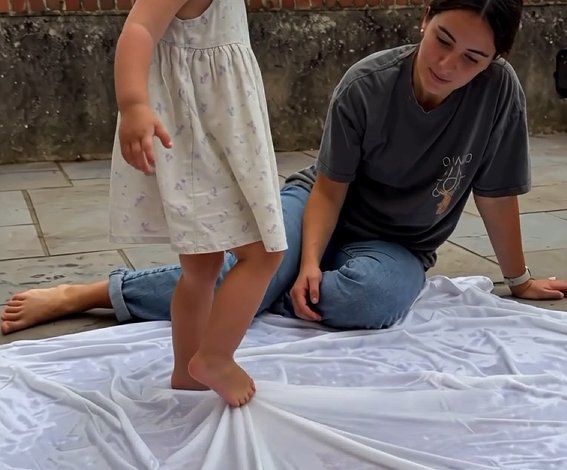
She walked past the marquee, past the banquet tables, past the string quartet standing with their bows down, to the two tent poles at the near corner of the lawn — and she threw a sheet over the guy line and pulled it down and knotted it at the bottom, and then did the same with the second one, four feet away.
It took eleven seconds. It was the least elegant thing that had ever happened on that property.
What she had made was not a tent. It was two sheets hanging from a rope with a gap between them, about three feet high at the lowest point, sagging in the middle, making a small shaded tunnel over a patch of grass.
Then she sat down on the ground at one end of it, folded her legs, and took a wooden clothespin out of her pocket.
Tap, tap. Pause.
Tap, tap. Pause.
“Ethan,” Julianna said, “this is a catastrophe. Get the nurse. Get her inside—”
“Shut up.”
He said it quietly and without turning around, and Julianna’s mouth closed.
Because his daughter had stopped screaming.
Not stopped crying — she was still crying, still shaking, still rigid in the nurse’s arms with sick down the front of the lace dress. But the shrieking had broken off, and her head had come round, and her eyes had found the white cloth sagging over the grass.
Tap, tap. Pause.
Chloe twisted hard in the nurse’s grip.
Ethan said, “Put her down.”
“Sir, she’s—”
“Put her down on the grass.”
The nurse put her down on the grass.
And Chloe Vance, four years old that day, who had not voluntarily put her own weight on the ground in ten months, who had been carried from room to room through a house with twenty-foot ceilings like something being transported, got onto her hands and knees in a two-thousand-dollar dress.
And crawled.
Eighty people. The string quartet. The entire charity board. A woman in an emerald gown with sick on her hem.
Nobody made a sound.
She crawled eleven feet across the lawn into the shade of two bedsheets, and when the cloth passed over her head and she had something above her — something close, something she could see — she sat down in the grass and stopped shaking.
Avery did not touch her. She kept tapping.
Tap, tap. Pause.
Ethan got there about four seconds later.
He did not crouch, and he did not kneel. He went down flat on the grass in a four-thousand-dollar suit and crawled under a bedsheet, on his elbows, in front of every investor he had.
Inside it was close and dim and smelled of laundry detergent and warm cotton. The light came through the sheet soft and white. The ceiling was three feet high.
His daughter was sitting in the grass with her knees up.
He didn’t reach for her. He had learned that much through a pane of glass over four days.
He sat down awkwardly with his back bent under the cloth and put his hands in his lap, and Avery slid the clothespin across the grass and he picked it up and tapped it on the ground.
Tap, tap. Pause.
He got it wrong the first three times — too fast, too loud, too eager.
Avery didn’t correct him. She just let the child’s reaction do it, and on the fourth try he slowed down, and Chloe’s head came round.
She looked at her father. Properly. The way she had not looked at anyone in ten months.
Then she shuffled across about eighteen inches of grass and sat down against his leg, and put her hand over the top of his hand, over the clothespin, and pressed down.
Ethan Vance put his head down under a bedsheet and wept in front of nobody at all, which was the first privacy he’d had in a year.
They stayed under there twenty-five minutes.
Outside, the quartet started up again, eventually, because someone had the sense to nod at them. The caterers kept circulating. Eighty people had an extremely strange hour and then, being who they were, began to talk about other things.
Constance Hale — seventy-one, chair of the foundation, a woman who had buried a daughter in 1998 — stood near the tent line for most of it and did not let anyone go past.
When Ethan finally came out, grass all down one side of him, carrying a four-year-old who had fallen asleep against his collar, Constance said one sentence to him and then walked away before he could answer.
“My mother did something like that for me during the war, and I have never forgotten it.”
“The board,” Julianna said in the study at eleven that night. “The Hendersons left at seven. There were photographs, Ethan. You crawled on the ground.”
“Yes.”
“Do you understand what they’ll say?”
“They’ll say my daughter crawled eleven feet across a lawn on her own,” he said. “Which she did.”
“You humiliated me.”
He looked up at that, and something in his face made her stop.
“She was sick on your dress,” he said, “and your first sentence was that she was humiliating us. I heard it. The nurse heard it. I’ve been hearing things like that for ten months and telling myself they were about stability.”
“Somebody had to hold this house together—”
“I know.” And that was the hardest part, because it was true. She had walked into a catastrophe eleven months ago and been handed a wrecked man and a shattered child and no instructions, and she had done the only competent thing she knew, which was to make everything look correct.
She had genuinely believed correct and well pointed the same way.
“You weren’t wrong to try,” Ethan said. “I was wrong to let you do it alone, and I was wrong about what I was asking for.”
She left on the Monday. Garment bags, a car, a framed photograph from the hall table that was mostly of her. There was no scene. There rarely is, in houses like that.
The ceilings were the next thing.
He had the architect in on the Wednesday, which was perhaps the single most Ethan Vance response to the problem available — but what came out of it was not a renovation.
It was a canopy. A fitted one, in unbleached cotton, hung at seven feet across one third of the nursery, and another in the breakfast room, and a third over the end of the long hallway she had to cross to get anywhere.
Not permanent. That was Avery’s one condition and she was immovable about it.
“You’re not building her a bunker,” she said. “You’re giving her a handhold. It comes down a foot at a time, a few inches a month, and some months it goes back up, and nobody treats that like a failure.”
It took two and a half years.
The new psychologist arrived in October — found through a paediatrician this time, not a board member’s wife. A tired, very good woman in her sixties who spent her entire first visit sitting on a nursery floor doing almost nothing while Chloe watched her from under the cloth.
At the end of the hour she said: “She isn’t avoidant. She’s braced. Those are completely different problems and somebody has been treating the wrong one for a year.”
Ethan wrote it down. It’s in the desk drawer.
It did not get easy.
That’s the part people leave out of the version they tell at dinner parties, where a billionaire crawls under a bedsheet and a frozen child moves and everybody goes home improved.
There were months of regression. There was a night in February when a storm took a branch off the oak and Chloe went flat on the hallway tile and stayed there forty minutes while her father lay down on the floor beside her — not touching, just there, breathing loudly enough to be heard — until her hands came away from her head.
She had an absolute horror of open sky for another two years. Car journeys were negotiated. The sunroof in the Range Rover was taped over for eighteen months, which Ethan did himself with duct tape and which looked appalling.
But the clothespin went everywhere. One in her pocket, one in his.
Avery stayed three years.
She was not a saint and would have hated this version of it. She was twenty-three, late most Mondays, played her music too loud in the laundry, and once let Chloe eat cereal for dinner four nights running because the sound of the spoon in the bowl was the only thing that was working that week.
She left for a child development programme upstate. Ethan paid for it under an arrangement she made him rewrite twice, until it stated in plain language that it required nothing of her: no return, no further employment, no obligation of any kind, and that Chloe was not a condition of any part of it.
She came back most summers anyway. Chloe would hear the car on the gravel and come down the big staircase far too fast, on her own two feet, holding the rail with one hand like any other seven-year-old in a hurry.
Chloe is nine now.
She walks under open sky without thinking about it. She has been on a plane. She went to a music festival in June and stood in a field with forty thousand people and had, by her own report, “the best day of my entire life.”
She does not remember the car. She does not remember the forty minutes. She has been told, carefully and in stages, and it is a fact about her life rather than a thing inside it.
What she does remember, or claims to, is the sheets. She says she remembers the smell of the laundry and the white light coming through and her dad’s shoulders being too big for the space.
Her father says she can’t possibly remember it; she was four.
She says she does.
And every birthday, on the lawn, somebody puts two white sheets over the guy line at the corner of the marquee — sagging, inelegant, about three feet high — and leaves them there all afternoon.
Nobody uses them. Nobody takes them down either.