A Widower Sat Alone at a Wedding

Since then, Daniel had mastered the art of showing up alone.
Arrive. Congratulate. Smile on cue. Leave early—before the loneliness started to feel louder than the music.
His fingers tightened around his car keys. He was already planning a discreet exit when someone stopped beside his table.
Not a server. Not a guest looking for their seat.
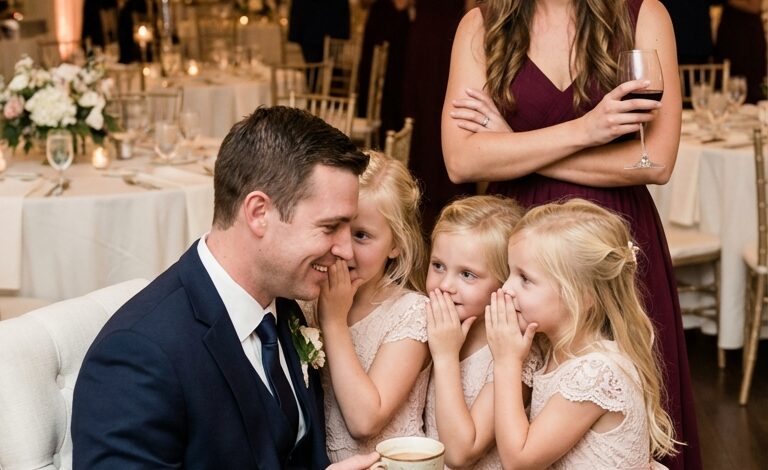
Three little girls stood there, shoulder to shoulder, staring at him with the kind of serious focus adults rarely manage.
They looked like triplets—around six years old—with soft curls pinned back by matching pale-pink bows. Their dresses were neat, their faces intent, as if they were about to pitch him the most important deal of his life.
“Are you lost?” Daniel asked gently. “Do you need help finding your parents?”
The girl in the middle shook her head. “We’ve been watching you.”
“And you’re exactly who we need,” another added, like she’d rehearsed the line.
Then they leaned in close, whispering like they were planning a heist.
“Just for tonight,” the first one said quickly.
“Only until the wedding ends,” the second added, pulling a wrinkled dollar bill from a tiny purse as if it were a serious contract.
The third girl’s confidence cracked for a moment. “Please,” she said softly, her voice trembling. “Our mom always ends up sitting alone at parties. People look at her like something’s wrong with her. But she’s not broken… she’s just really tired.”
They turned together and pointed across the room.
Near the bar stood a woman in a simple red dress. She held a glass of wine like a shield. Her posture was graceful, but guarded—like someone who’d learned how to look fine even when she wasn’t. Her smile was polite and practiced, but it didn’t reach her eyes.
“That’s our mom,” one girl whispered. “Emily Brooks.”
“She works at the hospital,” another added.
“She reads us bedtime stories even when she’s exhausted,” the third said. “But nobody really talks to her at parties.”
Emily’s gaze snapped toward them. The moment she saw her daughters standing beside a stranger, concern flashed across her face and she hurried over.
Daniel felt something twist in his chest—an old ache, but also a familiar recognition. He thought of Clara, and something she used to say when he withdrew from the world:
“If you see someone sitting alone, don’t assume they want to be. Sometimes they’re just waiting for someone to notice.”
Daniel looked down at the three hopeful faces.
“Alright,” he said quietly. “But I need to know your names first.”
Emily reached the table, clearly embarrassed. “I’m so sorry,” she said, breathless. “I hope they haven’t been bothering you.”
Up close, Daniel noticed the exhaustion in her eyes—the kind that comes from working long shifts, raising children, and still trying to show up with a steady smile.
“They haven’t,” Daniel said, standing. “They were actually recruiting me to come sit with you. Weddings can be… rough when you’re here alone.”
Emily hesitated, then gave a small, relieved laugh. “If you’d like to join us, I’d appreciate it.”
“I would,” Daniel replied.
“Emily Brooks,” she said, offering her hand.
Behind her back, the girls beamed and gave Daniel silent, enthusiastic thumbs-up—like they’d just closed a deal.
A Quiet Table, A Real Conversation
Emily’s table was tucked into a corner—easy to miss, easy to overlook. The girls climbed into their seats with obvious victory.
Emily sighed. “I tell them not to talk to strangers.”
“But we’re really good at it,” one declared proudly.
Daniel laughed—an unfamiliar sound, but a welcome one.
As the evening went on, conversation came naturally. The girls offered dramatic commentary on the guests. Emily matched their humor with quick wit. And Daniel—who’d been bracing himself to feel empty—found himself relaxing in a way he hadn’t in years.
When the DJ called everyone to the dance floor, the girls immediately launched a campaign.
“Everybody’s dancing,” one insisted.
“Especially you two,” another added, deadly serious.
Daniel and Emily exchanged a hesitant look, then stood.
It had been years since Daniel danced with anyone. He moved carefully at first, like a man returning to a language he’d forgotten how to speak.
“Why did you say yes?” Emily asked quietly as they swayed.
Daniel didn’t dodge the truth. “Because you were apologizing before I even introduced myself,” he said. “And I know what it feels like to expect people to turn away.”
When they returned to the table, the girls glowed like they’d pulled off something heroic.
“Nobody looked at Mom like she was invisible anymore,” one whispered, satisfied.
The Question That Cut Too Deep
Later, an older guest stopped at their table and looked Emily over with blunt curiosity.
“And where is the girls’ father?” she asked, as if the answer were owed.
Daniel didn’t hesitate. “I’m Daniel,” he said calmly, resting a steady, reassuring hand on the back of Emily’s chair.
The woman walked away, but the moment lingered—because it wasn’t just a question. It was a reminder of how quickly people judge what they don’t understand.
One More Connection—And a Letter From the Past
Days later, Daniel and Emily met again—this time for coffee. It felt simpler without the wedding noise, like they could hear each other clearly.
Mid-conversation, Emily grew quiet. Her fingers tightened around her cup.
“There’s something I need to tell you,” she said.
Daniel’s stomach dropped. “Okay.”
She took a breath. “I was working the night your wife was brought into the hospital.”
Emily explained that she had been one of the nurses there during Clara’s final hours—one of the people who tried, who stayed, who witnessed the moment Daniel’s life split into ‘before’ and ‘after.’
Daniel didn’t know what to say. Grief rose like a wave.
That evening, he found an envelope tucked under his windshield wiper.
Inside was a letter—written in Clara’s handwriting, dated before she passed.
Daniel’s hands shook as he read the final line:
“And if life ever gives you another chance to love… take it.”
When Daniel showed Emily the letter, neither of them spoke at first. They simply stood there, two people who had carried too much alone for too long—until they finally stepped into an embrace that felt like relief.
Not a Replacement—A Future
Life didn’t turn perfect overnight. Healing never works like that. Some days were light. Some days were heavy.
The girls, however, remained confidently proud of themselves.
“We’re emotional geniuses,” one announced one afternoon, as if it were a job title.
A year later, Daniel knelt in Emily’s living room with a small ring in his hand.
“I’m not trying to replace the past,” he told her. “I just want to build a future with you.”
And often, Daniel thought back to that wedding night—the one he almost left early.
The night three little girls with pink bows asked him to pretend.
Because somewhere along the way, he stopped pretending.
If this story moved you, share what part hit you the hardest in the comments—and if you’d like more real-life-inspired stories about love, loss, and second chances, bookmark this page and come back for the next one.