An Unusual Moment During an Everyday Snack Time!

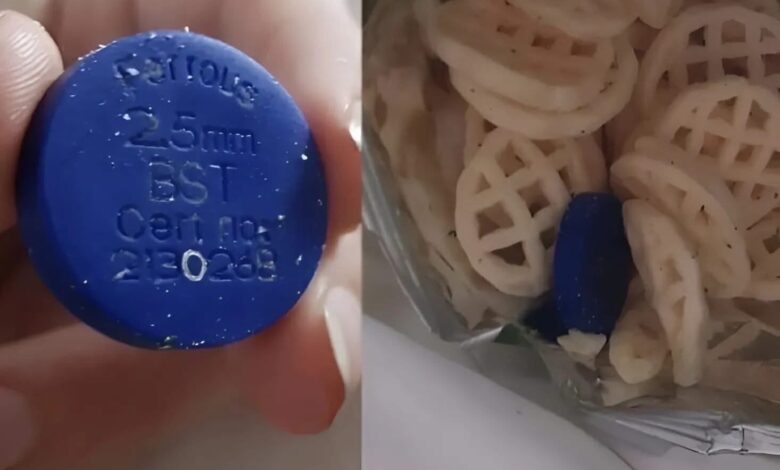
The mundane rhythms of domestic life are rarely interrupted by mystery, but one Tuesday afternoon, a standard snack break transformed into a puzzling detective story. It began as an ordinary scene: my son was sitting at the kitchen island, the crinkle of a fresh bag of sour cream and onion chips signaling a moment of quiet indulgence. However, the rhythmic crunching stopped abruptly. He reached into the bag and, instead of a seasoned potato chip, pulled out a small, vibrant blue disk.
The object was immediately jarring. Amidst the pale, golden hues of the snacks, this solid blue circle looked like a foreign invader—a piece of plastic or metal that had no business being inside a sealed food package. My initial reaction was a sharp jolt of parental protective instinct. I told him to set the bag aside immediately, my mind racing through various unpleasant scenarios of industrial accidents and contaminated batches. To a consumer, finding anything unexpected in a product meant for ingestion feels like a violation of a silent contract of safety.
I took several high-resolution photos of the object, noting its uniform shape and lack of sharp edges, and decided to leverage the collective intelligence of the internet. I posted the image to a community forum, framed with a mixture of genuine concern and a request for information. I expected horror stories or advice on how to file a lawsuit; instead, what I received was a fascinating masterclass in the hidden complexities of modern industrial engineering.
The responses arrived with surprising speed, many coming from individuals with decades of experience in food science, manufacturing, and quality control. They didn’t share my alarm; in fact, their tone was almost celebratory. “You found a ‘Golden Ticket’ of food safety,” one commenter noted. I soon learned that the mysterious blue disk was not a piece of trash or a broken part of a machine. It was a highly specialized tool known as a “test piece” or a “validation puck.”
In the high-speed world of snack production, where thousands of bags are filled every hour, manufacturers rely on sophisticated metal detectors and X-ray systems to ensure no stray fragments of machinery ever reach the consumer. To ensure these multi-million-dollar systems are functioning with absolute precision, quality control teams must test them at regular intervals. They do this by intentionally introducing these blue disks into the production line.
These disks are engineered with a specific, measurable amount of ferrous, non-ferrous, or stainless steel material embedded within the plastic. The bright blue color is an intentional choice; because blue is a color that rarely occurs naturally in food, it is the easiest for a human eye to spot if the automated system happens to miss it. The “test” is simple but critical: if the metal detector is working correctly, it should “see” the disk as it passes through the conveyor belt and automatically trigger a mechanical arm to kick that specific bag off the line.
In my son’s case, we were witnessing the result of a rare statistical anomaly. Somehow, during a routine validation check, this specific bag had bypassed the rejection arm, or perhaps the system had been paused and restarted in a way that allowed the test piece to slip through the cracks. While the presence of the disk was a technical failure of the sorting mechanism, the irony was that the object itself was a symbol of the very safety standards I had feared were lacking.
Learning the truth behind the blue disk was a profound exercise in perspective. My initial fear was rooted in the unknown—the assumption that an “alien” object must be a sign of negligence. In reality, that small blue circle was a tangible piece of a massive, invisible infrastructure designed specifically to protect us. It represented a layer of rigorous testing that happens thousands of times a day in factories across the country, ensuring that the food we provide for our families is as safe as modern technology can make it.
This experience offered a rare “behind the curtain” look at the industrial food complex. We often take for granted the reliability of the products we buy, rarely stopping to think about the sensors, the magnetic fields, and the quality control protocols that stand between the farm and our pantry. The disk was a reminder that safety is not an accident; it is a deliberate, engineered outcome. It is the result of thousands of small, blue validations that ensure the integrity of the whole.
After doing more research, I found that these pucks are common across various industries—from pharmaceutical bottling to frozen vegetable packaging. They are the silent sentinels of the assembly line. While I did reach out to the manufacturer to let them know a test piece had made its way into the wild—information that is actually quite valuable for them to recalibrate their sensors—I no longer felt the need to demand an apology. Instead, I felt a strange sense of reassurance.
My son, for his part, found the whole ordeal more exciting than scary. To him, it wasn’t a “contaminant”; it was a souvenir from a hidden world. We kept the disk on the kitchen windowsill for a while, a small blue reminder that things are not always what they seem at first glance. It taught us a lesson about the importance of curiosity over panic. When we encounter something that doesn’t fit our expectations, our first instinct is often fear, but if we take the time to investigate and ask questions, we often find that the truth is far more interesting and far less threatening than our imagination would suggest.
The incident also highlighted the power of modern connectivity. Ten years ago, I might have simply thrown the bag away in disgust and never bought that brand again. Today, the ability to share a photo and receive expert feedback within minutes allows us to move from a place of suspicion to a place of education. It turns a potential crisis into a learning opportunity for the whole family.
Now, whenever we open a bag of chips, we look for a moment, not with anxiety, but with a new appreciation for the invisible hands that keep our food safe. We understand that for every millions of bags produced, a few will always have a story to tell. Our story happened to be blue, circular, and a testament to the fact that someone, somewhere, is checking the machines to make sure we can enjoy our snacks in peace. It was an unusual afternoon, certainly, but it ended with a deeper faith in the systems that sustain our everyday lives.