Billionaire Came Home Early—and Froze When He Saw What the New Nanny Was Doing With His Kids in the Backyard…

His black Mercedes rolled into the driveway, and before he even turned off the engine, he heard something that didn’t belong in that house anymore.
Laughter.
Not polite chuckles. Not forced smiles. Real, messy, full-body laughter—the kind kids make when they feel safe enough to be completely themselves.
Ethan sat still for a moment, phone buzzing with notifications from investors and meetings he’d normally treat like emergencies. For once, he ignored it.
He stepped out, loosened his tie, and followed the sound into the backyard.
What He Saw Stopped Him Cold
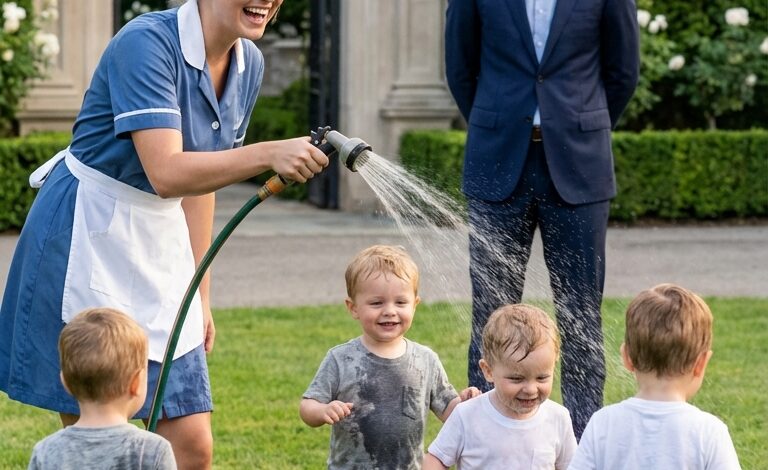
All four of his children were barefoot, drenched, and sprinting across the grass like they didn’t have a care in the world. Their shirts clung to their backs, their hair dripped water, and their laughter bounced off the fence like music.
In the middle of it all stood Maria—the new nanny he’d hired just three days earlier.
She held a garden hose like it was the most powerful toy on earth, spraying wide arcs of water into the evening air. The mist caught the sunlight, scattering tiny rainbows across the yard while the kids jumped and squealed, trying to “catch” them.
Maria wasn’t standing on the sidelines supervising with a clipboard smile. She was in it—soaked, laughing, fully present.
Ethan felt something tighten in his chest.
Not anger. Not suspicion.
Confusion… and something uncomfortably close to guilt.
Because he couldn’t remember the last time he’d seen his children look like that.
A Fall, Then a Lesson
Five-year-old Noah slipped on the wet grass and went down hard, face-first into the mud.
Ethan’s body moved on instinct—he stepped forward, bracing for the crying that usually followed any minor accident.
But Noah lifted his muddy face, blinked, looked at Maria… and burst out laughing.
Maria ran over, then—without hesitation—slid right into the mud beside him as if it was the most normal thing in the world. The other kids piled in, turning the moment into a chaotic, muddy group hug.
In that pile of laughter and grass stains, Maria looked like the safest place on earth.
And Ethan realized something he didn’t want to admit:
His kids didn’t need more stuff. They needed more life.
When his oldest, Lucas, finally noticed Ethan by the fence, the boy’s grin vanished. The children froze, suddenly unsure if they were “allowed” to be this loud, this wild, this happy.
Maria turned quickly, worry crossing her face.
“I’m sorry, Mr. Carter,” she began.
Ethan didn’t respond right away—because he wasn’t upset.
He was shaken by how normal joy had started to feel… unfamiliar.
“They Just Needed to Play.”
Later that night, the house was back to its usual stillness. The dining table was arranged like a showroom—napkins folded perfectly, silverware aligned with precision.
Ethan found Maria in the kitchen, quietly washing dishes and humming to herself.
“Thank you,” he said, the words coming out awkwardly. “For today.”
Maria didn’t act like she’d done something extraordinary.
“They’re good kids,” she said simply. “They just needed to play.”
The sentence hit harder than any business report or parenting book ever could.
That night, Ethan stood in Noah’s doorway watching him sleep. He brushed a strand of hair from his son’s forehead and made a promise he didn’t say out loud to anyone else:
He was going to come back—really come back.
A Billionaire Learns a Different Kind of Wealth
Ethan started coming home earlier. Not perfectly. Not smoothly. But consistently.
He tried the small things that used to feel “unproductive”: burning cookies with the kids, flying cheap kites at the park, sitting on the floor drawing with chalk. He even started leaving his phone face down during dinner—an unthinkable move in his old life.
And slowly, something shifted.
The house stopped feeling like a museum and started feeling like a home again.
Maria didn’t demand credit. She didn’t lecture him. She simply kept showing the children what safety and attention looked like—and Ethan began learning by watching.
Then Life Tested Them
One afternoon, storm clouds rolled over Denver and the rain came down hard. Ethan walked in and immediately sensed something was off.
Maria sat at the kitchen table staring at her phone, hands trembling.
“My mom is in the hospital,” she said quietly. “She got worse. I have to go.”
In the hallway, the kids stood silent, fear written all over their faces. They weren’t just worried about Maria leaving—they were terrified that the warmth she’d brought would disappear with her.
Maria’s voice cracked as she spoke, like she was afraid to step away from the fragile progress they’d made.
Ethan surprised even himself with how steady his response was.
“You need to go,” he told her. “We’ll be okay. I can handle this.”
And for the first time, he meant it.
The Week That Changed Him
Maria left in the rain with a small suitcase while the children clung to her, begging her not to go.
Ethan didn’t run from the chaos this time.
He forgot lunches. He burned breakfasts. He fumbled through bedtime routines and stayed up through fevers and nightmares. At 2 a.m., washing dishes with cracked, soap-dry hands, he finally understood the invisible labor that had been holding his family together.
Not the kind you can outsource with a paycheck.
The kind that costs time, patience, and heart.
A week later, the phone rang in the middle of the night.
Maria’s voice was small through the tears. “My mom passed away.”
Ethan swallowed the lump in his throat.
“You were with her,” he said gently. “That matters. And you’re not alone. You’ll always have a place here.”
The Return
On a rainy Saturday, Ethan was attempting to bake a cake with the kids—an effort that looked more like a flour explosion than dessert—when the doorbell rang.
Maria stood on the porch soaked to the bone, exhausted, and offering the kind of soft smile people wear when they’re holding themselves together by a thread.
The children didn’t wait for permission.
They ran straight into her arms.
Maria dropped to her knees and hugged them tight, tears mixing with rainwater. Ethan watched from the kitchen, feeling something in his chest loosen—like a door that had been stuck for years finally swung open.
From that day on, the house was never quiet again.
Not Perfect—Real
Toys lived on the floor. The dining table had crumbs. The backyard carried muddy footprints like badges of honor.
Maria began studying at night to become a teacher. Ethan adjusted his schedule, cutting work hours he once thought were “non-negotiable.” He started choosing presence over pressure, family over constant hustle.
Years later, during dinner, Lucas—now a teenager—looked up and asked casually, “Dad… have you ever thought about getting married again?”
Noah, always blunt, added, “You like Maria, Dad.”
Maria turned red and escaped to the kitchen.
Ethan followed a few minutes later and found her holding a cup of tea, trying to look busy.
His voice shook. “I can’t pretend anymore. You’re more to me than the person who helps with my kids.”
Maria’s eyes filled. “I fell in love with you a long time ago,” she admitted. “But I thought… I was just the nanny.”
Ethan shook his head.
“You were never ‘just’ anything,” he said. “You saved this family.”
He took her hands—hands shaped by work, care, and the kind of love that doesn’t ask to be noticed.
The next morning, the kids didn’t need a formal announcement. They saw it in the way Ethan and Maria looked at each other across the breakfast table.
That night, Ethan walked past the dining room and noticed a white napkin crumpled on the table, stained with a little bit of beans.
He picked it up, smiled… and left it right where it was.
For the first time in years, the house wasn’t perfect.
It was alive.
Closing Thought
If this story reminded you that time and attention are the real family “luxury,” share your thoughts in the comments—and tell us: what’s one small change you could make this week to be more present with the people you love?