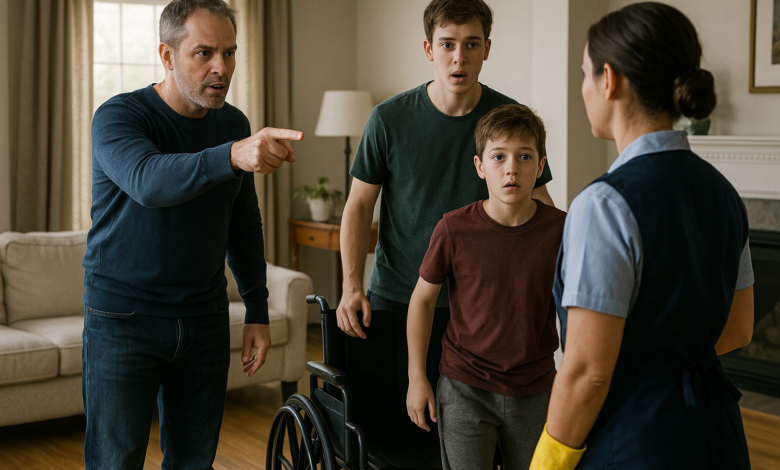
He fired the housekeeper for letting his “disabled” sons stand up from their wheelchairs

Not propped. Not supported by braces. Not held upright.
Standing on their own two legs.
These were the same boys whose medical files were thicker than most legal contracts. The same children “top specialists” had warned would be permanently confined to wheelchairs before kindergarten. The same children Jonathan barely dared to hug, terrified he’d hurt them.
Yet there they were, giggling in tiny toy doctor coats, circling a woman stretched dramatically across the rug like a patient in an ER drama.
Maria Lopez—the housekeeper—lay still, bright yellow cleaning gloves still on her hands, letting the twins “treat” her.
“Doctor Ethan! The heartbeat is dropping!” Lucas shouted, loud and excited—more energy than Jonathan had heard from him in months.
Ethan, supposedly the weaker twin according to every report, lifted his arm and took two careful steps toward Maria’s head.
Jonathan’s stomach turned. If Ethan fell, it could be catastrophic—at least, that’s what every expensive consultation had drilled into him.
His voice cracked through the room like a warning shot.
The boys jolted. Ethan wobbled, lost his balance, and fell onto the rug. He burst into tears.
Maria sprang up instantly, placing herself between the twins and their father as if shielding them from a storm.
“Mr. Hayes!” she said, startled, still holding Lucas’s hand.
Jonathan rushed past her and dropped to his knees beside Ethan, hands shaking as he checked his legs.
“Where does it hurt? Tell me—did you break something?”
“We were just playing, Dad…” Lucas sobbed. “We were fixing the blue patient.”
Jonathan rose slowly, his fear curdling into fury. His eyes locked on Maria.
“I pay you to clean,” he said, voice cold. “Not to endanger my kids. I gave clear instructions. No one takes them out of their chairs without medical supervision.”
Maria didn’t back down.
“Sir… they weren’t going to break. They need to move. They beg me to play whenever the nurse isn’t watching.”
Jonathan’s jaw tightened. “When the nurse isn’t watching?”
He stepped closer, towering over her. “So you’ve been interfering with the treatment plan I’m paying for?”
Then he made the kind of decision he was famous for—fast, decisive, and absolute.
“You’re fired,” he snapped. “Five minutes. Pack your things. Leave before I call security.”
Maria’s expression didn’t shift into panic the way most people’s would. It hardened into something else—certainty.
“If I leave,” she said quietly, “they’ll go back to sleeping all day. Those boys have muscles, Mr. Hayes. What they don’t have is energy… because the nurse keeps them drugged.”
Right on cue, Nurse Diane entered with a polished silver tray. Two syringes rested on it like routine.
“Mr. Hayes,” Diane said smoothly. “I heard raised voices. Their heart rates are elevated. I warned you untrained staff shouldn’t overstimulate them.”
Jonathan looked from Diane—the highly recommended private nurse with elite references—to Maria, a housekeeper with no medical credentials.
His instincts picked the “professional.”
Maria turned to leave, but before she reached the door, she quietly reached toward a side table. Her yellow glove brushed an empty glass vial—one Diane had just handled. In one subtle motion, Maria slipped it into her glove.
“I’ll go,” she said. “But here’s a free piece of advice your expensive experts didn’t mention.”
Jonathan didn’t respond.
Maria kept her voice low. “If your children are truly sick… why does the nurse keep their medicine in her purse instead of the medical cabinet?”
She paused. “Check the kitchen security cameras. Today. Two p.m.”
The Video That Changed Everything
Jonathan didn’t know what he expected to find. Maybe nothing. Maybe an overworked housekeeper grasping at excuses.
But when he pulled up the footage, his blood ran cold.
Diane stood in the kitchen, calm as ever. She reached into her designer bag, pulled out an unlabeled bottle, and poured liquid into the twins’ juice—smiling like it was just another task on her schedule.
Earlier that same day, Maria had been dancing with the boys in those ridiculous yellow gloves while they laughed like kids who still believed the world was safe.
“They weren’t sick…” Jonathan whispered, his voice hollow.
And he had just fired the only person who had noticed.
Within minutes, the mansion erupted into chaos. Alarms sounded. Staff shouted. The twins struggled, their breathing turning shallow and uneven.
Diane’s voice rose in theatrical panic. “I think that woman poisoned them before leaving!”
But Jonathan wasn’t listening anymore.
He ran.
One Mile Down the Road
He found Maria walking in the rain, shoulders squared, face tight with anger and fear.
“I didn’t steal anything!” she shouted, holding up her yellow-gloved hand like proof.
Jonathan slammed the brakes and leaned across the passenger seat.
“Get in the car!” he yelled. “You were right. They’re dying!”
Maria’s eyes widened, then sharpened with focus. She climbed in.
On the drive back, she spoke fast—like someone who’d been piecing together a puzzle for weeks.
“I overheard her on the phone,” Maria said. “She mentioned a drug—succinylcholine.”
Jonathan swallowed. “What is it?”
“A muscle relaxant,” Maria replied. “It can paralyze the lungs.”
Jonathan’s hands tightened on the steering wheel. “So they can’t breathe.”
Maria nodded once. “They’re suffocating.”
The Arrest That Followed
The ambulance arrived as they did. Maria handed the vial she’d taken to the emergency physician.
The doctor inspected it, then looked up sharply.
“Neuromuscular blocker overdose,” he confirmed. “Move—now.”
Within minutes, Ethan and Lucas were on ventilators.
Police searched Diane’s purse and found the bottle.
There was no dramatic confession. No heartfelt apology. Just the cold sound of handcuffs clicking around the wrists of the “perfect nurse” as rain washed the driveway and the lies at the same time.
But the victory didn’t erase the damage.
Years of chemical sedation had weakened the boys’ muscles. Specialists explained that even though they had the ability to stand, their strength and coordination had been stolen slowly—day by day.
They might not walk normally again.
Jonathan sat beside their beds, staring at their small hands, realizing money hadn’t protected them. It had simply paid for the wrong person to get close.
Maria stood in the doorway, wiping her eyes.
“They walked once,” she said, steady and sure. “They’ll walk again.”
Rebuilding a Home—and a Family
The mansion changed after that.
Luxury furniture disappeared. In its place came therapy mats, balance bars, and equipment designed for pediatric rehabilitation. The living room stopped looking like a showroom and started looking like a place where real life happened.
And Jonathan Hayes—the man who once measured success in profit margins—got down on the floor with his sons.
He crawled with them. Played games. Counted steps like they were priceless.
Every wobble became progress.
Every fall became practice.
Every laugh became proof that he hadn’t lost them.
A Birthday Surprise No One Expected
Six months later, guests filled the garden for the twins’ birthday party. Many arrived expecting to see two fragile boys in wheelchairs, carefully watched, carefully managed.
Instead, Ethan and Lucas ran across the grass—unsteady, stumbling, but running—faces bright with the kind of joy that can’t be faked.
Later that evening, Jonathan found Maria and handed her a small box.
Inside was a single yellow rubber glove.
Jonathan’s voice softened. “This glove saved my family,” he said. “It taught me how to be a father.”
He looked toward the lawn where the twins’ laughter floated through the air.
“And it showed me who truly belongs in this home.”
The mansion that once felt like a hospital finally felt like something else.
Like a family.
If this story moved you, share your thoughts below: What do you think Jonathan should have noticed sooner—and what would you have done in his place? Your comment might help another reader spot the warning signs before it’s too late.