I Bought an Old Doll at a Flea Market, Gave It to My Daughter, and Heard a Crackling Sound Coming from It!

I never expected to tell a story like this. Even now, when I think back on it, my chest tightens and my fingers go cold. Some moments don’t announce themselves as important. They arrive quietly, almost politely, and only later do you realize they changed you for good.
My name is Pauline. I’m thirty-four years old, a single mother, and I clean office buildings at night. It’s honest work, exhausting and invisible, but it keeps the rent paid most months. My daughter, Eve, is six. She is gentle in a way that feels almost old-fashioned, the kind of child who notices when adults are tired and tries to make herself smaller to help. That kind of kindness doesn’t come from nowhere. It comes from learning early that life isn’t always generous.
Three years ago, Eve’s father died of cancer. It wasn’t dramatic. There were no speeches, no miracles. One month he was trying to smile through pain, the next he was gone. After that, everything collapsed at once. Grief, bills, silence. I didn’t have the luxury of falling apart. Someone had to keep moving, and that someone was me.
Since then, it’s been the two of us, building a version of normal from routines and quiet promises. Eve’s birthday was coming, and I wanted to give her something that felt special. Not expensive—just meaningful. Something that said, “I see you. You matter.”
But money has a way of flattening good intentions. Rent cleared my account. Groceries took what was left. Utilities loomed like a threat. The night before her birthday, I sat at the kitchen table with a pen and scrap paper, rearranging numbers until my eyes burned. No matter how I did it, the truth stayed the same.
“Love matters more than presents,” I whispered into the quiet kitchen. Eve never complained. She never asked for more than she knew we could give. Still, I noticed the way she paused in store aisles, how her hand hovered before she pulled it back. She already understood the limits of our world.
The next morning, I left Eve with my neighbor Janice, who promised cartoons and cupcakes, and I went to the flea market with my twenty dollars and a quiet hope I didn’t name out loud.
The air was sharp and cold, the kind that wakes you whether you want it to or not. The market was full of forgotten things—cracked dishes, tangled cords, toys missing pieces. Lives that had moved on, leaving fragments behind.
That’s when I saw the doll.
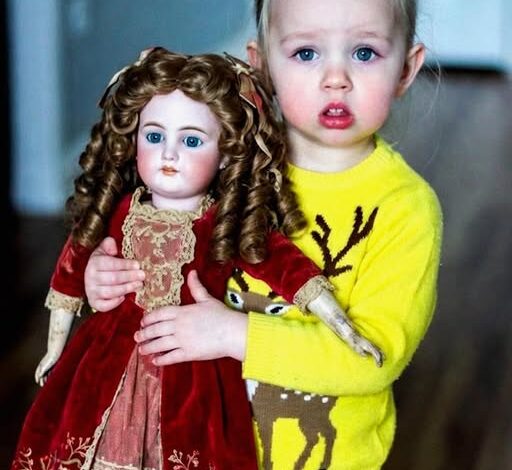
She sat on a faded cloth, her dress pale and worn, yarn hair unraveling in places. But her eyes—bright blue, calm, almost watchful—stopped me. She held a smaller baby doll against her chest, and there was something tender in the way she was posed. Not accidental. Intentional.
I picked her up and asked the woman behind the table how much she wanted.
Before she could answer, the man beside her spoke. “Take her,” he said quietly. “Please.”
I hesitated. The woman looked exhausted, her eyes red and distant. When she finally spoke, her voice was steady but thin.
“She’s meant to be loved,” she said. “Take her. That’s what she would’ve wanted.”
I didn’t ask who she meant. Somehow, I already knew. I thanked them and carried the doll home as if she might break.
On Eve’s birthday morning, I set the wrapped box in front of her. She stared at it like it might disappear if she blinked.
“You got me something, Mama?” she asked, almost afraid to hope.
“Of course,” I said. “It’s your birthday.”
When she opened it, her face lit up in a way that made every sacrifice feel worthwhile. She hugged the doll tightly, delighted by the tiny baby tucked in its arms.
“She’s beautiful,” Eve said. “I’m going to call her Rosie.”
Rosie felt right.
I went into the kitchen to start breakfast when I heard it—a faint crackling sound, like static from an old radio. Eve didn’t seem to notice. I took the doll gently and ran my fingers along the seam of her dress. Something felt off.
Carefully, I loosened the stitching. Inside, I found a small bundle of fabric. Inside that, a folded note and a red paper heart.
My hands shook as I opened it.
“Happy Birthday, Mommy.”
Before I could breathe, a tiny recorded voice crackled to life.
“Happy birthday, Mommy!”
Eve looked up at me. The joy drained from her face, replaced by a seriousness that didn’t belong to a six-year-old.
“That’s not for me,” she said softly.
The next morning, I went back to the flea market with the doll. The same couple was there. When the woman saw Rosie, she froze. When I told her about the recording, her knees buckled and the man caught her.
“My daughter,” she whispered. “Clara. She hid it there. She wanted to surprise me.”
She told me Clara had died just before her eighth birthday. The doll had been a gift she never got to give. Hearing her daughter’s voice again broke her open—and somehow stitched her back together at the same time.
“You gave her back to me,” she said, gripping my hand. “Even just for a moment.”
We stood there, two mothers linked by loss, grief passing quietly between us like shared breath.
A week later, Miriam came to my apartment. She brought Clara’s old toys and an envelope filled with money—far more than I could accept. I tried to refuse. She wouldn’t let me.
“It’s for Eve,” she said firmly. “You gave me something priceless. Let me do this.”
From that day on, Miriam became part of our lives. She taught Eve to crochet. She baked with her. She left notes when she watched her during my night shifts. She told stories about Clara, and Eve listened like each one was a gift.
One night, I found a drawing on the kitchen table. Three figures holding hands. Above them, Eve had written: “Mama, Miriam, and Me.”
I cried—not from sadness, but because love had found a way to grow where grief once lived.
Sometimes healing doesn’t arrive with answers or closure. Sometimes it shows up quietly, in the shape of an old doll, a child’s voice, and two families learning that love doesn’t vanish when someone is gone.
It changes. And sometimes, it brings people together who were never meant to walk alone.