I Couldn’t Walk for 15 Years—Then an 8-Year-Old Boy Whispered 3 Words That Changed Everything

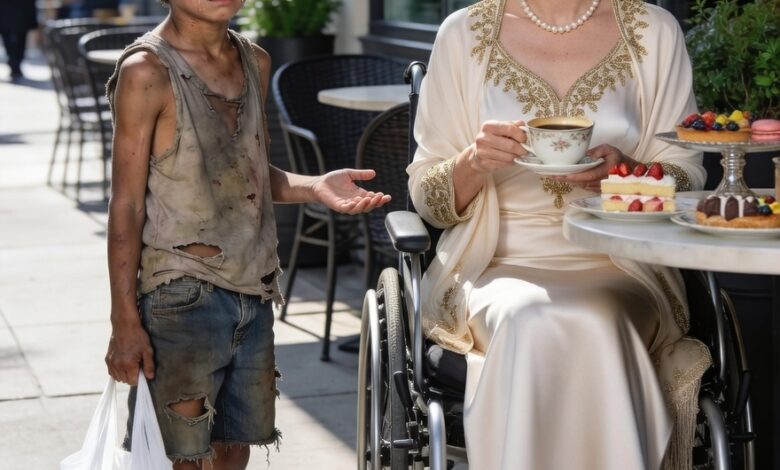
I still hear it clearly: the crack of porcelain as a mug hit the floor. A waitress had dropped her tray when she saw what was happening.
I was gripping the edge of the table so hard my hands hurt. My legs—my legs that had been useless for 5,475 days—were trembling.
Not “in my head” trembling. Not imagined. Real shaking. Like current running from the base of my spine down to my toes.
The boy stood beside me, holding my left hand. His shirt was faded and dusty, his fingers rough like someone who’d spent too many nights outside. But his grip was steady—protective, almost grounding—like he was anchoring me to the present.
Then he leaned in and whispered three words.
“You’re forgiven.”
What Doctors Couldn’t Fix Wasn’t My Spine
Most people assumed I’d suffered a catastrophic injury. Even strangers would glance at my wheelchair and quietly look away, like my story was too heavy to touch.
But my paralysis didn’t come from a broken back.
Fifteen years earlier, I was driving on a night when the weather turned violent. Rain came down so hard it blurred the road into a sheet of gray. My car skidded. Headlights flashed. A truck crossed into my lane.
My husband, Michael, and our four-year-old daughter, Emily, were gone instantly.
I survived.
And that survival did something to me that no scan could fully explain. The guilt didn’t just live in my thoughts—it moved into my body. Over time, my brain shut down my ability to walk. Later, specialists gave it a name: functional neurological disorder, a condition where the body can physically move, but trauma disrupts the brain’s ability to send or process signals normally.
In plain words: my body wasn’t “broken.” I was.
Somewhere deep down, I believed I didn’t deserve to stand again.
So when that boy said, “You’re forgiven,” it felt like something inside my chest finally cracked open.
My Feet Touched the Floor
It wasn’t graceful. It wasn’t cinematic.
I pushed my wheelchair back with my hips and stood up like someone learning how to be human again. My muscles screamed from years of inactivity. My right foot dragged, and my knees shook like they might fold.
But I was upright.
I felt the cold floor through the soles of shoes that had stayed clean for over a decade—because they’d never touched pavement.
I started crying in a way I can’t polish into pretty words. It was grief and relief and shock all at once—fifteen years of buried pain coming out in one breath.
Someone near me shouted, “Oh my God—she’s standing!”
People gasped. A few pulled out their phones. Others just stared, frozen between disbelief and awe.
I didn’t care about any of it. I wrapped my arms around my own legs and sobbed, whispering apologies into the air—apologies I’d been carrying for years.
And Then He Was Gone
When I finally looked up, I wanted to hug the boy. I wanted to thank him, ask his name, ask how he knew exactly what to say.
But the door was swinging gently, letting in warm city air.
He had disappeared.
On the table where he’d been sitting, there was only an empty plate and a small wooden object: a rough, hand-carved figure of a woman carrying a child on her back.
The Hospital Couldn’t Explain It—But Trauma Could
Within minutes, paramedics arrived. Then police. Then the unavoidable chaos that comes when dozens of strangers insist they just watched a woman stand up after years in a wheelchair.
The next days were a blur of MRI scans, neurological exams, and doctors trying to fit my story into a neat medical box.
Physically, I needed rehabilitation to rebuild strength and balance. That part made sense.
What didn’t make sense was the boy.
How could a stranger see the exact wound I’d hidden from everyone—including myself?
I Found Him at a Refugee Shelter
I used money I’d once spent chasing every possible therapy and hired a private investigator.
We searched food programs, shelters, refugee centers, and immigrant support organizations across the city. Weeks passed with no answers.
Then one afternoon, at a refugee shelter outside Chicago, I saw the same calm, familiar eyes.
He was sitting in a dirt yard, quietly stacking small rocks like it was the only peaceful thing left in his world.
He wasn’t a ghost. He wasn’t magic. He wasn’t some mysterious “internet angel.”
He was an eight-year-old boy named Malik—someone who had escaped civil war, crossed continents, and lost everyone he loved along the way.
When he saw me, he didn’t look surprised. He just said softly, “There were too many people watching. You needed to cry alone.”
I showed him the wooden carving.
“How did you know what to say to me?” I asked.
His Answer Was Simple—and Devastating
He didn’t talk like a child who’d been protected from life. He spoke like someone who’d seen too much of it.
“In the camp,” he told me, “I saw mothers stop walking after bombs killed their children.”
He swallowed hard, then continued. “They thought it was their fault they were still alive.”
He looked at me and said, “Your eyes in the café looked like my mom’s.”
That was it. Not a miracle trick. Not a secret technique. Just a child recognizing the same kind of suffering he’d watched up close.
“I couldn’t save her,” he whispered. “But I knew you only needed someone to tell you it wasn’t your fault.”
He cried for his mother, for his home, for the childhood that war had stolen from him.
And I held him—on legs that had returned just in time to hold someone else.
How Healing Turned Into a New Family
That day, I started the process to become his foster parent.
It wasn’t quick. It wasn’t easy. It was paperwork, interviews, waiting lists, court dates, and moments where I wondered if I had the strength to keep pushing forward.
But every time I felt myself slipping, I took another step—sometimes down a courthouse hallway, sometimes just across my living room—and remembered why I was fighting.
Today, three years later, my wheelchair sits in the back of the garage collecting dust.
Malik goes to school. He’s healthy. He still has nightmares sometimes, and some days are heavier than others. But his laughter fills our home in a way I once thought I’d never hear again.
The Real Miracle
The real miracle wasn’t that I walked again.
The miracle was learning that healing can arrive through compassion, not perfection. Through connection, not explanations.
Yes—science can help us understand trauma, the nervous system, and how the brain protects us in ways that don’t always look logical.
But science will never fully measure the power of a human being looking you in the eyes at the exact right moment and giving you permission to let go.
Malik freed me from the guilt that kept me trapped for fifteen years.
And I was given the chance to make sure he wasn’t alone in the world.
Sometimes, all it takes to stand up again… is hearing the words you’ve needed all along.
If this story moved you, share what part hit you the hardest in the comments—and if you know someone carrying silent guilt, send this to them. You never know which three words might help them breathe again.