I Thought My Boss Was Hiding an Affair, One Phone Call Proved I Was Completely Wrong –

That’s why, when small changes started happening, they didn’t look like “red flags” at first. They looked like… nothing.
- Meetings scheduled late, sometimes with no clear reason
- Office doors closing more often than usual
- Conversations that stopped the second someone walked by
- Laughing behind glass walls that felt oddly private
Individually, each thing was harmless. But once your brain starts searching for a pattern, harmless details can turn into “proof” fast.
How Workplace Rumors Start (Without Anyone Saying a Word)
No one came out and accused him of anything. There were no dramatic confrontations. No shouting in the hallway.
Instead, the office atmosphere changed in a way that’s hard to explain unless you’ve lived it: people got quieter. Conversations became careful. Everyone started watching instead of working.
And then there was her—a younger employee who seemed to be around at unusual times. She stayed late. She appeared in meetings most people at her level wouldn’t attend. She popped up in places that didn’t quite match her role.
In a healthy workplace, that could mean mentorship, training, or a special project. But in an office already full of unanswered questions, it meant something else.
Not because anyone had real evidence—because the story felt convenient.
Once that idea took hold, everything started to “fit.”
The late meetings weren’t meetings anymore. The closed doors weren’t about focus or confidentiality. The laughter wasn’t casual—it was suspicious.
That’s the thing about assumptions: they don’t need facts. They just need gaps.
The Phone Call That Changed Everything
Then came the phone calls.
A woman would call the office now and then, asking for our boss. Her tone was always polite, but there was something underneath it—uncertainty, maybe even concern. Each time, we handled it professionally and moved on.
Until one day she called again.
This time, her voice was different—tight, direct, impatient. She wasn’t asking casual questions. She sounded like someone who needed answers now.
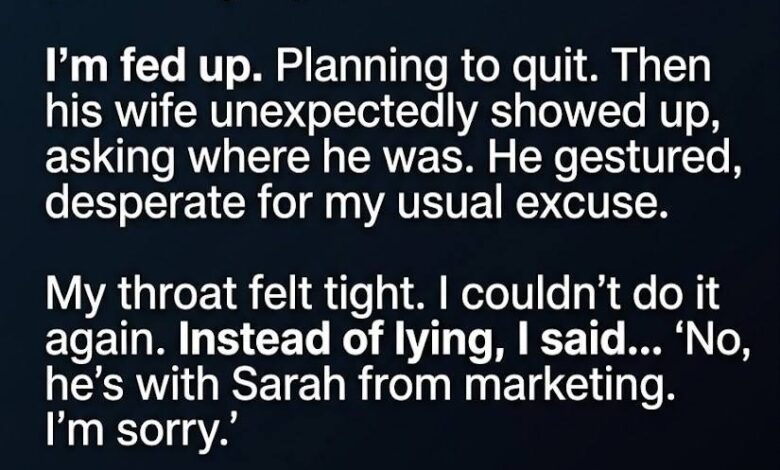
And in that moment, with weeks of whispered theories sitting in the back of my mind, I did something I’m not proud of.
I didn’t give the usual neutral response.
I let the assumption speak for me.
The words came out before I could filter them—shaped by office gossip, not reality.
And then… silence.
Not the awkward kind where someone doesn’t know what to say. Something calmer.
A soft laugh—almost gentle—like she wasn’t offended, just stunned by how wrong we had it.
The Truth We Never Considered
What she said next dismantled every “obvious” conclusion we’d built.
There was no affair.
The late meetings? Legitimate, sensitive conversations that required privacy.
The closed doors? Confidential work—exactly the kind that responsible management keeps behind closed doors.
The laughter? Normal. Human. The sound of people getting through stressful days together.
And the younger employee we’d quietly judged?
She wasn’t someone sneaking around. She had every reason to be there—reasons that made our assumptions look not just incorrect, but unfair.
In one phone call, the entire storyline collapsed.
What Hit Me Harder Than Embarrassment
I expected to feel awkward. Guilty. Maybe defensive.
But what hit me harder was something else: how easily we’d created a whole reality out of incomplete information.
We didn’t “misread” a situation.
We built a narrative, reinforced it with selective details, and treated it like fact—because it matched what we suspected.
That’s how workplace gossip becomes dangerous. It doesn’t stay a rumor. It becomes a lens. And once you’re looking through it, everything you see feels like confirmation.
The Lesson I Took With Me
That experience changed how I handle uncertainty at work—and honestly, in life.
Now, when something looks suspicious, I pause before I decide what it “means.” When I don’t have the full picture, I remind myself that my brain will try to fill in the blanks anyway—and it won’t always choose the truth. It will choose the story that feels most believable.
Because certainty is easy.
Truth takes effort.
And the truth is rarely as loud as the story we invent when we think we already know the answer.
Closing Thought
If you’ve ever caught yourself assuming the worst at work—or anywhere—take a second and ask: Do I know this… or am I just connecting dots that aren’t really there?
Want more real-life workplace stories and practical lessons about communication, leadership, and office culture? Share your thoughts in the comments—and if this hit home, pass it along to someone who might need the reminder.