I Thought My Dad Was Dead – Then He Showed Up at My Wedding as My Stepfather Walked Me down the Aisle!

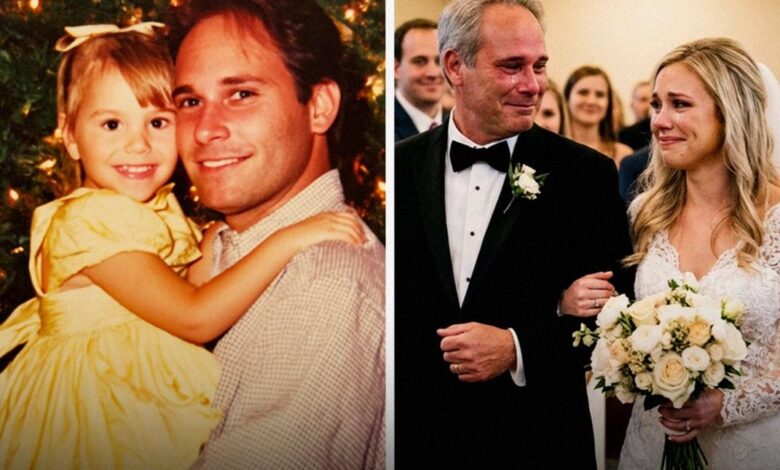
I grew up believing my father died when I was eight years old. There was no funeral, no grave, no folded suit in the closet that smelled like him. Just a quiet afternoon when my mother sat me down, looked at me with a kind of practiced calm, and said, “He’s gone now, Stephanie. Let him go.” That was the whole explanation. No details. No stories. Just an ending.
So I accepted it. Children do that when adults speak with certainty. When teachers asked, I said he was dead. When classmates compared tragedies like trading cards, I nodded and repeated the same word. Dead. Simple. Final. My mother never kept photographs of him in the house. There were no anniversary dates, no accidental mentions. She said remembering him hurt too much, and I learned early that silence was safer than curiosity.
A year later, Dan entered our lives.
He didn’t sweep in with grand gestures or try to force affection. He didn’t tell me bedtime stories about bravery or promise to be a replacement for anyone. He simply showed up. He drove me to school when my mother worked late. He waited in plastic chairs outside doctors’ offices. He fixed things before they broke and handed me small amounts of cash without comment when he knew I needed it. I fought him for years out of principle, because admitting I needed him felt like betraying a man I barely remembered.
Once, when I was a teenager, I accused him of trying too hard. He surprised me by agreeing. “I’m not your dad,” he said gently. Then, after a pause, “But you feel like a daughter to me.” Something shifted that day. Not dramatically. Quietly. The way foundations settle.
When Noah proposed years later, there was no question who would walk me down the aisle. I asked Dan, and he looked at me like I’d handed him something fragile and priceless at the same time. I thought the shine in his eyes was pride. I didn’t recognize guilt.
The morning of my wedding was chaos softened by excitement. Dresses rustled. Makeup brushes clattered. My mother paced with a sharp edge to her movements. Dan stood near the window, adjusting his cufflinks again and again. When I asked if he was nervous, he smiled and said he just didn’t want to mess anything up. I told him he never did.
The music was about to start when he took my arm. His hand lingered at my wrist, just long enough to anchor me. He leaned in and whispered, “There’s something you need to know.” I laughed, assuming it was nerves or sentimentality. Before he could continue, a scream cut through the air.
The doors to the hall stood open. A man I didn’t recognize stepped inside.
He looked older than I expected a ghost to look. His hair was thinning, his posture slightly bowed, his face marked by something heavier than age. When his eyes met mine, my mother made a sound I’d never heard from her before—sharp, raw, almost feral. She told me not to look at him. Dan moved in front of me without thinking.
The man didn’t hesitate. “You’ve been lied to for fifteen years,” he said. “And you deserve the truth.”
My chest felt hollow. I already knew who he was before he said it. “My name is Nigel,” he continued. “I’m your father.”
The wedding stopped. Guests were ushered out. Noah stayed beside me, steady and silent, letting me decide what came next. I wanted answers. Not later. Not someday. Now.
That evening, in an empty hall that still smelled faintly of flowers, Dan finally told me everything. Nigel hadn’t died. He’d been arrested for corporate fraud. My mother told the world he was gone because waiting was inconvenient and messy. Nigel wrote letters every year—birthdays, holidays—letters I never saw. Dan knew. He kept the secret because he believed, wrongly, that protecting a child sometimes meant hiding the truth.
I met Nigel a week later in a roadside diner. Burnt coffee. Cracked vinyl booths. He looked at me like someone afraid to blink. He said he never stopped thinking about me. That he showed up at the wedding because he couldn’t stand being erased anymore. I believed he was sorry. I also knew that believing him didn’t magically make him my father. He was a stranger with familiar eyes.
The next morning, I confronted my mother. She acted as if nothing had happened, stirring blueberries into a bowl with steady hands. When I told her we were done, she looked surprised—not heartbroken, just inconvenienced. She said she did what she had to do. I told her she did what was easiest for her. That she erased a man and taught me silence instead of truth. I left without waiting for her reply.
Noah and I married quietly in his parents’ backyard weeks later. There were no grand entrances, no spectators waiting for drama. Dan walked me down the aisle again. His hands shook. His smile didn’t. When he placed my hand into Noah’s, he whispered that I had a good heart and not to let anyone take it from me.
Nigel attended. He stayed in the back. We speak now, carefully, like people learning a new language without a dictionary. I don’t know what he will become to me, if anything. What I do know is this: love isn’t proven by biology or declarations at doorways. It’s proven by presence. By staying. By choosing someone again and again when it’s inconvenient.
I spent most of my life believing my father was dead. It turns out he was absent instead. And the man who stayed—who showed up quietly, imperfectly—was the one who earned the right to walk beside me.
We don’t choose where we begin. But we do choose who we become. I choose peace. I choose truth. And I choose the people who never left.