Mexican President Claudia Sheinbaum issue!

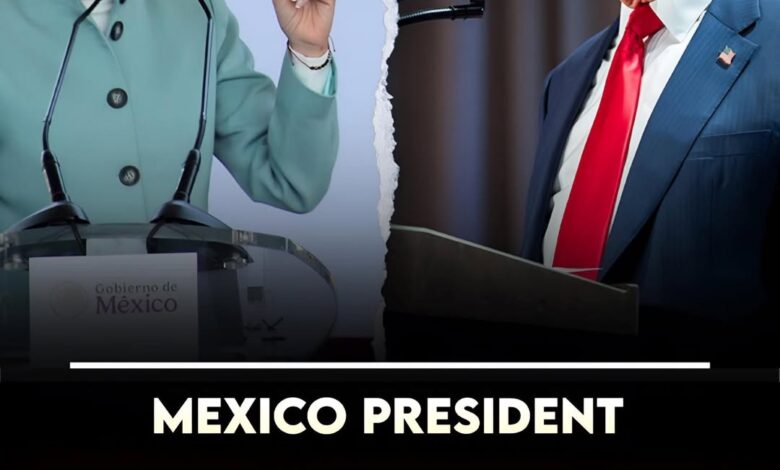
In the high-stakes theater of Western Hemispheric politics, the voice of Mexico has emerged as a resonant and defiant counterpoint to the dramatic events unfolding in Caracas. President Claudia Sheinbaum’s recent condemnation of the United States’ military operation in Venezuela—and the reported capture of Nicolás Maduro—was far more than a standard diplomatic protest.1 It landed with the weight of a thunderclap, signaling a profound reassertion of Mexican sovereignty and a warning that the legal architecture of the Americas is under threat.2 By invoking the United Nations Charter and the venerable Estrada Doctrine, Sheinbaum has not only criticized a specific tactical maneuver but has also drawn a definitive red line around the principles that govern power in the region.
The core of Sheinbaum’s rebuke lies in her appeal to Article 2(4) of the UN Charter, which explicitly prohibits the threat or use of force against the territorial integrity or political independence of any state.4 For Mexico, this is not an abstract legalism; it is the cornerstone of a global order designed to protect smaller nations from the unilateral whims of hegemonic powers.5 By framing the American strikes in Caracas as a fundamental breach of this international covenant, Sheinbaum is positioning Mexico as the guardian of multilateralism.6 Her message to Washington is clear: no matter the internal politics of a nation or the criminal allegations against its leader, the act of “foreign boots on sovereign soil” represents a dangerous regression to an era of interventionism that Latin America has spent decades trying to transcend.
Central to this stance is the Estrada Doctrine, a pillar of Mexican foreign policy since 1930.8 The doctrine posits that foreign governments should not judge the legitimacy of other regimes, as doing so constitutes an insulting violation of sovereignty. In a modern context, Sheinbaum is using this principle to resist the “might makes right” philosophy that she sees emerging from the current U.S. administration. While other nations in the region have murmured alarm or maintained a cautious silence, Mexico has chosen to lead with a philosophy of non-intervention.9 This choice is rooted in a collective regional memory of coups, covert operations, and imposed leaders—a history that Sheinbaum insists must not be repeated.10 To her, the reported capture of a sitting president, regardless of his ideology, sets a precedent that endangers every state in the hemisphere.
This diplomatic stand also serves as a strategic maneuver regarding Mexico’s own relationship with its northern neighbor. The tension is amplified by recent rhetoric from President Donald Trump, who suggested that Mexico itself might require similar “intervention” to address the power of drug cartels.11 By standing firm on the Venezuelan issue, Sheinbaum is preemptively defending Mexican soil.12 She has used her daily briefings to dismiss the notion of a U.S. invasion of Mexico as something she does not believe is being taken “seriously,” yet her categorical rejection of foreign interference serves as a shield.13 She is reminding the world—and the White House—that cooperation on critical issues like migration, security, and the fentanyl crisis cannot be taken for granted if the basic rules of sovereignty are discarded.
The ripples of Mexico’s “thunderclap” are being felt throughout Latin America, particularly among left-leaning leaders in Brazil and Colombia who share Sheinbaum’s apprehension.15 There is a growing fear that the hemisphere is sliding toward a new era of coercion, where criminal indictments are used as a pretext for military regime change. Mexico’s insistence on dialogue and negotiation as the only legitimate paths forward is a direct challenge to the “Operation Absolute Resolve” strategy.16 Sheinbaum’s administration is effectively arguing that the battle for Caracas is, in reality, a battle for the soul of international law.17 If the global community acquiesces to the unilateral removal of a leader, the very concept of a sovereign state becomes a fragile privilege rather than an inherent right.
Furthermore, Sheinbaum’s critique extends to the United Nations itself.18 Alongside Foreign Secretary Juan Ramón de la Fuente, she has lamented the “passive role” of the UN, suggesting that the primary multilateral structure of the world has proven ineffective in containing the abuses of great powers.19 This critique highlights a broader frustration among nations of the Global South, who see international law as their only defense against power asymmetries.20 By raising her voice when the UN has remained relatively quiet, Sheinbaum is attempting to fill a moral and legal vacuum, asserting that the American continent belongs to its people, not to a single power or a single doctrine.
Ultimately, President Sheinbaum’s warning is a call for a return to a “zone of peace” built on mutual respect and the peaceful settlement of disputes.22 She is betting that principles will ultimately prove more durable than pressure. In the long winters of geopolitical crisis, Mexico is positioning itself as the voice of conscience, reminding its neighbors that intervention has never brought lasting democracy or stability to the region.23 The real test in the coming months will not be found in the courtrooms of New York where Maduro may face trial, but in the diplomatic corridors of Mexico City and Brasília. The question remains: will the hemisphere accept a new status quo of intervention, or will the red line drawn by Mexico inspire a collective reassertion of Latin American independence? For Claudia Sheinbaum, the answer is found in the history of her people—a history that dictates that only the residents of a nation have the right to determine its future.