My Grandma Kept the Basement Door Locked for 40 Years – What I Found There After Her Death Completely Turned My Life Upside Down

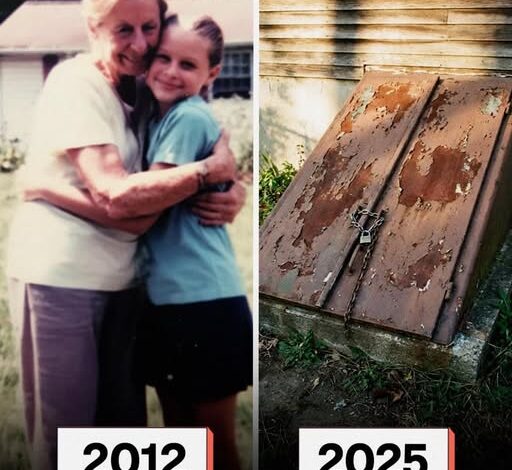
When my grandmother Evelyn died, I thought the hardest part would be letting go of the woman who practically raised me. I wasn’t prepared for the secret she’d been guarding for forty years—a secret locked behind a basement door she never once allowed me to open. I grew up in her little house.
After my mom died when I was twelve and with a father I’d never known, Evelyn became my entire world. She was strict, smart, impossible to fool, and she carried herself with the kind of quiet strength that made you believe things would be okay as long as she was in the room.
She taught me how to bake pies that didn’t fall apart, how to keep my backbone straight when someone tried to push me, and how to rebuild your life even when grief had chewed holes through the center of it.
For all the years I lived with her, there was only one rule she never bent: stay away from the basement. The old metal door on the back of the house was always locked. I never saw her open it, not once. And when I asked why—because a locked door in a kid’s world might as well be the gateway to buried treasure—she shut me down without hesitation.
“There are old things down there you could get hurt on,” she’d say. End of conversation. Eventually I stopped wondering. The basement became something I mentally walked around, the way you walk around an old wound.
Life kept moving. I grew up, went to college, visited Grandma on weekends, and eventually met Noah, the man I’d build a life with. But while my life expanded, hers slowly shrank. Evelyn aged in the way people do when they’ve spent a lifetime pushing through every storm. First came the fatigue. Then the forgetfulness. The humming she used to do while cooking stopped.
The porch, her favorite spot, started to feel like “too much effort.” I saw it happening, and I hated it, but the woman was stubborn enough to stare down a tornado, so admitting she was declining was never going to happen.
The call came while I was folding laundry. Dr. Smith’s voice was too gentle, too familiar, too final. “I’m so sorry, Kate. She’s gone.” I dropped everything. The grief hit so fast it stole the air out of my lungs. Noah held me together long enough to get through the funeral.
After that, I was on my own. Mom had been an only child, Grandma’s brothers were long gone, and the handful of distant relatives wanted nothing to do with sorting through her belongings. “Do whatever you think is best,” they said. So we drove out to the house one last time.
Walking into her home without her felt wrong. Her slippers were still by the couch. Her scent—lavender and something warm I still can’t name—clung to the air. Noah promised we’d go slow. We sifted through decades of her life: my childhood drawings, brittle photos of Mom as a toddler, old recipe cards worn from use. Every object cracked something open inside me.
When the last of the upstairs rooms was packed, I found myself outside with the basement door directly in front of me.
It was the only part of her life I’d never been allowed to see. And now it was my responsibility. The lock looked ancient. I had never seen a key for it. “We should open it,” I told Noah. “There might be things she meant to save.” “Are you sure?” he asked. But I was already certain. The lock snapped after one hard push. Cold stale air slid up the stairs like a ghost stretching its limbs. Noah took the flashlight and went down first. I followed, holding the railing like it might bite.
The basement wasn’t cluttered. It wasn’t dangerous. It was organized. Too organized. Along the brick wall sat a neat line of boxes, each one carefully labeled in Grandma’s unmistakable handwriting. Not random junk. Not forgotten storage. Something curated. Something protected.
Noah opened the nearest box, and the first thing we saw was a soft, yellowed baby blanket folded with impossible care. Beneath it, tiny knitted booties. And under those—an old black-and-white photograph. It was Evelyn. She looked sixteen at most, sitting in a hospital bed, exhausted and frightened, holding a newborn.
A newborn who wasn’t my mother.
My stomach dropped. I tore open the next box. Adoption papers. Government letters stamped SEALED. Pages of correspondence, each one more heartbreaking than the last. And then I found the notebook. Thick, worn, its pages overflowing with her handwriting. Every page carried a piece of the story: agency names, dates, meetings, attempts, rejections. “They won’t tell me anything.” “Told me to stop asking.” “No records available.” The last entry, written two years ago, stopped me cold: “Called again. Still nothing. I hope she’s okay.”
That was when everything inside me broke. My grandmother had a daughter before my mother. A baby girl she was forced to give up at sixteen. And she had spent the rest of her entire life trying to find her. She’d kept the basement locked not because it was unsafe—but because it was too painful. She lived with this grief quietly, privately, the way she carried everything heavy. Alone.
I knew what I had to do. I used everything I found—names, dates, agencies—and started searching. Late nights, endless calls, dead ends. The adoption system back then was a maze designed to keep people apart. But then came the DNA test. It felt like a desperate shot in the dark. And then the results came in.
Her name was Rose. Fifty-five years old. Living two towns over. A direct match. I messaged her with my heart in my throat. She responded the next morning, ready to meet.
We chose a small coffee shop. I got there early, barely breathing. When she walked in, I knew instantly. She had Grandma’s eyes—the same shape, the same deep, steady warmth. We sat, and I gave her the photo. Then the notebook. Then the truth. She listened silently, tears slipping down in quiet streaks. “I thought I was a secret she wanted to forget,” she said. “I didn’t know she searched.” “She never stopped,” I told her. “She just ran out of time.”
We talked for hours. And when we hugged goodbye, something heavy in me finally loosened. Rose and I stay in touch now. It’s not some dramatic instant-family miracle—but it’s real. Every time she laughs and her smile tilts just like Evelyn’s, I feel like I handed my grandmother the answer she spent her life chasing.
I opened that basement door to close up a house. Instead, I opened an entire chapter of her story—and gave the ending she never had the chance to reach.