SOTD – I Noticed a Little Boy Crying in a School Bus, and I Jumped in to Help after Seeing His Hands

The cold that morning was sharp enough to bite through layers, the kind that settles into your bones and refuses to let go. I’ve driven a school bus for more than fifteen years, long enough to know that winter mornings test everyone—kids, parents, and drivers alike. I unlocked the gate before sunrise, climbed into the familiar yellow bus, and let the engine rumble awake while the heater struggled to keep up. I thought it would be another ordinary day. I was wrong .
The route began like it always did. Kids piled in wrapped in scarves and oversized coats, boots clomping against the steps, laughter bouncing down the aisle. I joked with them, waved to parents, and teased little Marcy about her pink pigtails and bossy attitude. Those small exchanges mattered more to me than the paycheck ever did. They reminded me why I kept showing up before dawn, even when the bills stacked up and my wife reminded me—often—that kindness doesn’t pay the electric company.
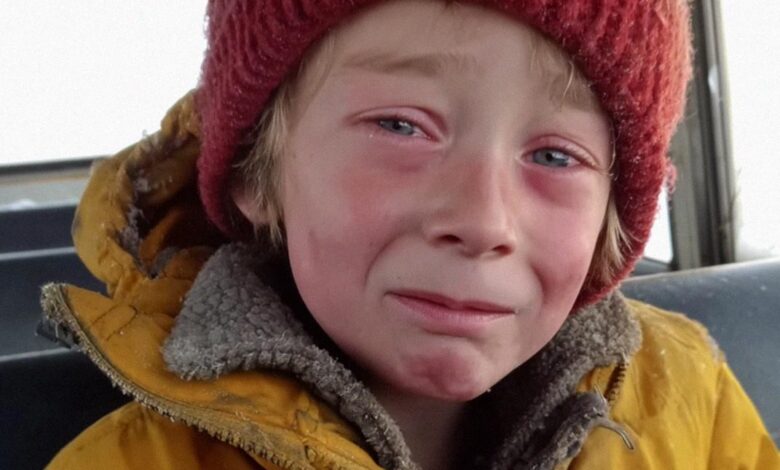
After the morning drop-off, I did my usual walk-through. I checked the seats for forgotten backpacks, mittens, half-eaten snacks. That’s when I heard it—a soft sniffle from the back corner of the bus. It was the kind of sound you don’t ignore. I followed it and found a small boy huddled by the window, coat pulled tight, eyes fixed on the floor. He said he was cold. When I asked to see his hands, he hesitated, then slowly held them out. His fingers were blue, stiff, and swollen. Not just cold—exposed for too long.
I didn’t think. I pulled off my gloves and slid them onto his hands. They swallowed his fingers, but warmth mattered more than fit. He told me his parents would get him new ones next month. The old pair had ripped. His dad was “trying hard.” Those words stuck. I knew that tone. I’d lived it. I promised him something better later and watched his face lift just enough to remind me why silence is sometimes heavier than cold.
Instead of coffee that day, I walked to a small shop down the block. I bought a thick pair of gloves and a navy scarf with bold stripes, the kind a kid could feel proud wearing. It cost me my last spare dollar. I didn’t hesitate. Back on the bus, I placed them in a shoebox behind my seat and wrote a simple note: “If you feel cold, take something from here.” No names. No attention. Just an option.
That afternoon, I watched the mirror. Kids paused. Read the note. One small hand reached in and took the scarf. No eye contact. No words. But that boy didn’t shiver getting off the bus, and he smiled. I thought that would be the end of it. A quiet moment, handled quietly. I underestimated how far small things travel.
A few days later, I got called into the principal’s office. My stomach dropped. I ran through every worst-case scenario—complaints, misunderstandings, policy violations. Instead, I found a smile. The principal explained the boy’s situation. His father was a firefighter recovering from an injury. Work had stopped. Money was tight. What I’d done hadn’t just kept a kid warm—it had lightened a family already under strain.
More than that, the shoebox had been noticed. Teachers mentioned it. Parents asked about it. The school decided to act. A fund was created. Winter clothing bins appeared. No questions asked. Gloves, scarves, coats. Quiet dignity. All sparked by one pair of borrowed gloves and a handwritten note.
Word spread. A bakery donated hats. A retired teacher knitted wool caps. The shop owner offered weekly gloves. Notes began appearing in the bin. Thank-yous written in uneven handwriting. Gratitude wrapped in crayon. I kept driving my route, pretending not to notice how much bigger the box had become.
One afternoon, the boy ran up the steps holding a folded piece of paper. Inside was a drawing of me and the bus, surrounded by kids wearing scarves and gloves. At the bottom, it said, “Thank you for keeping us warm. You’re my hero.” I taped it near my steering wheel. Some things deserve to be seen every day.
Then came the assembly. I sat in the back, uncomfortable, confused, until my name was called. Applause filled the gym. The project had grown beyond our school. Other buses. Other neighborhoods. No child walking into class with numb fingers anymore. And then the boy’s father stepped forward, still moving carefully, uniform crisp, eyes full. He shook my hand and thanked me—not for charity, but for dignity. For seeing his son.
That was when I understood something I’d missed for years. My job wasn’t just about driving safely or keeping schedules. It was about paying attention. About noticing what others overlook. About understanding that one quiet act, done without an audience, can move further than anything loud.
Winter eventually loosened its grip. The bus still rattles. The heater still struggles. Bills still come. But I drive differently now. Not prouder—steadier. Because somewhere along the route, a child learned they didn’t have to hide their hands. And I learned that sometimes the smallest kindness becomes the warmest ride of all.