The Girl I Thought Was a Dream.. –

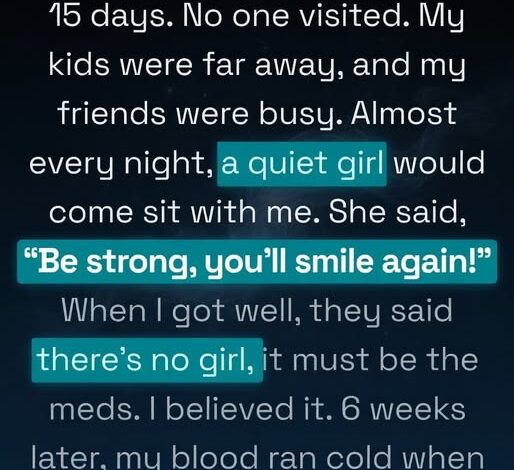
She was always at the edge of the room, never demanding attention. A quiet girl with dark hair and eyes that didn’t pity me—eyes that looked straight through the pain and saw the person trapped underneath it. She didn’t talk much. She didn’t ask questions. She just stayed, and somehow that made the sterile hospital air feel less suffocating.
No one else saw her.
When I mentioned her, the staff exchanged those looks people give when they’re trying to be kind but don’t want to encourage something they think isn’t real. They suggested trauma. Stress. Medication side effects. The mind’s way of coping when reality is too sharp to hold.
And for a while, I almost believed them.
Because when you’re broken enough, you’ll cling to anything that helps you breathe—especially if it’s quiet, gentle, and shows up when the world feels empty.
But then one night, when the pain was loud and the loneliness was louder, she leaned closer and said something so simple it cut through everything:
“You’ll smile again.”
Not like a motivational poster. Not like a nurse trying to keep me hopeful. It sounded like a promise from someone who knew what it cost to believe in one.
After that, her presence became my anchor. Physical therapy was brutal. Recovery was slow. My emotions swung between numbness and anger, and some days I didn’t recognize myself at all. But when she was there, I felt less like a patient and more like a person.
Eventually, I was discharged.
Home didn’t feel like home. It felt like a place where the accident echoed in every corner. Friends checked in, but life kept moving for everyone else, and I was still stuck in the aftermath—learning how to live inside a changed body and a changed future.
Then, one afternoon, there was a knock at the door.
I expected a visiting nurse. Maybe a caseworker. Someone with a clipboard and a schedule.
But when I opened it, I froze.
There she was—standing in full daylight, not in the soft blur of exhaustion or medication. Dark hair. Familiar eyes. Real as the air in my lungs.
My stomach dropped.
This wasn’t a dream. This wasn’t my mind trying to survive. This was a person.
“My name is Tiffany,” she said, voice shaking like she’d rehearsed it a hundred times and still wasn’t ready.
And then she told me the truth.
She was the daughter of the woman who caused the crash.
The woman who didn’t survive it.
The words landed like weight. The room felt smaller, the air thicker. I didn’t know what expression I was supposed to wear—anger, grief, confusion, all of it fighting for space in my chest.
Tiffany didn’t come with excuses. She didn’t try to explain away what couldn’t be undone. She just stood there with trembling hands and the kind of guilt that changes the way a person holds themselves.
Then she placed something in my palm.
A necklace.
An heirloom—mine. Something that had disappeared in the chaos of the accident, something I assumed was gone forever. It wasn’t just metal and stone. It was a piece of my past returned to me, proof that the story wasn’t over, even if it had been shattered.
In that moment, I understood something I wasn’t ready to admit before:
We weren’t connected by coincidence. We were connected by tragedy—one that destroyed one life and rewrote two others.
Over the next few weeks, Tiffany came by again. Not to ask for forgiveness like it was a quick transaction. Not to force closure. She came because she was grieving too, and because she didn’t know where else to put the weight of what had happened.
We sat in my living room in long, quiet stretches. Sometimes we talked. Sometimes we didn’t. There were tears. There were hard truths. There were moments when anger rose up so fast I had to step away and breathe.
But little by little, something shifted.
I learned that forgiveness isn’t a single decision you make once and never revisit. It’s a slow, daily choice—especially when the pain is real and the consequences are permanent.
And Tiffany… she wasn’t a ghost. She wasn’t a hallucination.
She was a human being carrying her own wreckage, showing up anyway.
Now, when I catch myself smiling—when it happens naturally, without forcing it—I think back to that hospital room and that quiet voice.
“You’ll smile again.”
It wasn’t a dream.
It was a lifeline—thrown by someone who needed saving, too.
Closing Thought
If this story moved you, share what stood out most in the comments—have you ever found healing in an unexpected place? And if you’d like more real-life inspired stories about recovery, resilience, and second chances, bookmark this page and come back for the next one.