What psychologists reveal when someone helps a waiter clear the table!

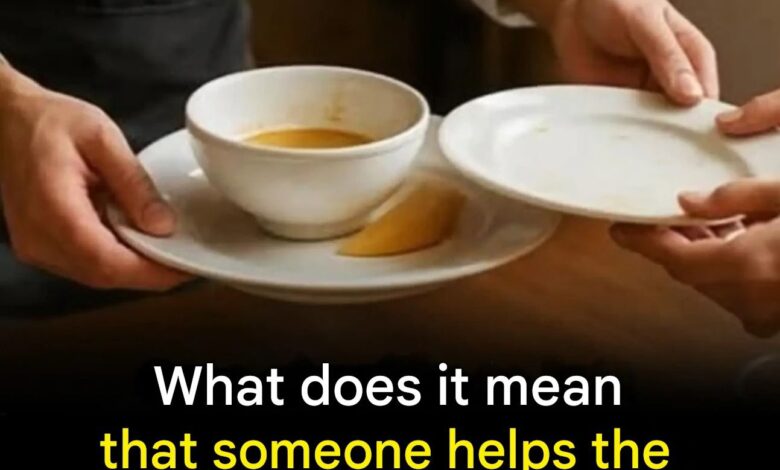
It’s a small moment that often passes without comment. A plate pushed gently toward the edge of the table. Glasses gathered into one place. A hand reaching out as a server balances dishes and navigates a crowded dining room. Helping a waiter clear the table doesn’t look like much, yet psychologists say this simple gesture can quietly reveal how a person relates to the world around them.
At first glance, it might seem like basic politeness or habit. Some people grew up doing it. Others picked it up after working service jobs themselves. But beneath the surface, this action reflects deeper patterns of empathy, awareness, and social perception that tend to show up across many areas of life.
Psychologists often point to this behavior as a strong indicator of empathy. Empathy isn’t just about feeling bad when someone is upset. It’s the ability to notice another person’s experience without being prompted. When someone helps a server, they’re recognizing mental load: the pace of service, the physical strain of carrying dishes, the pressure of multitasking while staying pleasant. They’re responding to something invisible rather than something explicitly asked for.
That awareness is a core component of emotional intelligence. Emotionally intelligent people tend to scan their environment instinctively. They notice who’s overwhelmed, who’s uncomfortable, who’s working under pressure. They don’t need dramatic cues. Subtle signals are enough.
Importantly, helping a waiter is rarely performative. Unlike holding a door open or saying “thank you,” it doesn’t reliably earn praise. In some cases, it’s barely acknowledged. That’s precisely why psychologists find it meaningful. It suggests the action isn’t driven by recognition or reward, but by an internal value system. The person acts because it feels natural, not because it will be noticed.
There’s also a strong link between this behavior and respect for roles that society often undervalues. Service workers operate in the background of daily life. Their labor is expected, often rushed, sometimes ignored. When someone helps clear a table, they’re implicitly rejecting the idea that certain jobs exist solely to serve others without reciprocity. They’re signaling, even unconsciously, that they see the worker as a person rather than a function.
Research in social psychology consistently shows that how people treat those with less social power—waiters, cleaners, retail staff—reveals more about their character than how they treat peers or authority figures. Kindness toward someone who can’t “do anything for you” is one of the clearest markers of genuine decency.
Another trait often associated with this gesture is humility. Helping clear plates means momentarily stepping out of the role of “guest” and into shared responsibility. It communicates, “I’m not above this.” People who do this tend to feel comfortable blurring rigid social hierarchies. They don’t see dignity as something that comes from status, but from behavior.
This also connects to cooperation. Humans are wired to collaborate, but modern social settings often discourage it. Restaurants, for example, are structured around clear divisions of labor: diners sit, servers serve. When someone breaks that script in a small, respectful way, it shows flexibility. They’re willing to adapt if it makes things easier for someone else.
Psychologists note that people who exhibit these micro-cooperative behaviors often display them elsewhere too. They’re the ones who help colleagues without being asked, notice when someone’s falling behind, or take on unglamorous tasks to keep things running smoothly. They tend to be reliable, not because they crave approval, but because they’re attuned to shared outcomes.
Interestingly, this gesture can also reflect a person’s relationship with control. Some people feel uncomfortable intervening in situations that aren’t explicitly theirs. Others fear “doing it wrong” or overstepping. Helping a waiter requires a relaxed sense of boundaries and trust—trust that the gesture will be understood as helpful, not intrusive. That comfort often comes from social confidence and low anxiety about judgment.
However, psychologists are careful to point out context matters. Not helping doesn’t automatically indicate a lack of empathy. Some people have been told by servers not to interfere. Others worry about hygiene rules or safety. Cultural norms also vary widely. In some places, helping is expected; in others, it’s discouraged.
What matters isn’t the isolated act, but the pattern. People who are empathic tend to look for ways to ease other people’s burdens when it’s appropriate. Clearing a plate is just one visible expression of that mindset.
There’s also a subtle cognitive component. Helping a server requires perspective-taking: imagining what the job demands in that moment. Perspective-taking is a foundational skill in healthy relationships. It’s what allows someone to anticipate needs, avoid unnecessary conflict, and respond thoughtfully rather than reactively.
In long-term partnerships and friendships, these small anticipatory behaviors often matter more than grand gestures. Remembering to refill someone’s water, noticing when they’re tired, picking up slack without being asked—these actions are built on the same psychological muscle as helping clear a table.
Some psychologists also connect this behavior to early social learning. People raised in environments where mutual aid was normalized—families where everyone pitched in, households without rigid role enforcement—are more likely to carry that instinct into adulthood. Helping doesn’t feel like a disruption to them; it feels like how things work.
From another angle, this gesture can reveal comfort with vulnerability. Helping a waiter means briefly risking awkwardness. Maybe the server says, “I’ve got it.” Maybe the plates clatter. People who still offer help tend to value intention over perfection. They’re less paralyzed by the fear of minor social missteps.
That trait often correlates with resilience. Individuals who aren’t overly self-conscious are better at navigating uncertainty, learning from mistakes, and staying emotionally regulated under pressure.
What psychologists consistently emphasize is that character is rarely revealed in dramatic moments. It shows up in the quiet, automatic choices people make when no one is keeping score. Clearing a table is one of those choices. It doesn’t change the world. It doesn’t make headlines. But it does reflect how someone moves through shared space—with awareness, respect, and a willingness to lighten someone else’s load.
In a culture that often celebrates loud confidence and visible success, these understated behaviors can be easy to overlook. Yet they’re often the foundation of trust, cooperation, and genuine connection.
Helping a waiter clear the table isn’t about being “nice.” It’s about being attentive. And attentiveness—quiet, consistent, unassuming—is one of the strongest indicators of emotional maturity there is.