Wheel of Fortune Contestant Viewers by Cracking a $65K Puzzle in Seconds!

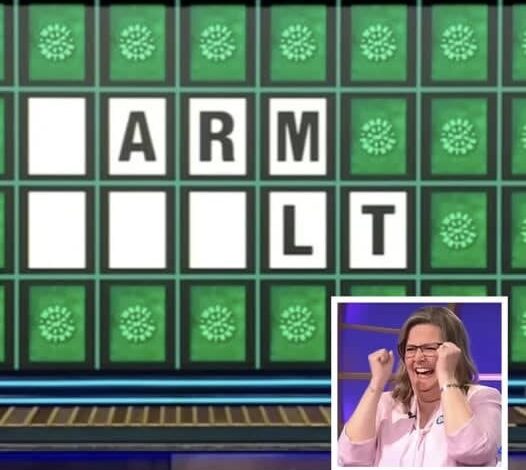
Wheel of Fortune has produced its fair share of memorable moments over the decades, but every so often, a single contestant delivers a performance so sharp it jolts even longtime viewers out of routine watching. That’s exactly what happened when Delinda Rood, a woman from Rosemount, Minnesota, stepped onto the iconic stage and turned a quiet start into one of the fastest and most impressive Bonus Round solves in recent memory.
From the moment the episode aired, social media lit up. Viewers replayed the clip. Comment sections filled with disbelief. And even the host, Ryan Seacrest, looked momentarily stunned as Rood calmly delivered the correct answer almost the instant the puzzle appeared.
By the end of the night, she walked away with $65,650 in total winnings. But the number alone didn’t explain why the moment hit so hard. It was the speed, the confidence, and the contrast to how the game had begun.
Rood appeared on the November 4 episode alongside Justin Zamora of Palo Alto, California, and Shateria Smith of Chattanooga, Tennessee. On paper, it looked like a fairly typical lineup. No returning champions. No celebrities. Just three everyday contestants hoping to spin their way to a good night.
Rood introduced herself as an “ambivert,” someone who sits comfortably between introversion and extroversion. It turned out to be a fitting description. She wasn’t loud or showy, but she wasn’t timid either. She watched closely, waited patiently, and when the moment came, she moved with precision.
The game didn’t start in her favor. The opening toss-up puzzle, “My Game Face,” went unsolved by all three contestants. That early stumble set an oddly tentative tone, with missed buzz-ins and cautious guesses. For a brief stretch, Rood seemed slightly out of sync, trailing behind as the board filled and emptied without her name flashing too often.
Then came the second toss-up: “Practical Joker.”
This time, Rood buzzed in decisively and solved it cleanly, immediately pocketing $2,000. It wasn’t flashy, but it was a reset. Her posture changed. Her focus sharpened. From that point on, she played like someone who had settled into the rhythm of the game rather than fighting it.
Over the next several rounds, Rood built momentum steadily. She didn’t dominate every spin, but she avoided costly mistakes. She chose consonants strategically, solved puzzles efficiently, and let others overextend when the board turned risky. By the time the main game wrapped up, she had secured her place in the Bonus Round.
That’s where the night turned unforgettable.
As the Bonus Round puzzle appeared, the usual ritual unfolded: letters revealed, category announced, the familiar ticking clock looming overhead. Viewers expected the standard pause — the furrowed brow, the silent mouthing of possibilities, the dramatic last-second guess.
Instead, Rood barely hesitated.
Almost as soon as the final letters appeared, she spoke the correct answer. No second-guessing. No verbal filler. Just a clean, confident solve that seemed to land before the audience had fully registered the puzzle.
For a split second, the studio felt frozen.
Ryan Seacrest’s reaction said everything. He blinked, smiled, and looked genuinely caught off guard — a rare moment for a host trained to handle surprises without missing a beat. The audience erupted as the prize reveal confirmed what viewers at home were already realizing: this wasn’t just a win, it was a statement.
The Bonus Round prize pushed Rood’s total winnings to $65,650, a figure that would be impressive under any circumstances. But it was the speed of the solve that turned it into television gold. Longtime fans immediately began comparing it to other legendary quick solves, debating where it ranked among the fastest in the show’s modern era.
What made the moment resonate even more was how ordinary Rood appeared leading up to it. There was no exaggerated confidence, no pre-packaged “game show personality.” She played like someone who had prepared quietly, trusted her instincts, and refused to panic under pressure.
That combination is rare.
Game shows thrive on tension. They’re built around hesitation, risk, and near-misses. When someone cuts through all of that with clarity, it feels almost disruptive — in the best possible way. Rood didn’t just solve a puzzle. She punctured the suspense with certainty.
Viewers responded immediately. Clips of the solve circulated online within hours. Comments praised her composure and intelligence. Others admitted they were still staring at the screen when she had already answered.
What stood out most wasn’t luck. It was recognition. The kind that comes from pattern awareness, vocabulary familiarity, and the ability to synthesize incomplete information instantly. That’s not something you improvise in the moment. It’s something you bring with you.
For Wheel of Fortune, moments like this are part of why the format endures. The rules are simple. The stakes are clear. And every so often, a contestant reminds everyone that mastery can look effortless.
Rood didn’t scream. She didn’t jump. She smiled, accepted the win, and moved on with the same grounded demeanor she’d carried throughout the episode. That restraint only amplified the impact. It felt real. Earned. Clean.
In a television landscape crowded with exaggerated reactions and manufactured drama, her performance cut through precisely because it didn’t try to.
By the time the credits rolled, the story had already written itself: a slow start, a steady climb, and a lightning-fast finish that left both host and viewers stunned. One contestant. One puzzle. A moment that will be replayed for years whenever fans argue about the greatest solves in the show’s history.
Delinda Rood came to Wheel of Fortune like countless others before her. She left it with something far rarer than money — a moment of pure, undeniable excellence that needed no explanation.
Just a puzzle, a voice, and the kind of confidence that speaks once and gets it right.