THE THREE GIRLS WHO LEARNED TO COME DOWN BY PLAYING ON THE STAIRS

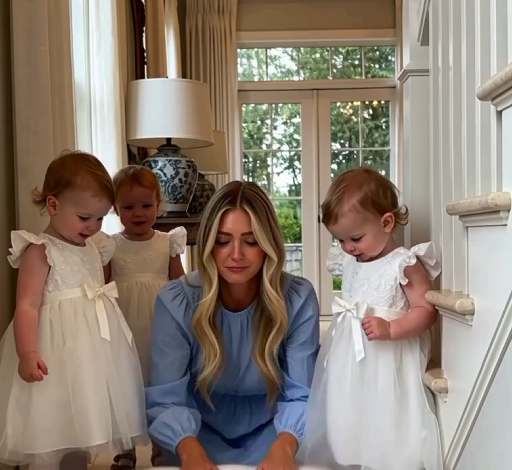
Bruno’s hand stayed resting on Clara’s while Adrián remained sitting on the bottom step, not knowing what to do with his own body.
Teo had slid down to the second cushion and Nico was knocking his heels against the edge, waiting for her to go back up and repeat the descent. Clara didn’t celebrate the progress with applause, because she had learned that some children got frightened when adults turned a small decision into a performance.
She only smiled and went back to the top.
“One more,” she said, “and then we stop.”
All three looked at the stairs.
Adrián looked at his sons.
For two years he had confused the absence of accidents with the presence of well-being.
He had recorded hours of sleep, amounts of food, the duration of tantrums, and the number of steps each boy managed to take before sitting down on the floor.
He had never recorded who they moved toward.
Clara had seen it.
Bruno moved toward a calm voice, Teo toward the rhythm of a body that didn’t push him, and Nico toward a staircase turned into something he could understand with his legs.
Valeria crossed her arms in the hallway.
“Adrián, your business partners and their families are coming tomorrow.”
“I know.”
“You can’t have pillows on the steps.”
Adrián took a while to answer, because Bruno had just slid down one more step without crying.
“We’ll take them away before they arrive.”
Valeria nodded, relieved.
Clara looked up.
“If you want to take them away, that’s fine.”
“That’s all?” Valeria asked. “You’re not going to defend your method?”
“It isn’t a method,” Clara answered. “It’s a staircase, and they want to come down.”
Valeria let out a dry laugh.
“In this house, things don’t work just because someone wants them.”
Clara looked back at the children.
“Maybe that’s why they haven’t moved in so long.”
Adrián felt the blow, though he wasn’t sure whether it was aimed at him or at the house.
That night he put the cushions away in a cupboard, but he didn’t order Clara to leave.
The next morning, he found them lined up beside the staircase, ready to be used.
It hadn’t been Clara who left them there.
Bruno had dragged one from the sitting room while Teo pushed another with both hands and Nico waited sitting on the first step.
Adrián wanted to call someone to take them away.
Then he saw that all three were watching him.
“Do you want to do it again?” he asked.
Nico slapped the cushion.
Teo raised his arms.
Bruno reached for Clara’s hand.
Adrián stepped aside to give them room.
That was the first change nobody photographed.
It hadn’t been a word, a perfect smile, or a scene worth a celebration.
It had been a father stopping himself from interrupting.
Clara arrived at the mansion every day at eight twenty, her hair tied back any old way and a jacket that smelled of rain, soap, and damp earth.
She didn’t look like a caregiver prepared for a house where the staff walked in silence and the children had a dining room separate from the rest of the family.
Sometimes she arrived with mud on her hem because she’d crossed the garden in her own neighborhood after walking one of her brothers to school.
Sometimes she carried a bag of stale bread for the birds and dry leaves she’d found by the sidewalk.
Valeria said that demonstrated a lack of judgment.
Clara didn’t try to convince her.
She had spent years looking after her younger siblings, reading their faces before they could explain what they needed, and staying awake beside them when a hard night seemed like it would never end.
She hadn’t learned to care for children in an elegant course.
She had learned it by waiting.
That was why she didn’t lift the triplets up when they went rigid on the floor.
She sat nearby and waited for each one’s body to stop bracing for an order.
At first, the waiting seemed pointless.
Bruno could spend twenty minutes with his forehead against the carpet.
Teo cried if an adult came too close too fast.
Nico hid under a small table every time the doorbell rang.
When guests arrived, all three folded in on themselves as if they wanted to take up less room than their own shoes.
Adrián had tried to solve it with a visual calendar, special headphones, transition rooms, and a reward chart.
Clara used an old blanket.
She spread it under the table and crawled underneath without asking them to come out.
She didn’t tell them they should relax.
She didn’t ask them to look at her.
She hummed a wordless melody while folding the corners of the blanket into a low tent.
Nico appeared first.
Only one eye was visible.
Clara acted as if she hadn’t noticed.
Teo crawled to the edge.
Bruno stayed hidden, but he stopped clenching his fists.
After ten minutes, all three were under the table with her.
Adrián watched from the doorway with an open notebook in his hand.
Clara raised a finger toward the notebook.
“Don’t write this down.”
“Why not?”
“Because if you turn it into a result, tomorrow you’ll expect it to happen the same way again.”
Adrián looked at the page full of numbers.
“I need to know what works.”
“You need to know who they are when they’re not trying to obey.”
The sentence struck him as too simple to be useful.
Even so, that afternoon he closed the notebook.
The following days were not easy.
Teo cried on the stairs again when a staff member moved the cushions without warning.
Bruno banged his knee against the edge of the second step and went back to the sofa for hours.
Nico refused to eat because Valeria had ordered that everyone sit up straight and use the small silver spoon.
Clara didn’t call that a setback.
She put the cushions back.
She cleaned Bruno’s knee with an ordinary towel.
She let Nico eat pieces of pear with his fingers while she sat on the floor.
Adrián watched her with an unease he couldn’t name.
He had built his company by calculating risks before they happened.
Clara accepted that a child would trip, cry, and try again, without turning the stumble into a sign of failure.
Valeria used every accident to gather evidence against her.
“The house looks abandoned,” she said after finding muddy footprints in the hallway.
“The house looks used,” Adrián answered.
“I don’t recognize you.”
“I don’t recognize myself either, when they look at me like I’m another employee.”
Valeria went quiet.