THE THREE GIRLS WHO LEARNED TO COME DOWN BY PLAYING ON THE STAIRS

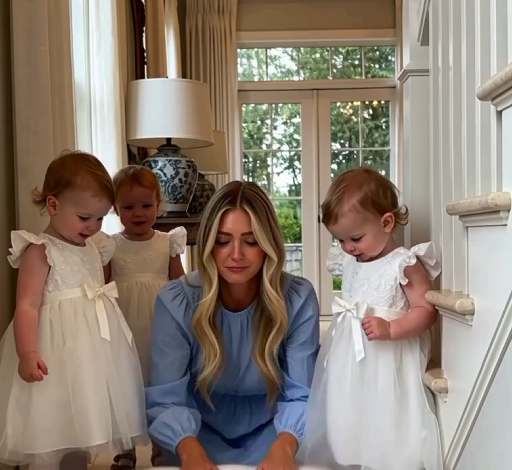
She was not a cruel woman.
She had helped Adrián raise the children since his wife died, and she was convinced that order had been the only thing keeping the family from falling apart.
Her mistake was believing that protecting the family’s image was the same as protecting its members.
Every time the triplets screamed in front of a visitor, Valeria thought about the comments that would follow.
Every time Clara let them walk barefoot on the grass, she saw a loss of authority.
Every time the children preferred to sit beside Clara, she felt the place she had defended for two years beginning to disappear.
The mansion had an enormous garden, but the triplets had barely touched the soil.
The paths were swept, the shrubs trimmed, and the lawn treated so that no leaf would disturb the symmetry.
Clara brought out a basin of water and three wooden spoons.
She didn’t explain the plan.
She filled the basin and began stirring the water slowly.
Nico came closer first.
Teo stayed by the glass door.
Bruno looked at the mud forming under the basin and tucked his feet away.
Clara sank a finger into the wet soil.
Then she drew a line that ended beside her sneaker.
Nico copied the movement.
Teo took a step.
Bruno didn’t move, but he stopped covering his legs with his hands.
Adrián came out to the garden in a white shirt with his phone still on.
He saw Nico splash water at Clara.
He saw Teo laugh without sound.
He saw Bruno look at his own feet as if they were something that could belong to him again.
And he saw Clara let the mud cover her fingers without hurrying to clean them off.
“They’re going to get dirty,” Valeria said from the terrace.
“Yes,” Adrián answered.
“And that seems all right to you?”
Adrián looked at Bruno.
“It seems to me that they’re here.”
For a week, Clara repeated small rituals.
They came down the stairs before breakfast.
They crossed the garden to the basin.
They touched the grass after the rain.
They went back inside when one of them raised a hand.
There were no rewards.
There was no children’s music.
There was no adult voice narrating every step.
Clara’s freedom consisted of not filling every silence.
Adrián began arriving before his meetings.
At first he stood near the door.
Then he sat on the bottom step.
Then he took off his shoes to cross the grass with them.
The first time Nico handed him a muddy spoon, Adrián held it as if it were a fragile artifact.
“Now you have to use it,” Clara said.
“For what?”
“For whatever he wants.”
Nico put the spoon over the basin.
Adrián moved it in circles.
The boy laid his hand on top of his.
It wasn’t the same gesture he’d made with Clara.
It was briefer, more uncertain, and more important to him.
Adrián didn’t try to repeat it.
He just kept stirring the water.
The birthday had left a strange photograph in the family archive.
Irene, the photographer hired to document the celebration, had captured the guests smiling while the triplets disappeared behind the sofa.
Days later, going through the images, she found another one taken by accident.
In it, Bruno was on the stairs with his mouth open and a hand extended toward Clara.
It wasn’t a smile.
It wasn’t yet a word.
It was the first sound his mouth had dared to reach for in front of another person.
Irene showed the photograph to Adrián.
“It doesn’t look like much,” he said.
“That’s why it looks true.”
Adrián put the picture in the drawer of his desk.
He didn’t share it with anyone.
That night he stopped reviewing the step chart.
He didn’t tear it up.
He simply stopped opening it.
The next challenge came in the form of a family lunch.
Valeria had invited six relatives to prove that the children could behave if someone maintained sufficient firmness.
She ordered the cushions removed from the staircase and asked that the garden be closed during the meal.
Clara didn’t argue.
She arrived early and sat beside the door of the dining room.
The triplets came in wearing identical clothes, new shoes, and their hair combed back.
At the sound of the guests’ voices, all three folded almost at the same moment.
Bruno went for the wall.
Teo started breathing fast.
Nico crawled under the table.
Valeria leaned toward them.
“Say hello to your family.”
Not one of them answered.
“Adrián, do something.”
Adrián took a step, but Clara raised her hand.
Not to stop him.
To ask him to wait.
She sat down on the floor beside the table and set a wooden spoon near Nico.
Then she put another beside Teo.
Bruno got a third.
Clara struck hers against the floor once.
She waited.
She struck it again.
Nico copied her.
Teo struck twice.
Bruno lifted his spoon but didn’t let it fall.
The adults’ conversations died down little by little.
Valeria looked about to ask for them to be taken out.
Adrián sat down beside Clara.
He gave no instructions.
He didn’t ask for quiet.
He just picked up a spoon and waited.
The rhythm began to travel across the table.
Nico came out from under it.
Teo stopped covering his ears.
Bruno looked toward the guests.
Irene, who had come back to deliver the photographs, was by the door with her camera in her hands.
Bruno opened his mouth.
The sound came out small, rough, and almost incomplete.
“A…”
Clara didn’t move.
Neither did Adrián.
Bruno looked at his father.
Then he looked at Clara.
“Cla,” he said.
The word wasn’t perfect.
It was enough.
Valeria put a hand to her chest.
“Don’t turn this into a scene,” she whispered.
“The scene was already here,” Adrián answered.
Bruno held out his arms to Clara.
She lifted him only when he insisted.
The boy rested his head on her shoulder, but he didn’t close his eyes.
He was looking at the guests as if he’d just discovered they could stay there without forcing him to disappear.
That day, the first sound mattered more than the first laugh.
The laugh could have been an accident.
The word had chosen a direction.
Over the following days, the triplets began to change in small, concrete ways.
Teo stopped crying every time someone opened the garden door.
Nico began bringing spoons to Adrián.
Bruno walked three steps from the staircase to Clara’s hand.
Nobody made them repeat it in front of a camera.
Nobody called the grandparents to announce it.
The family began receiving the news in a less tidy way.
One afternoon, Adrián canceled a meeting to go out to the garden with them.
Another afternoon, Valeria found all three asleep on a blanket after playing in the mud.
The woman nearly demanded they be carried upstairs.
Then she saw Adrián sitting on the ground, his back against a planter and his eyes closed.
“You can’t let everything depend on her,” she said.
Adrián opened his eyes.
“It doesn’t depend on her.”
“They go looking for her.”
“Because she stays.”
Valeria didn’t know how to answer.
Adrián got up with difficulty.
“I’m going to stay too.”
The promise didn’t fix anything that day.
Bruno hid again when a new staff member came in.
Teo refused to come down the stairs.
Nico got angry because Clara had to go out for an hour.
But Adrián didn’t call Clara to solve it.
He sat in front of the staircase and waited.
At first, all three cried.
Then Teo put a hand on the first cushion.
Adrián didn’t hold him.
Bruno came out from under the table and sat beside him.
Nico dragged the blanket over to his feet.
The house didn’t suddenly turn warm.
It became slower to abandon the children in the difficult moment.
The pressure against Clara increased when Adrián’s business partners visited again.
One of them looked at the dirt stains on Nico’s trousers and smiled uncomfortably.
Valeria saw the reaction and filed it away as evidence.
That same night, she spoke with Adrián in the study.
“Your sons are calmer with her, yes, but the house has lost every limit.”
“What limit?”
“That adults decide and children learn.”
“They are learning.”
“They’re choosing who’s in charge.”
Adrián looked at the photograph of Bruno with his mouth open.
“Maybe they need to choose who to trust.”
Valeria drummed her fingers on the desk.
“You don’t know what will happen if she leaves.”
The sentence hung in the air.
Adrián thought about it as a risk.
Then he thought about Clara arriving each morning with her cloth bag.
He thought about the children waiting beside the staircase.
He thought about how he had never asked what she wanted to do before coming to that house.
The conversation ended without agreement.
Two days later, the agency called to confirm that Clara’s trial shift was about to end.
The agency had found a family offering a more stable contract and better-paid hours.
Clara hadn’t sought out the position.
The coordinator had told her she could accept it if she wished.
Clara listened to the offer in the kitchen while cutting bread into small pieces.
She didn’t answer right away.
Adrián came in as she hung up.
“What’s happened?”
“They’ve offered me another job.”
“Do you want to take it?”
Clara looked out toward the garden.
“I don’t know.”
“Why not?”
“Because there’s still a lot to do here.”
Adrián wanted to say he could raise her pay.
He wanted to say he could turn the trial shift into a contract.
He wanted to say the children needed her and this was no time to think about anything else.
He said none of it.
“What do you need?” he asked.
Clara looked down at her hands.
“To study.”
Adrián went still.
“To study what?”
“Early childhood education, if I can ever afford it.”
“Why can’t you?”
“Because I’ve spent years helping at home, and there was always something more urgent.”
She didn’t say it as a complaint.
She said it the way someone describes a wall.
Adrián went back to the study and opened, for the first time in months, a folder that had nothing to do with the triplets.
Inside was information about salaries, schedules, and household expenses.
He didn’t find a single line about Clara’s future.
That bothered him more than he expected.
Valeria heard about the offer before the end of the afternoon.
“If she leaves, the children will regress,” she said.
“They’re not an investment that can be lost.”
“They’re your sons.”
“Then we can’t build their calm around one single person.”
Valeria took a deep breath.
“And you can’t turn her into part of the family because it makes you feel less guilty.”
Adrián took the hit.
“I don’t want to buy her staying.”
“Well, that’s exactly what you’ll do.”
“No.”
“Then what will you do?”
Adrián looked toward the staircase.
“Open a door for her.”
Clara decided to accept the other job.
Not because she wanted to get away from the children.
She did it because the position had fixed hours and would let her enroll in an evening course.
When she told Adrián, he didn’t try to stop her.
“You have four days left here,” Clara said.
“I know.”
“The children don’t know.”
“We’ll tell them without making it a secret.”
The news landed badly.
Bruno refused to come down from the stairs.
Teo shoved the cushions against the wall.
Nico clung to Clara’s jacket and didn’t let go for almost an hour.
Clara didn’t promise she’d be back the next day.
She didn’t promise nothing would change.
She sat on the floor with all three and let their sadness take up the space.
Adrián sat on the other side.
For the first time, the children were between the two adults without anyone trying to move them.
“Clara is going to work at another house,” Adrián said.
Teo began to cry.
“And we are going to learn to wait for her without disappearing,” he continued.
Nico shook his head.
Bruno reached out a hand toward Clara.
She took it.
Adrián said nothing more.
Over the next four days, Clara kept the rituals.
She didn’t make them more intense to leave a final memory.
She didn’t teach them one last skill.
She came down the stairs, crossed the garden, and waited beside them like any other morning.
The difference was that Adrián was present for every scene.
He sat on the grass even when the damp stained his trousers.
He learned to wait without counting the minutes.
He learned that Teo needed to see a still hand before coming closer.
He learned that Nico was asking for food when he started hitting a spoon twice.
He learned that Bruno didn’t want to be picked up after walking — he wanted someone to walk near him.
Valeria observed from the edges.
At first she brought towels, disinfectant, and a list of rules.
Then she began bringing clean socks.
One afternoon, she found Nico asleep on a wet blanket.
Instead of calling a staff member, she covered him with her own shawl.
The boy opened his eyes.
Valeria froze.
Nico went back to sleep.
The woman didn’t tell anyone what had happened.
The next day, she left three old towels by the garden door.
Clara saw them and smiled.
“They’re hideous,” Valeria said.
“They’re perfect.”
“Don’t get used to it.”
“I don’t want the house to depend on me.”
Valeria looked at the children.
“That’s what you say now.”
“That’s what has to happen.”
The last morning came too soon.
Clara brought her cloth bag and a small box with her things.
There weren’t many objects inside.
A mug, two books, a sweatshirt, and a photograph Irene had given her.
The triplets were waiting on the stairs.
The cushions were lined up from the top all the way to the bottom step.
Adrián had placed them there before Clara arrived.
She looked at the staircase and then at him.
“You’ve done it wrong,” she said.
“Which part?”
“You’ve put too many.”
“I thought it would be safer that way.”
“You thought like yourself.”
Adrián removed two cushions.
Bruno smiled.
Teo sat at the top.
Nico took the first step without help.
Clara came down beside him.
Then she went back up.
The three children slid down one by one.
Adrián waited at the bottom with his arms open, but he didn’t lift any of them until each one asked.
When the moment came for Clara to leave, the house seemed to hold its breath.
She put on her jacket.
Nico followed her to the entrance hall.
Teo crawled after him.
Bruno stayed on the stairs, trembling.
Clara crouched in front of the door.
“I’m going to go,” she said, “and you’re going to still be here.”
Nico grabbed her sleeve.
Teo began to cry.
Bruno came down one step.
Adrián took a step toward them.
Clara raised her hand.
Not to stop him, but so that he wouldn’t resolve that moment for them.
Bruno came down another step.
Then another.
The boy who had cried every time he was set down on the floor walked all the way to the entrance without anyone carrying him.
Nico let go of Clara’s sleeve only to open the door.
Teo sat down on the doormat.
Clara stayed on the other side of the threshold.
Bruno reached her and took her hand.
Then he let go.
He took two steps toward Adrián.
He looked back at Clara.
And he returned to his father.
That was the second change nobody could turn into a number.
He hadn’t chosen between Clara and Adrián.
He had discovered that he could go from one to the other without losing either.
Adrián knelt down.
Bruno leaned against his chest.
Teo arrived next.
Nico stayed beside Clara until the last moment.
Adrián didn’t ask him to come in.
“You can stay there,” he said.
Nico took a deep breath.
Then he crossed the threshold.
Clara closed her eyes for an instant.
“Don’t promise them they won’t miss you,” Adrián said.
“I won’t.”
“What will you tell them?”
“That missing someone doesn’t mean breaking again.”
Adrián nodded.
Clara left.
The three children cried.
They didn’t hide.
They didn’t fold up behind the sofa.
They cried in the entrance hall, surrounded by their father, their aunt, and a door that stayed closed.
Adrián sat down on the floor.
Valeria sat beside him.
Nobody tried to distract them.
After a while, Bruno rested his head on his father’s knee.
Teo took Valeria’s hand.
Nico dragged the blanket over to all three.
The house didn’t change because Clara had gone.
It changed because the others had learned to stay.
Adrián kept Clara’s shift open for two weeks, but not to force her back.
He kept it so she could decide without fear.
He also spoke to the evening school where she wanted to enroll.
The tuition was more expensive than he had imagined.
Transport, books, and the schedule demanded a kind of planning Clara couldn’t manage alone.
Adrián prepared a proposal.
He didn’t call it a salary.
He didn’t call it a reward.
He included no conditions about returning to the mansion.
It was a full scholarship to study early childhood education for two years, with housing and materials paid.
Valeria read the document before Adrián handed it over.
“This looks like a debt,” she said.
“Then change the language.”
“Changing the words isn’t enough.”
“What do you propose?”
Valeria took a clean sheet of paper.
She wrote that the support required no work, no commitment to stay, and no repayment.
She wrote that Clara could accept, decline, or modify the offer.
She wrote that the children were not a condition.
Adrián signed at the bottom.
The family that had spent a fortune making everything look perfect was using its resources to open a path for someone who had arrived with a cloth bag.
Clara received the proposal in a café near the station.
She didn’t cry reading it.
She spent a long time looking at the last page.
“Why?” she asked.
Adrián was sitting across from her with no work jacket on.
“Because you want to study.”
“And the children?”
“They love you, but they’re not the price of your future.”
Clara looked down.
“I could come back some weekends.”
“Only if you feel like it.”
“I could show them the garden.”
“They already do that.”
“Who does?”
Adrián smiled awkwardly.
“Me, Valeria, and them.”
Clara accepted the scholarship a week later.
She didn’t come back as an employee.
She came back some afternoons because she wanted to see them.
The first time she returned, the triplets were in the garden with their knees covered in dirt.
Adrián was trying to build a small dam out of stones.
Valeria was holding a towel over Nico’s head while he filled a jug.
Clara stopped by the door.
Nico saw her first.
He ran toward her, but stopped before touching her.
He looked at his father.
Adrián opened his arms.
Nico ran to Clara and then went back to him.
Teo did the same.
Bruno came down the garden steps without help.
Clara didn’t say she was proud.
She crouched and touched the soil.
Bruno placed a leaf in her palm.
“What is it?” she asked.
“House,” the boy said.
The word was still small.
But it was no longer aimed only at her.
Adrián heard it from the basin.
Valeria turned toward the garden.
Irene, who had come to deliver an album, raised her camera and caught the moment.
This time, nobody asked the children to pose.
The new photograph showed the three of them around a leaf, Clara with muddy hands, Valeria holding a towel, and Adrián kneeling beside a stone.
It didn’t look like a perfect family.
It looked like a family that was present.
On Clara’s first day of classes, Adrián took the children to see her from a distance.
They didn’t go into the building.
They waited by the railing with a box of homemade cookies.
Clara came out at the end of the afternoon and was surprised to find them there.
“You didn’t have to come,” she said.
“We know,” Adrián answered.
“Then why did you?”
Bruno held out a broken cookie.
Clara accepted it.
Teo showed her a small dry leaf.
Nico raised both arms to be hugged.
Clara knelt down.
Adrián stayed a few steps back.
He didn’t try to take the center.
When the children let go of Clara, they came back to their father without anyone asking them to.
The car door closed.
Clara went into class.
Adrián pulled away slowly.
On the drive, the triplets talked in incomplete sounds about the mud, the stairs, and the cookie.
Adrián didn’t correct a single word.
Getting home, he made dinner with them.
The first time, he burned the bread.
The second, he forgot the fruit.
The third, he let Nico mix everything in a bowl that was far too big.
Valeria appeared in the kitchen and surveyed the disaster.
“This isn’t a dinner,” she said.
“It’s what we have.”
“We could order something.”
“We could sit down first.”
Valeria sat down.
The triplets took their chairs without anyone tying them to a schedule.
Bruno put a spoonful on Adrián’s plate.
Teo gave another to Valeria.
Nico left his beside an empty space.
Adrián looked at the place.
“It’s for Clara,” the boy said.
“She isn’t coming today.”
Nico didn’t move the spoon.
“Not tomorrow either.”
“No,” Adrián said, “but we can save it.”
Valeria took a small plate and set it beside her own.
It wasn’t a promise that Clara would live there again.
It was a way of acknowledging that someone could be absent without being erased.
Over time, the mansion stopped punishing every sign of life.
Mud stains appeared in the hallways.
Wooden spoons took over a kitchen drawer.
The cushions on the staircase stopped being decoration and became part of the house.
Adrián went on working too much, but he no longer used work to avoid the difficult afternoons.
Sometimes he sat on the floor without speaking while the children played around him.
Sometimes he got it wrong.
He lifted Teo too quickly, or insisted that Bruno finish a task.
Then Valeria would remind him that being close didn’t mean doing it perfectly.
Adrián learned to apologize.
The triplets learned that an apology didn’t change the house immediately, but it could leave the door open.
Clara advanced in her studies without becoming a polished expert or a distant figure.
She went on arriving with stained sneakers and her hair badly tied back.
She went on sitting on the floor when someone cried.
The difference was that now she knew her patience could also take her somewhere else.
The scholarship didn’t make her the family’s property.
It let her stop choosing between caring for others and building her own life.
Valeria was the one who took longest to accept the change.
For months, she went on fixing the children’s clothes before visits.
But she stopped hiding them when they began to fold up.
One afternoon, during a small reception, Bruno crouched beside a chair at the sound of too many voices.
Valeria knelt down next to him.
She didn’t pull him out.
She didn’t ask him to say hello.
She just left a clean towel on the floor.
Bruno looked at it.
Then he looked toward the garden.
Valeria pointed at the door.
“We can go outside if you want.”
The boy took her hand.
They went out together.
Adrián saw them from the hallway.
He didn’t intervene.
The family was repairing itself without him directing every move.
Spring arrived with a hard rain that left the garden full of puddles.
The old housekeeper would have ordered the doors closed to protect the lawn.
Adrián opened one of them.
The triplets waited for permission.
Valeria appeared with three old jackets.
“Only one hour,” she said.
Nico jumped first.
Teo followed him.
Bruno reached for his father’s hand.
Adrián gave it to him.
Clara was in class that afternoon, but her way of staying had left a new shape inside the house.
The four of them crossed the garden.
Mud splashed Adrián’s trousers.
Valeria laughed before she could stop herself.
Bruno opened his mouth.
“More,” he said.
Adrián looked at the puddle.
“More,” he repeated.
All three jumped.
The mansion remained large, expensive, and too silent in some rooms.
But it could no longer pretend that silence was the same thing as peace.
On the staircase, the cushions stayed lined up.
In the garden, the old towels waited by the door.
In the kitchen, a small spoon occupied an empty plate on the nights when Clara wasn’t there.
And in Adrián’s study, the photograph of Bruno with his mouth open stopped living in a drawer.
He set it on the desk, beside the letter confirming Clara’s enrollment.
Two things he would once have measured as separate problems now sat side by side in front of him.
One was the first time his son had moved toward another person.
The other was the first time he had spent his resources so that someone could choose their own future.
Adrián didn’t know whether that was enough to call himself a good father.
He no longer needed a number to decide to keep trying.
As evening fell, Bruno climbed three steps and let himself drop onto the cushion.
Teo waited at the bottom.
Nico ran toward the garden door.
Valeria carried the basin.
Adrián sat on the last step.
Clara, from the station, sent a photograph of her first notebook.
The children didn’t see it at that moment.
They were too busy coming down.
One by one, they came back to their father.
Then they ran toward the earth.
The house didn’t become perfect.
It became able to receive them.