A heartbroken millionaire father watched helplessly as HIS TWIN BABIES CRIED NONSTOP FOR MONTHS, driving away every nanny he hired … until a quiet young housekeeper arrived at his door one stormy night …

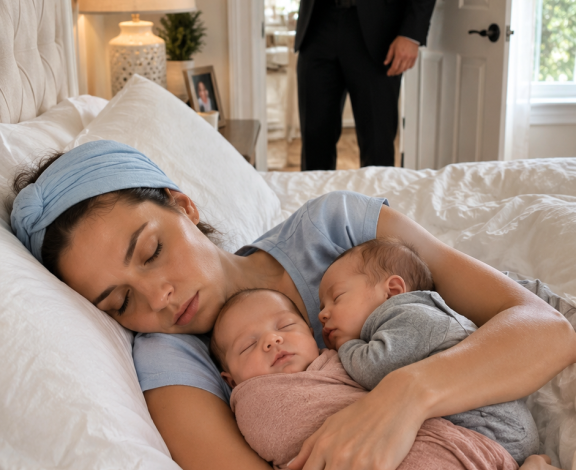
Four months earlier, Andrew’s wife, Madeline, was killed in a highway accident outside Boston. One day she was standing in their kitchen laughing over baby names and grocery lists. The next day she was a framed photo on the mantle, sympathy cards on the counter, and silence in every room that used to feel alive.
Since then, Andrew’s home had become a revolving door of “solutions.”
Nannies with impressive credentials. Sleep consultants with charts and schedules. Specialists with calm voices and expensive advice. Each arrived confident, organized, and certain they could help. And each left within days—drained, defeated, and quietly overwhelmed.
The last caregiver paused at the front door that morning, coat buttoned, eyes careful.
“They’re showing severe attachment distress,” she said. “Mr. Whitmore… you may need specialized support.”
Andrew nodded because nodding was easier than admitting the truth: he had no idea what to do anymore.
After she left, he stood in the hallway holding Noah against his chest while Eli cried from the nursery. For the first time in his life, Andrew Whitmore—who could buy almost anything—felt completely powerless.
That night, exhaustion clung to him. His suit was wrinkled from sleeping in office chairs and on nursery floors. His face was rough with stubble because grooming didn’t matter when every day felt like survival.
“I’m here,” he whispered, rocking Noah near the window. “I’m trying, buddy.”
Outside, rain slammed the glass so hard it blurred the garden lights into streaks. Andrew lowered himself onto the nursery floor between the two cribs—one baby in his arms, the other crying beside him—and something inside him finally gave way.
Not a dramatic breakdown. Just the quiet collapse of a man realizing love doesn’t always stop pain.
He bowed his head against the crib rails and let the tears fall, because at three in the morning there was no one left to impress.
Then the doorbell rang.
Sharp and unexpected, cutting through the storm like the house itself had spoken.
Andrew froze. Who would come to the Whitmore estate in weather like this—at this hour?
Still holding Noah, he went downstairs and checked the security monitor near the entrance.
A young woman stood under the porch overhang, soaked by rain that blew sideways in the wind. A worn suitcase sat near her feet. Strands of chestnut-brown hair clung to her face, but her expression was steady—tired, yes, but not shaken. Like someone who had already endured enough hardship to stop being afraid of discomfort.
Andrew opened the door, and cold, rain-scented air rushed inside.
“Good evening,” she said softly. “Or… morning, I guess.”
Her voice had the calm rhythm of small-town America.
“My name is Clara Bennett,” she continued. “I came because of the babies.”
Andrew stared, confused and guarded. “I didn’t hire anyone.”
Clara nodded once, as if she expected that.
“You didn’t,” she admitted, setting her suitcase down gently. “My cousin works with an agency in Hartford. She mentioned you haven’t slept in months… and that your boys lost their mother.”
Andrew’s jaw tightened. His instincts warned him not to trust a stranger who showed up uninvited, in a storm, speaking about his children like she understood them.
But Clara didn’t push. She didn’t pitch herself like a professional. She didn’t list credentials or talk about methods.
She only said, quietly, “Babies don’t understand schedules or résumés. They understand presence.”
Something about the way she said it—simple, not performative—made Andrew pause.
And before he could fully explain his own decision, he placed Noah carefully into her arms.
The change was immediate.
Clara didn’t bounce him with exaggerated energy. She didn’t use the high, forced “nanny voice” Andrew had heard a dozen times. She simply swayed—slow and steady—while humming a melody that sounded older than the mansion itself. Warm. Familiar. Like the kind of song you don’t learn from a book.
Noah’s eyelids fluttered.
Then he relaxed.
Within seconds, he was asleep.
Andrew stood there, stunned, as if the laws of the house had just changed.
Clara turned toward Eli’s crib, still humming.
“Anxiety spreads,” she murmured. “But calm spreads too.”
She rested a hand lightly near the rail, kept her breathing slow, and continued the same gentle rhythm.
Eli’s cries softened.
Then stopped.
For the first time in months, the nursery held silence that didn’t feel empty—it felt safe.
Andrew barely slept, even after that. Grief doesn’t loosen its grip overnight. But when morning came, he jolted awake in panic because the quiet felt unnatural.
He ran barefoot to the nursery and stopped in the doorway.
Soft sunlight spilled through half-open curtains. Noah and Eli slept under light blue blankets—no tears, no trembling breaths, no exhausted tension in their tiny bodies.
And on the floor beside the cribs, Clara slept too, curled under a thin blanket. One hand rested against the wooden rail, as if even in her dreams she was keeping watch.
Something in Andrew’s chest eased for the first time since Madeline died. Not “fixed.” Not healed.
Just… less suffocating.
Over the next few weeks, the mansion began to change in ways no amount of money had managed before.
The cold, clinical atmosphere left behind by rotating professionals faded. In its place came small, human comforts: soup simmering on the stove, herbal tea steeping on the counter, quiet acoustic music drifting through the halls on rainy afternoons.
And most importantly—laughter.
When the twins grew restless, Clara wrapped them in blankets and carried them outside to feel the sun, telling them gentle stories about rivers and horses from her hometown near Asheville. When thunderstorms rolled over Connecticut, she sat by the nursery window and hummed old folk songs until the babies settled against her chest like they finally believed the world was safe again.
Andrew watched it all with disbelief and something close to gratitude—because for the first time, the house didn’t feel like a monument to what he’d lost. It felt like a home trying to breathe again.
If this story moved you, share your thoughts in the comments: Do you think babies can feel grief the way adults do? And what do you believe matters more—training, or true presence? Subscribe for more real-life inspired stories about family, healing, and second chances.