A PRIVATE EQUITY FATHER BUILT A PERFECT HOUSE, BUT IT TOOK A PET STORE RECEPTIONIST MAKING CARROT BRIDGES IN HIS KITCHEN TO HEAR HIS TWINS AGAIN

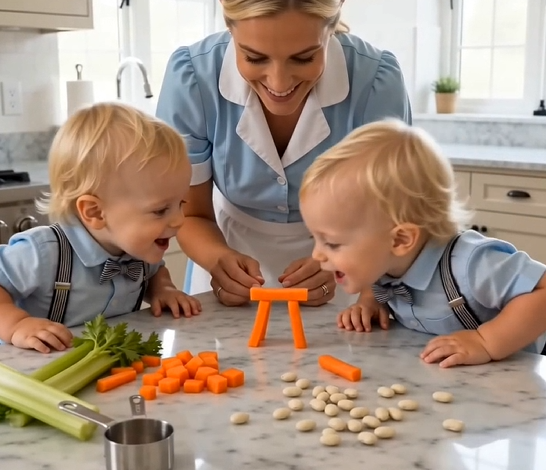
For one long second, nobody moved.
Charlotte stood at the edge of the island in a cream silk blouse, staring at the scattered beans like they were evidence of a crime. The maid beside her hovered with a trash bowl in hand. Ethan was still in his office clothes, jacket unbuttoned, phone in one hand, shock plain on his face.Milo’s small body was bent protectively over three carrot sticks and a line of white beans.
Mia’s fist was wrapped in Tessa’s shirt.
The room looked ridiculous for a house like that. A private equity man’s custom kitchen, all veined marble and imported fixtures, had been turned into a tiny freight yard by two nearly silent kids and a girl who used to sell aquarium gravel and kitten food.
Charlotte recovered first.
“This ends now,” she said, sharper. “They’re handling raw vegetables and dirty towels. This is exactly the kind of chaos that causes backsliding.”
Tessa’s face went red. “The towel’s clean.”
“That’s not the point.”
It was the point, and everyone knew it.
Charlotte had spent the last six months building herself into the Mercer household by mastering the language of standards. Air quality. Routines. boundaries. Best practices. Appropriate transitions. She spoke about the twins as if the right arrangement of adults could eventually restore them to a glossy version of childhood.
What she could not stand was visible proof that something messy and ordinary worked better than all of it.
Ethan looked at Milo first. Then Mia. Then at the island.
“How long?” he asked quietly.
Charlotte answered before anyone else could. “It doesn’t matter.”
“It does,” he said, still staring at the children.
Tessa swallowed. “Maybe fifteen minutes.”
Fifteen minutes.
Fifteen minutes, and Milo had said more than he had said to Ethan in days.
The maid tried once more to reach for the bowl.
Mia made a sound then—not a full scream, but a hard, panicked cry from deep in her chest. She pressed herself against Tessa’s side and shook her head violently. Milo slapped his palm over the little bridge and whispered, “No.”
That word landed harder than anything else in the room.
Not because it was loud. Because it was chosen.
Ethan finally lifted his eyes to Charlotte. “Leave it.”
Charlotte blinked. “Excuse me?”
“Leave it,” he repeated.
No one in the room had heard him sound like that in weeks.
The maid stepped back. Charlotte stared, furious, then gave a tight smile that barely covered it. “Fine. If you want to encourage disorder in place of treatment, that’s your choice.”
She turned and walked out, but not before Ethan saw the calculation in her face. This wasn’t about carrots. It was about losing the right to define what this family was.
Tessa looked like she wanted to disappear through the floor.
“You can keep going,” Ethan said.
She hesitated. “Sir, I wasn’t trying to—”
“I know.”
It was the first gentle thing he had said all day.
He stayed in the breakfast room doorway while they returned to the bridge.
At first the twins moved carefully, aware of him. Tessa didn’t force anything. She just lowered herself back to their level and nudged a bean across the carrot span with a teaspoon.
“Cargo delivery,” she murmured.
Milo pushed one after it.
Mia watched, then copied him with exaggerated care.
No one asked them to identify colors. No one asked for eye contact. No one praised compliance. The room, for the first time in that house, had no test in it.
After a while Milo held up a carrot stick without looking at anyone and said, “Broken.”
Tessa took it from him and answered as if this were perfectly normal and important. “Then the bridge crew needs repairs.”
Mia let out the tiniest burst of air that was almost a laugh.
Ethan felt something ugly move in his chest then. Not anger. Shame.
Because suddenly he could see the pattern clearly. The twins had not gone silent in a vacuum. They had gone silent in a home where every question had a right answer, every meal had a report, every evening had an objective. Even affection came with performance hidden inside it. He had mistaken management for care because management was what he knew.
That night, he found the old daily logs.
He had asked for them once, thinking structure would help. The binders filled an entire cabinet in the study. Pages and pages of notes: verbal output limited; noncompliance at snack; resisted transition; withdrew after correction; successful response after modeled prompt.
No page asked what made Milo stop breathing so hard when he got overwhelmed. No page said Mia only relaxed when someone sat on the floor instead of over her. No page mentioned that both children watched adults’ faces like weather reports.
At 7:15 p.m., Ethan usually returned to the nursery suite for the approved bedtime check-in. One question, one kiss on the head, lights out, no deviation.
That night he stood outside the door and listened.
The old bedtime nanny was trying to move the twins through the usual sequence. Bath, pajamas, two books, white noise. Milo had gone stiff. Mia was under the chair with her hands over her ears.
“Come on,” the nanny said with the exhausted brightness of someone following instructions she no longer believed in. “We have to keep to our schedule.”
Tessa, who had technically been told to stay downstairs until access questions were “reviewed,” was kneeling a few feet away with a folded hand towel and three baby carrots.
She didn’t touch the children. She just set the towel on the rug and laid the carrots across it into a tiny bridge shape.
Mia’s eyes went straight to it from under the chair.
Ethan saw it then: this wasn’t about vegetables. It was about a world small enough to enter. Something the twins could change with their own hands. No adult judgment. No demand to perform correctly before receiving warmth.
“Can she continue?” he asked the bedtime nanny.
The woman looked relieved. “Honestly? Yes.”
So Tessa stayed.
Over the next week, the kitchen island became the center of the house in a way no designer had intended.
Not all day. Not magically. The twins were still fragile. They still went mute under pressure. Milo sometimes froze with a spoon halfway in the air. Mia still hid if voices sharpened. But each evening, Tessa built some plain, foolish little thing in the breakfast area—carrot bridges, cucumber walls, blueberry “boats,” toast tunnels with raisins as cargo—and the twins came.
Milo always tested first.
He would stand at the edge of the island, shoulders tight, pretending not to care, then slowly move one object into place. Mia would watch him and follow, sometimes so exactly it hurt to see. If he tapped a bean twice before crossing the bridge, she tapped twice. If he handed Tessa a spoon, Mia handed her one too.
And eventually, they started speaking inside the game.
“Needs more.” “Mine goes there.” “Again.” “Wait.” “Don’t break it.”
Small words. But they were alive.
Ethan began coming home earlier to watch.
At first he stayed back, unnoticed or pretending to be. Then one evening Tessa looked up and said, “If you stand there like a security camera, they’ll lock up.”
He almost laughed from surprise.
She had no right, in his world, to say that to him. Which was probably why it helped.
“What should I do?” he asked.
It was the first time he had asked anyone that without already thinking he knew.
Tessa shrugged. “Sit down. Don’t ask them to show you anything. Move one bean.”
He took off his jacket, set down his phone, and sat at his own breakfast table like a guest.
Milo looked at him, suspicious.
Ethan moved one bean across a carrot bridge in silence.
Mia crawled onto her chair.
A minute later Milo added another bean beside his father’s.
No praise. No “good job.” Just a shared task with no score.
Charlotte hated every minute of it.
She had imagined herself easing into this house as the woman who restored softness after tragedy, who brought order, polish, and high standards to a wounded family. Tessa’s presence ruined the image. Worse, Ethan was changing in front of it.
He stopped asking for the twins’ daily performance summaries. He canceled one of the consultants. He told staff not to interrupt evening kitchen time unless there was actual danger. He began taking calls in the car so he would enter the house with both hands free.
Charlotte pushed back wherever she could.
She cornered Ethan in the dressing room one morning. “You’re romanticizing this because you finally saw one breakthrough moment.”
“I saw my children protect the first person who made them feel safe,” he said.
“Safe? She’s turning your kitchen into daycare chaos.”
“No,” he said. “The rest of us turned this house into a correction facility.”
That ended the conversation, but not the war.
Two days later, Charlotte made her move.
Tessa arrived at the side entrance and found her access code disabled.
The guard at the gate apologized. “I was told there were updated entry protocols.”
Tessa stood outside the service entrance with a grocery-store tote holding baby carrots, paper cups, and a little pack of dried beans she had bought with her own money because the kitchen staff kept clearing everything away too quickly.
Inside the house, it was 5:40 p.m.
Inside the house, the twins were already waiting.
When Tessa didn’t appear, the old routine was reactivated with impressive speed. Hand wash. Snack plate. Quiet table activity. No loose food items. No improvisation.
By 5:55, Milo had not touched his snack. By 5:57, Mia had slid under the breakfast chair. By 6:00, both children were silent again.
Ethan, delayed in traffic, opened the kitchen camera from his car.
He saw the old scene restored exactly as it had always been: spotless counters, untouched food, staff trying to redirect without feeling, children withdrawing in plain sight.
Then he saw Mia looking toward the side door.
Again and again.
He called the house line. “Where is Tessa?”
A pause. Then the manager said carefully, “There was an access issue this afternoon.”
“Who authorized that?”
Another pause.
By the time he got home, he knew.
He entered through the kitchen instead of the front hall. Charlotte was at the island in workout clothes, discussing floral samples with a vendor on speakerphone, as if nothing mattered more than next week’s dinner table.
“Where is she?” he asked.
Charlotte muted the call. “Ethan, please don’t do this in front of staff.”
“Where is Tessa?”
“I revoked access pending review. I told you before, she is blurring lines and creating unsanitary dependencies—”
Mia screamed.
It split the room open.
Not a tantrum. A raw, terrified scream from the floor beneath the breakfast chair.
Milo shoved his snack plate so hard it spun off the table and shattered on the tile.
Everyone jumped.
Ethan moved toward them, but the twins weren’t reaching for him. They were both staring at the side entrance.
“Open that door,” he said.
The manager hesitated. Charlotte said, “This is absurd.”
“Open. The door.”
When the side door swung inward, Tessa was still outside on the step, tote bag in hand, looking mortified.
Mia ran to her.
It was clumsy and desperate and completely undeniable. She crashed straight into Tessa’s legs, clung with both arms, and buried her face against her. A second later Milo came too, not as fast, but just as certain. He pressed the little dried-bean packet from Tessa’s bag against her stomach like proof that she had brought the right world back with her.
Charlotte went pale.
The twins had chosen in front of everyone.
Ethan dismissed the staff. Then he turned to Charlotte and, for the first time, did not soften to preserve appearances.
“You used my children’s fear to make a point about control,” he said.
Charlotte crossed her arms. “I was protecting this family from chaos.”
“No,” he said. “You were protecting your place in it.”
She looked at him for a long moment, maybe waiting for the version of Ethan who would smooth things over, who would translate pain into something clean and manageable.
He did not arrive.
By the end of the week, Charlotte was gone.
Not thrown into the street. Not dramatics. She collected her things and left with a face so controlled it looked brittle. People in houses like that rarely explode in public. They freeze.
The larger change was harder.
Ethan kept Tessa, but not by pushing the whole burden back onto her. That was the shift. He stopped treating her like a miracle worker hired to repair what he could avoid.
One evening, after the twins had spent twenty minutes building a “train yard” out of pretzel sticks and peas, Tessa wiped the island and said, “They’re talking more because nobody’s making every sound into a performance review.”
Ethan leaned against the counter. “I know.”
“No,” she said, not mean, just direct. “He doesn’t answer first because he’s stronger. He answers first to check if it’s safe. And she copies because if he survives it, maybe she will too.”
Ethan looked over at the breakfast nook where Milo was lining up peas by size and Mia was matching him one beat later.
He had never understood his own children so plainly.
“What do I do now?” he asked.
Tessa rinsed a bowl. “Be there when there’s nothing to measure.”
It sounded simple. For him, it was not.
He started with evenings.
No phone at dinner. No reports at the table. No performance questions in the car. No “What did you achieve today?” Instead: “Want to carry the napkins?” “Should this bean go here?” “Do we need a stronger bridge?”
At bedtime, he stopped outsourcing the tender part.
He sat on the rug while Milo stacked blocks against his knee and Mia leaned against his arm. If they didn’t want a story, he didn’t force one. If one of them hid under the little side table, he got down on the floor nearby and waited. Some nights he built carrot bridges on a folded washcloth just to help them cross from dinner into sleep.
The first time Milo touched his sleeve and said, “Dad, fix this one,” Ethan nearly broke.
The first time Mia fell asleep against his shoulder instead of a staff member’s, he stayed still so long his back cramped.
Weeks passed.
The twins did not transform into sparkling, chatty children from a catalog. They were still careful kids. Still watchful. Still more comfortable in small worlds than loud ones. But they laughed now. They asked for things. They protested. They dragged stools to the island at five-thirty and waited for evening kitchen time like it mattered.
Because it did.
And as they stabilized, Tessa began to pull back.
Not suddenly. Not in a cruel noble gesture. She simply started doing less of the parts Ethan needed to own.
If Mia reached for Tessa at bedtime, Tessa would smile and say, “Dad’s got the bridge tonight.”
If Milo handed her the spoon, she would sometimes pass it to Ethan instead.
One Friday, after the twins had fallen asleep upstairs and the kitchen finally stood quiet except for the hum of the refrigerator, Tessa folded a dish towel and set it on the island.
“I’m giving notice,” she said.
Ethan stared at her. “Why?”
Because he still had money, still had staff, still had the old reflex to keep help in place once he found someone irreplaceable.
Tessa picked at the corner of the towel. “Because they’re not reaching for me the same way anymore. That’s good. It means they don’t need me to hold the whole room together.”
He said nothing.
She went on, eyes on the marble instead of him. “And because if I stay too long, this house will turn me into another system. I don’t want that. I liked helping them. I really did. But they need their dad at night, not another employee forever standing in for him.”
For once, Ethan did not answer with an offer, a number, or a solution.
“When?” he asked.
“Two weeks.”
He nodded slowly.
In those last two weeks, he watched more carefully than he ever had in his life.
He watched Mia reach for his hand instead of scanning the doorway for Tessa. He watched Milo get frustrated when a cucumber wall fell, then look to his father instead of shutting down. He watched both children accept imperfection if the adult beside them stayed human.
On Tessa’s final evening, the twins built the biggest bridge yet across the kitchen island: carrot sticks, celery pieces, cracker squares, and a ridiculous line of black beans moving from one cutting board to another.
Milo placed the last carrot. Mia set one bean on top like a flag.
Then, with the solemn concentration children save for things that matter, Milo picked up the little wooden spoon they always used and handed it to Tessa.
Mia pushed the folded dish towel toward her too.
Not because they wanted her to keep working.
Because they were giving back the tools.
Tessa’s eyes filled immediately. She crouched between them and hugged them both, careful and brief, the way they liked it.
“You did it,” she whispered.
Milo frowned. “We did it.”
She laughed then, real and startled.
“Yes,” she said. “You did.”
The next morning she left before the house was fully awake. That was her choice. No grand scene. No dramatic driveway goodbye. She hated being watched when she cried.
But on the breakfast island, she left one thing behind.
Three washed carrot sticks laid across a folded clean towel.
When Ethan came down with the twins and saw it, Milo climbed onto his stool without being asked. Mia followed. Ethan stood there in his shirtsleeves, looking at the little bridge starter kit like it was more valuable than half the art in his house.
Then he rolled up his sleeves, opened the produce drawer, and said, “All right. What’s shipping tonight?”
Mia smiled first.
Milo pushed the bean bowl toward him.
And for the first time, the evening care of his children belonged to him.