For a Month All She Could Do Was Watch Him Play on the Floor

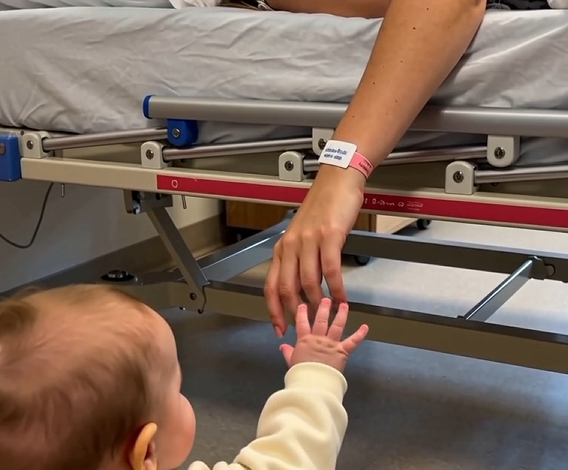
Here is why that toy stayed in room 7 for five weeks and did not go back to paediatrics.
In week three, a healthcare assistant came in to tidy and picked it up to take it out — entirely reasonably, it was on the floor, it was in the way, and the woman in the bed appeared to be asleep.
She wasn’t asleep.
She said, “Please leave it.”
And then, because the assistant had stopped and was waiting, she said the rest of it, which she had not said out loud to anybody including her husband:
“I can hear him from the corridor.”
The ward was laid out so that if you were lying on your left side in room 7 — which she was, for about six weeks, because of where the drain was — you faced the wall and the door was behind you.
She could not see who came in until they were past the end of the bed.
And every afternoon at two o’clock her husband and her son came down that corridor, and for the first three weeks she had no way of knowing they’d arrived until they were in the room.
With the bead maze, she did.
Because he’d start playing before they got to the door. Her husband would set the toy down in the corridor sometimes while he dealt with coats or the sanitiser or the buzzer, and the baby would get a hand on it immediately, and that small hard click would come down the hallway about four seconds before they did.
Four seconds. That’s all it was.
Four seconds of knowing they were coming, instead of them simply appearing.
She said — later, at home, trying to explain it to her sister and giving up halfway — that when you are that ill, the thing that goes first is not your body. It’s your sense that anything is still coming toward you. Everything that happens, happens to you, and it happens with no warning: a nurse, a doctor, a result, a needle, a conversation.
The click was the only thing in seven weeks that she got to hear arriving.
She came home in June.
The recovery was long and tedious and included, at one point, a very undignified fall on the stairs that the whole family now finds extremely funny and did not at the time.
She’s fine. That’s the end of the medical part. She goes for scans twice a year and they’re boring and she treats them as an inconvenience, which is a privilege and which she knows is a privilege.
Her husband bought the toy.
Not that one — that one belonged to the hospital and went back to paediatrics where it belonged, and he was slightly embarrassed to have even asked. He found the same model online for eleven pounds.
It was in the hall for about four years. Then it was in the loft for two.
Ivo is six.
He has been told the story, in the age-appropriate version, which is that Mum was poorly in hospital and he used to play on the floor next to her bed.
He asked the sharp question last year, the way children eventually do.
“Why didn’t you just hold me?”
And she said, “I couldn’t. I wasn’t strong enough to hold you for about a month.”
He thought about that for a while and then said: “That’s really sad.”
“It was,” she said. “But I could hear you.”
He didn’t understand that, and she didn’t push it, and he went off to do something else.
The toy is back downstairs now, in the box of things that are kept for the younger one, who is two and who bangs it on the floor rather than using it properly.
And every single time one of those beads clicks against another, in an ordinary living room, on an ordinary afternoon, his mother looks up.
Every time. Six years on.
She’s given up expecting to stop.